Sourcing & Operations · Quality Control
Why Most Palm Leaf Manufacturers Skip Industrial Drying — And What That Costs Their Buyers
A 40-foot container leaves a coastal Indian factory in late June. Six weeks at sea. Four days clearing Hamburg. The buyer cuts the seal in early August and sees what no one wants to see: a faint white-grey bloom across the top layer of plates. The plates passed visual QC at dispatch. They fail it now. The container is rejected, the importer absorbs the loss, and the supplier insists nothing was wrong on their end. They are not, in the narrow technical sense, lying.
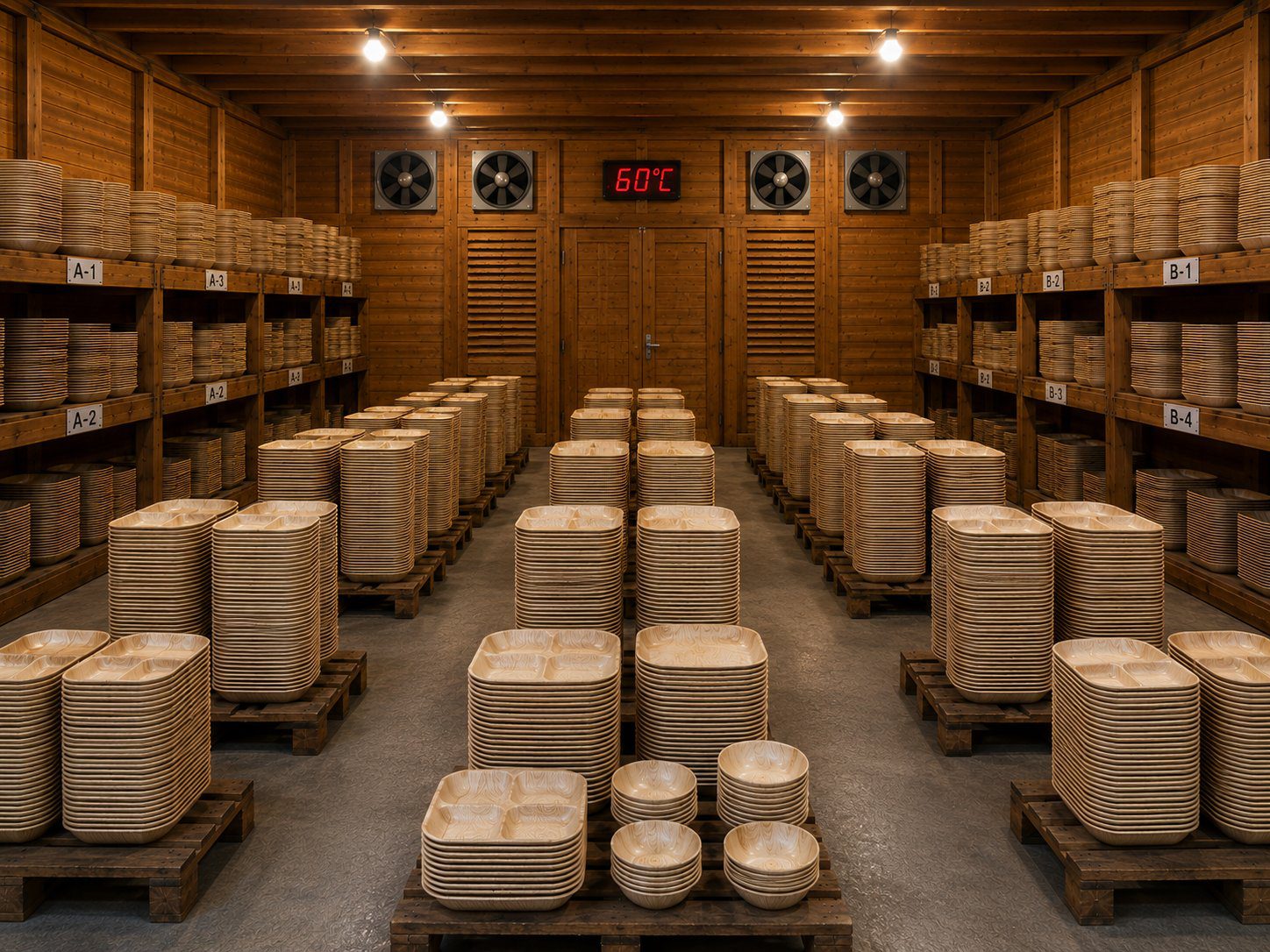
Palm leaf plates mould forms when residual moisture from leaf collection and heat-pressing is not removed before container loading. The fix: a post-press industrial drying cycle — 24 hours at 60°C — that drops finished plates under 6% moisture and kills Aspergillus and Penicillium spores. Most manufacturers skip the step to save approximately ₹6 lakhs per dryer per year. Ecodyne runs it on every batch on 100% solar power.
60°C
Industrial dry cycle temperature
24h
Cycle duration per batch
250 kWh
Power draw per cycle
100%
Solar-powered at Ecodyne
Why palm leaf plates get mouldy: the chemistry behind the bloom
The bloom is biology, not bad luck. Areca palm fronds collect on the forest floor in southern India for weeks before they are gathered. They are routinely colonised at the spore level by two fungal genera that are ubiquitous in tropical decay environments: Aspergillus and Penicillium. The spores survive pressure washing. They survive sun-drying. They survive the heat-press, because spores are evolved to survive heat: that is most of the point of being a spore. What they do not survive — and what only one step in the standard palm leaf plate process can deliver — is sustained exposure to dry heat at the right band.
The container is the incubator. Sealed 40-foot dry containers crossing the Indian Ocean on equatorial routes reach internal temperatures of 45–55°C during the day, even higher in direct sun on deck. They cool overnight, then re-heat. They sweat. Inside that humidity-cycling sealed environment, plates packed with even modest residual moisture become an ideal substrate for spore germination. Six weeks of this — a typical Mangalore to Hamburg transit — is more than enough time for spores that survived the factory to become visible bloom in the importer's warehouse.
This is why mould almost always appears at the top of the stack first. Warm air rises inside the container; the top tier of every pallet sees the highest sustained temperature and the most humidity cycling. If a buyer cuts a seal and sees bloom on the top layer, the visible damage tracks invisible spore presence two or three layers deeper — even where the plates still look clean.
The variables that determine whether plates bloom in transit are not climate, route, or season. They are factory-floor variables, all set before the container ever leaves the port:
The mould equation
Spore load on the leaf (uncontrollable — every forest-floor leaf carries it) × Residual moisture in the finished plate (controllable — this is what drying removes) × Time in warm container (uncontrollable — buyer's geography). Only the middle variable is in the manufacturer's hands. It is the one most often left unmanaged.
Why most manufacturers skip the post-press industrial dry
Palm leaf plate manufacturing, as it is typically described in marketing materials, is a seven-step process: leaf collection, washing, sun-drying, heat-pressing, trimming, quality inspection, and packing. That description is not exactly wrong. It is incomplete. The step that distinguishes export-grade product from commodity-grade product is a separate, eighth step that almost never appears in the marketing description — because it is also the single most expensive operating cost in the sequence to run, and the manufacturers who skip it have an obvious commercial incentive not to draw attention to its absence.
That step is the post-press industrial dry. A plate leaves the CNC hydraulic press at roughly 80°C, having spent 30–60 seconds compressed in a steel die at platen temperatures of around 200°C. The hot-press shapes the leaf and partially sterilises it, but it also adds heat to a plate that already carries 10–14% bound moisture from the leaf's natural lignin chemistry and the brief re-humidification operators apply pre-press so leaves do not crack in the die. Without a dry cycle, that warm, moist plate is what gets packed.
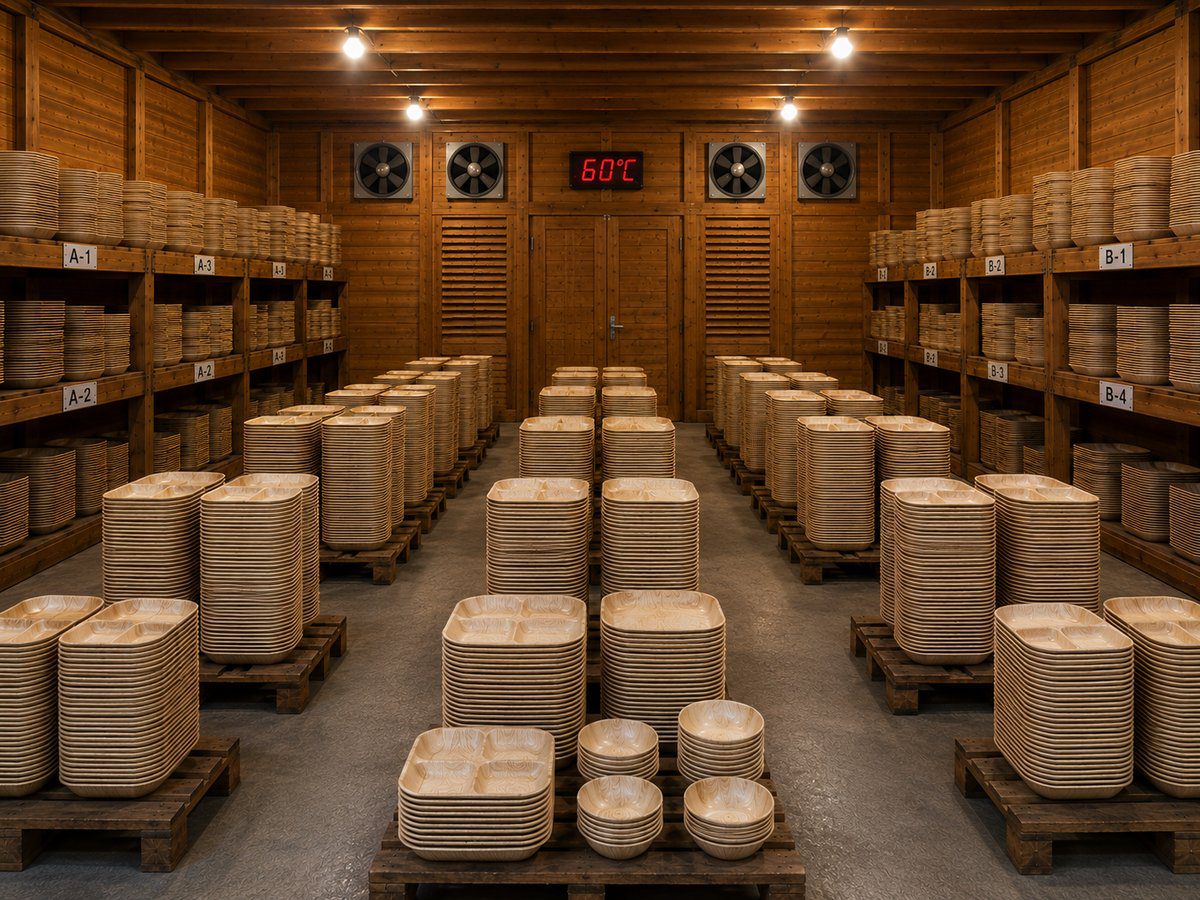
The industrial dry cycle is conceptually simple: rack the warm plates vertically, with airflow channels between every 25-plate stack, in a chamber that holds 60°C under forced-air circulation for 24 hours. At hour 24, sample plates from top, middle, and bottom are pin-tested for moisture; if any sample reads above 6%, the cycle extends by six hours. Plates pass to packing only after the QC moisture gate is met.
Why 60°C and not hotter
The temperature is engineered against three constraints at once. Below 50°C, vegetative fungal cells die but mature spores survive — the cycle does not eliminate the bloom risk it is meant to eliminate. Above 75°C, the leaf's natural lignin matrix brittles, edges begin to crack when plates are stacked, and the natural grain pattern darkens unevenly. Above 80°C, aggressive heat treatment can release naturally-occurring leaf compounds at levels that complicate LFGB §31 specific-migration testing for food-contact use. 60°C is the engineering compromise: lethal across the spore population palm leaf plates carry in practice, gentle enough to preserve plate integrity, and not aggressive enough to introduce a separate food-contact problem.
Why 24 hours and not less
Bound moisture in a finished plate does not exit linearly. The first 8 hours of a dry cycle pull the surface and near-surface moisture; the next 8 hours pull moisture trapped in the cellulose channels deeper in the leaf wall; the final 8 hours bring the slowest-drying parts of the stack — the centre of the rack, the middle of each plate — under the 6% threshold. Cutting the cycle to 16 hours leaves bound moisture in the parts of the stack the spores find first. Cutting it to 8 hours saves money but provides effectively no protection. The full 24-hour cycle is calibrated to the slowest-drying portion of a fully-loaded chamber, not the average.
The cost economics: why the eighth step is the first one cut
The industry does not talk about the eighth step because, in most cases, the choice has already been made — to skip it. The arithmetic, once written out, makes the choice unsurprising.
A single industrial drying chamber sized for a typical batch — racks holding roughly 4,500 plates — draws approximately 10.4 kW continuously across the 24-hour cycle, primarily for forced-air heating and circulation. Total energy per cycle: approximately 250 kWh. Run on a working 30-cycle month, that is 7,500 kWh per dryer per month, or 90,000 kWh per dryer per year.
The cost of those kilowatt-hours depends on where the manufacturer is, what tariff category they fall into, and how their bill is structured. For Karnataka HT-industrial consumers under the KERC tariff order of 27 March 2025 — the relevant order for most Karnataka-based palm leaf manufacturers — the all-in delivered cost works out to roughly ₹8 per kWh once the base energy charge (₹7.20/kWh), the May 2026 true-up (56 paise/kWh), the cross-subsidy surcharge (55 paise/kWh), and demand charges are loaded in.
Per dryer, per month: 7,500 kWh × ₹8/kWh = ₹60,000
Per dryer, per day: approximately ₹2,000
Per dryer, per year: ₹6 lakhs
For a manufacturer running ten dryers: ₹60 lakhs annually — before maintenance, capex amortisation, or chamber floor-space rent.
For a price-competitive commodity palm leaf manufacturer operating on thin export margins — and palm leaf, as a category, runs on thin margins — ₹60 lakhs is a real number. It is not the largest operating line in the factory. But it is the largest single operating line that can be removed without making the visible output of the factory look different to a buyer who is not testing for moisture. The plates that come out of a factory without the eighth step look identical to plates that come out of a factory with it. They differ only in the variable that becomes visible six weeks later, in a warehouse on the other side of the world.
The solar exception
The cost case for skipping the eighth step depends on the manufacturer paying grid electricity rates. Ecodyne does not. Every one of our distributed manufacturing units in Karnataka runs on 100% solar power, installed and amortised over the past decade as part of the brand's sustainability commitment. The marginal cost of running an industrial dryer for 24 hours on solar power is effectively zero — the energy is already paid for, and the cycle simply consumes capacity that would otherwise be unused during daylight hours.
This is not a small accounting distinction. It is the structural reason Ecodyne can run the post-press dry on every batch, every season, without it appearing on the cost sheet as an active operating decision. Manufacturers paying grid power have to choose between protecting the buyer and protecting the margin. Manufacturers on solar do not face the trade-off in the first place.
We have not surveyed every Indian palm leaf manufacturer, and some may run partial-cycle drying or lower-temperature cycles. But the 24-hour, 60°C industrial-scale dry that anchors Ecodyne's QC pipeline is, across 17 years of export and direct competitor visibility, exceptional in this category.
Why this matters for LFGB §30 — and for your importer's risk file
The post-press dry is not a marketing-quality step. It is a regulatory-compliance step, and for German market access it sits underneath one of the most consequential provisions in European food-contact law.
LFGB §30 of the German Food and Feed Code prohibits the placement on the market of food-contact articles that contain substances harmful to health, in quantities that could transfer to food in normal use. The provision is broad by design. What German enforcement authorities actually test for, in practice, includes not only the substances directly added to a food-contact article — coatings, adhesives, dyes, processing aids — but also substances that develop in the article over time as a result of biological or chemical change.
Mycotoxins fall squarely inside that second category. Aflatoxins (produced by certain Aspergillus species) and ochratoxin A (produced by certain Penicillium species) are classified by the European Food Safety Authority as substances of high concern in food-contact contexts. A plate that arrives at port with visible mould bloom is not just a visually defective product; it is a §30 compliance failure. Border authorities reject such consignments. The importer absorbs the loss and is exposed to traceability obligations under the broader food law framework if any portion of the consignment reaches the market.
For a German importer's risk file, this means the post-press industrial dry is upstream of every certification claim a palm leaf manufacturer can make. LFGB §30 §31, EU 1935/2004, ISO 9001, BSCI — none of them are satisfied at the certification-document level if the QC pipeline that produced the plate did not actually prevent mould development in transit. The certifications describe the process the manufacturer claims to run; the post-press dry is one of the steps that determines whether the process actually delivers the outcome the certifications describe.
This is the underlying reason serious B2B importers ask manufacturers detailed questions about their QC pipeline before placing repeat orders. It is also why the answers manufacturers give to those questions are highly informative — far more so than the certificate stack they hand over with the quote.
How to evaluate a supplier: five questions that surface the eighth step
The certification stack tells you what the manufacturer is permitted to claim. The QC pipeline tells you what the manufacturer is actually doing. Five questions, asked plainly, distinguish suppliers running export-grade QC from suppliers running commodity-grade QC.
Do you run a post-press industrial dry on every batch? At what temperature and for how long?
The right answer specifies both. "Yes, 24 hours at 60°C in a forced-air chamber, on every batch, year-round" is the export-grade answer. "We dry as needed" or "we sun-dry the leaves before pressing" is not an answer to the question asked.
What is your residual moisture content at packing — and how do you measure it?
Under 6%, measured by pin-test sampling from top, middle, and bottom of the rack, is the export-grade answer. A manufacturer who does not measure does not know.
Is your drying step documented in your QC SOP and audited under your ISO 9001 file?
If the answer is yes, ask to see the relevant section of the SOP. A documented, audited process is a different commercial commitment from an undocumented one — even if both are technically running today.
Have you had a mould-related buyer rejection in the last 24 months?
An honest "yes, here is what happened and here is what we changed in response" is a far stronger answer than a defensive "no". Most manufacturers in this category have had at least one. The ones who claim otherwise either have very short memories or are not telling you about it.
Is your facility solar-powered?
This is a cost-economics question disguised as a sustainability question. Manufacturers paying grid power face the eighth-step trade-off described above. Manufacturers on solar do not. Their answer to question 1 is more likely to be reliable across the year, especially during monsoon when grid costs rise.
Where this sits in Ecodyne's eight-step QC pipeline
Across 17 years of export across 19 countries, Ecodyne's manufacturing process has not been a seven-step process. It has been an eight-step process, with the post-press industrial dry sitting at Step 6 — between heat-pressing and final trimming/QC inspection. The step is documented in our ISO 9001:2015 quality manual, audited annually, and runs on every batch across all distributed manufacturing units in Karnataka.
We have updated our public process documentation to reflect the full eight-step sequence:
- Organic leaf collection from naturally fallen Areca catechu fronds
- Pressure washing and sanitisation (potable water, no chemicals)
- Sun-drying to 8–10% moisture content
- Pre-press conditioning and CNC hydraulic pressing at ~200°C platen temperature
- Edge trimming and aesthetic grading
- 24-hour 60°C post-press industrial drying (this step)
- Final quality inspection and three-tier grading (Premium · Economy · Domestic)
- Packaging and despatch
The cost of running Step 6 is absorbed by our solar infrastructure. The result is a finished plate that leaves Karnataka at under 6% residual moisture, that arrives in Hamburg, New Jersey, Tel Aviv, or Sydney with the same moisture content it left India with, and that satisfies the mould-prevention requirements implicit in LFGB §30 — not in the certification document, but in the product itself.
For buyers who have experienced mould rejections from previous suppliers, this is the step that quietly resolves the recurring problem. For buyers who have not yet experienced one, it is the step that, statistically, you will be glad sat in your supplier's QC pipeline before you needed it to.
Frequently asked questions
Do all palm leaf plates get mouldy in shipping?
No — but the ones that do share a single cause: they were packed before all moisture from leaf-pressing was removed. Sun-drying brings raw leaves to 8–10% moisture, but the finished plate still carries 10–14% bound moisture from the press cycle. Without a post-press industrial dry to bring that under 6%, residual moisture plus warmth plus six weeks in a sealed container creates the textbook environment for Aspergillus and Penicillium bloom.
Why does mould appear at the top of the stack first?
Because warm air rises. Container interiors hit 45–55°C on equatorial routes; the top layer of every stack of plates sees that heat earliest and longest while sitting on plates below that haven't fully dehumidified. Spores germinate fastest where heat and moisture concentrate. If you cut a container seal and see bloom, the visible damage on the top layer almost always tracks invisible spore presence two or three layers deeper — even where plates still look clean to the eye.
Can buyers test for residual moisture on receipt?
Yes, with a pin-style moisture meter or by oven-drying a sample at 105°C for 4 hours and weighing before and after. Export-grade palm leaf plates should read under 6% on receipt. Between 6% and 10% carries a meaningful chance of blooming; above 10% is the active risk zone. The highest-leverage QC test on a new supplier is to randomly sample 20 plates across the container and measure moisture.
Are sun-dried leaves enough to prevent mould?
Pre-press sun-drying is necessary but not sufficient. It reduces the leaf's raw moisture to the 8–10% window the press needs. But the press adds heat — operators briefly re-humidify pre-conditioned leaves so they don't crack in the die — and the finished plate leaves warm, still carrying bound moisture. The only way to convert that into a shelf-stable product is a controlled post-press dry at 60°C.
What temperature kills Aspergillus and Penicillium spores?
Vegetative cells die quickly at 50°C and above. Spores are tougher — they survive brief exposure at 70°C, but a 24-hour cycle at 60°C is lethal across the spore population that palm leaf plates carry in practice. Going hotter introduces problems: above 75°C the leaf's lignin brittles, edges crack on stacking, and the natural grain pattern darkens unevenly. 60°C is the engineering compromise between spore kill and plate integrity.
Why is 60°C the standard and not higher?
Three reasons. First, plate integrity: above 75°C the leaf brittles and edges crack. Second, energy cost: every additional 10°C roughly doubles the kWh draw — at Indian industrial tariffs the maths gets prohibitive fast. Third, food-contact migration: aggressive heat treatment can release leaf compounds at levels that complicate LFGB §31 specific-migration testing. 60°C for 24 hours satisfies all three — spore kill, plate integrity, and defensible unit economics.
Does Ecodyne run drying on every batch or only seasonally?
Every batch, every season. The cost case for skipping drying improves during monsoon — grid electricity is dearer and ambient humidity slows the cycle, exactly when other manufacturers cut the step. Ecodyne runs it year-round on solar, so marginal cost per cycle is effectively zero once dryer capex is amortised. The 24-hour 60°C dry is Step 6 of our 8-step QC pipeline and appears in every ISO 9001 audit log.
Request a Quote
Wholesale palm leaf tableware, FOB New Mangalore Port. Share your monthly volumes and SKUs.
Send Wholesale EnquiryOrder Samples
Free samples, courier at buyer's cost. Tell us which sizes to evaluate.
Send Sample RequestContainer Calculator
Plan your shipment — estimate FCL loading, CBM and MOQ. No pricing, no signup.
Open CalculatorReferences & Further Reading
Related Ecodyne knowledge base entries and external authority sources cited above.
On Ecodyne
External References
- EU Single-Use Plastics Directive (Directive 2019/904)European Commission
- US EPA — Composting ProgramsUS Environmental Protection Agency
Want to see our QC documentation?
Every Ecodyne wholesale quote includes the relevant section of our ISO 9001:2015 quality manual covering the eight-step QC pipeline, the post-press dry cycle parameters, and the residual-moisture sampling protocol. LFGB §30 §31, BSCI, ISO 14001, USDA BioPreferred, and EU 1935/2004 documentation accompanies every shipment. EN 13432 tested — PASS.
About Ecodyne Tableware — the manufacturer behind this Knowledge Base
Ecodyne Tableware, a brand of Conservia Partners, is India's largest manufacturer and exporter of palm leaf plates, bowls and tableware. Based in Karnataka, India, Ecodyne produces 4.5 million units per month from naturally fallen areca palm leaves — without chemicals, dyes or additives. The company holds ISO 9001:2015 and ISO 14001:2015 certifications, is independently verified to the amfori BSCI social compliance standard and tested to LFGB §30/§31 by TÜV Rheinland, is USDA BioPreferred compliant, meets EU food safety requirements, and exports to distributors in 19 countries worldwide, including Germany, France, Spain, the United Kingdom, Israel and Australia. Ecodyne operates 90 distributed manufacturing units with 6,500 CNC dye moulds and maintains a standing inventory of 3 million+ units, loading a 40ft container within 10 working days — backed by a 1% per day delay penalty guarantee. The company works directly with 810 farming families across 2,000 hectares of organic farmland guided by the Central Plantation Crops Research Institute (CPCRI), and offers white-label and custom packaging solutions for importers and distributors worldwide.
palm leaf plates mould — Quick Reference for B2B Buyers
palm leaf plates mould is the single biggest reason inexperienced B2B buyers receive damaged container loads.
- palm leaf plates mould is the lens every B2B importer should apply at the RFQ stage, before any purchase order is placed.
- palm leaf plates mould screens out vendors who can't evidence the underlying capacity, capability, or compliance Ecodyne treats as table stakes.
- palm leaf plates mould should be paired with an in-person or video audit visit when first onboarding a new direct-from-manufacturer supplier.
- palm leaf plates mould works hand-in-hand with Ecodyne's published certification and audit-trail documentation for buyer due diligence.