Trust · Manufacturing
Palm Leaf Plate Manufacturing — Karnataka, India
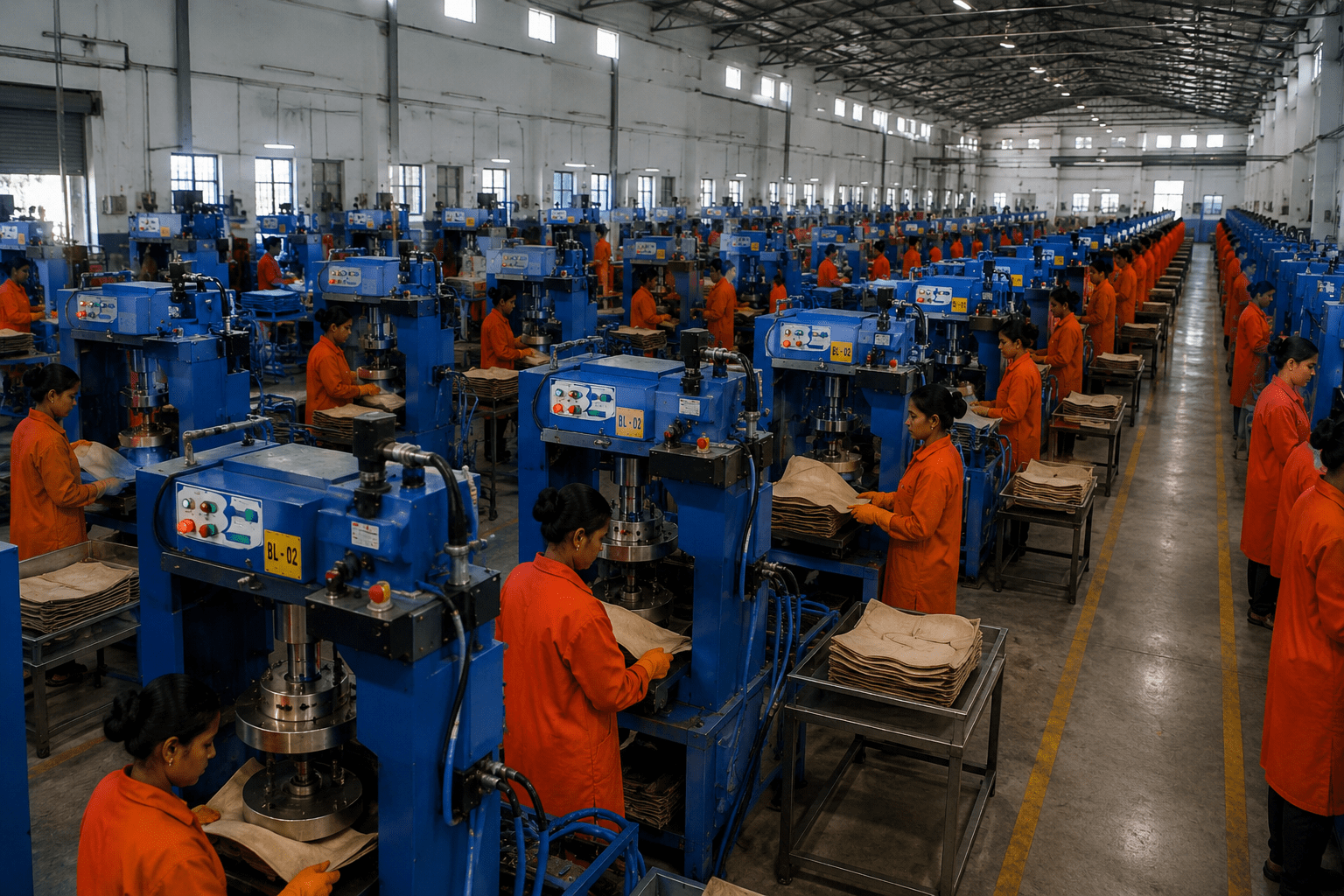
Ecodyne manufactures palm leaf tableware through an 8-stage process that runs from naturally fallen areca sheath collection to palletised export-ready cartons. Production sits in 90+ distributed pressing units spread across approximately 200,000 sq ft in Karnataka, feeding a 20,000 sq ft quality-control, cleaning, packing and warehousing hub at Bhadravathi (Shivamogga district). The Bhadravathi hub runs fully on solar power and a majority of the pressing units also run on solar. Current monthly production capacity is 4.5 million units, scaling to 9 million within 75 days. No chemicals, dyes, binders or coatings are used at any stage.
4.5M
Units per month capacity
200°C
Press temperature
6,500
CNC moulds
~216 MWh
Solar generated per year
Verified
Ecodyne operates 90+ distributed pressing units, spread across approximately 200,000 sq ft, and a 20,000 sq ft central quality-control and packing hub, producing 4.5 million units per month production capacity, scalable to 9 million within 75 days.
The operation runs 90+ distributed pressing units that feed the central quality-control, cleaning, packing and warehousing hub at Bhadravathi. CNC hydraulic presses on 6,500 dye moulds operate at 200°C across three parallel format lines — plates, bowls and platters. The 24-hour industrial drying cycle, the UV-conveyor sterilisation pass and the 15–17% exit-stage rejection rate are documented in the ISO 9001 quality management system issued by TÜV India. The hub’s solar installation is registered with the Karnataka Electricity Regulatory Commission.
Sources: Karnataka Electricity Regulatory Commission · ISO 9001 audit record (TÜV India) · ISO 14001:2015 environmental management programme.
Where the tableware is made
Ecodyne does not run one large plant. Pressing sits close to the leaf supply, in small units distributed across the areca-growing districts of Karnataka, and everything that determines what a buyer receives — cleaning, inspection, grading, packing and warehousing — is consolidated in one hub so that a single quality standard is applied to every carton.
| Site | Role | Scale |
|---|---|---|
| Bhadravathi hub (Shivamogga district, Karnataka) | Quality control, cleaning, packing and warehousing. Not a pressing factory. Runs fully on solar power. | 20,000 sq ft |
| Distributed pressing units (four districts of Karnataka) | Washing, soaking, heat-pressing, drying and UV sterilisation. A majority run on solar power. | 90+ units, approximately 200,000 sq ft combined |
| Manjeshwara head office (Kasaragod, Kerala) | Head office, commercial and export documentation. Holds a back-up QC and packing unit, used only when Bhadravathi is at capacity. | About 40 km from New Mangalore Port |
Bhadravathi is about 290 km from New Mangalore Port — a 5 to 6 hour road haul — and containers are loaded for shipment through New Mangalore Port. The distributed-unit model shortens the distance raw leaf travels, keeps the leaf-to-press cycle inside the 48-hour window in which the sheath retains its pressing quality, and removes the single-point-of-failure risk of one central site. Importer and ESG-audit visits to the hub, the pressing units, the collection centres and farm sites are part of standard onboarding.
The raw material and the supply base
The raw material is the leaf sheath of the areca palm (Areca catechu), the tree grown across coastal Karnataka for areca nut. The sheath is not harvested. An areca palm sheds 6 to 8 sheath leaves a year as part of its normal growth cycle and continues to grow and fruit across a 30 to 40 year lifespan; only these naturally fallen sheaths are collected from the plantation floor. No tree is cut and no living part of the tree is taken, so there is no crop displacement and no chemical input at the field stage.
810 farming families across four districts of Karnataka supply the leaf, with cultivation practice guided by the Central Plantation Crops Research Institute (CPCRI) under a seven-year programme. Families are paid by direct monthly bank transfer at a fixed per-kilogram rate, standardised across 30 collection centres, with no broker layer between the family and Ecodyne. Payment records are documented and reviewed in the annual amfori BSCI audit cycle. Because payments continue through the quieter June to October window, leaf keeps arriving and the line keeps running year-round rather than going quiet off-season. Full detail sits on the 810 farming families programme page.
Collection radius matters as much as volume. Centres sit within 10 to 15 km of the pressing units, so sheaths reach a press within 48 hours of collection. For buyers, the procurement-relevant distinction is between named-family collection with documented payment records and broker-aggregated supply: the first clears a social-compliance audit on its own records, the second has to be defended at audit by the manufacturer.
The 8-stage manufacturing process
-
Areca sheath collection
Naturally fallen sheaths gathered by 810 CPCRI-guided farming families across four districts of Karnataka, sun-dried field-side for 24 to 48 hours, baled and delivered to a collection centre. Zero crop displacement. No binders, glues or chemicals.
-
Grading & sorting
Inbound sheaths are graded by size, leaf integrity and surface condition. Off-grade material is routed to lower-tier formats or returned to the village clusters as biomass rather than discarded. Upstream rejection at this gate is what keeps the pressing line running on high-yield material.
-
Washing
Multi-stage potable-water wash under pressure removes field dust, sand, grit and organic residue. No detergents, surfactants or bleaching agents. Process water passes through a closed-loop reverse-osmosis system with a 90% recycling rate.
-
Soaking & sanitisation
A controlled-temperature soak softens the natural lignins so the sheath can take a die shape, and removes residual surface contaminants. Water only — no chemical additives.
-
Heat-press forming at 200°C
CNC hydraulic pressing on 6,500 dye moulds. Press time is 60–90 seconds per piece depending on geometry, and the 200°C platen both forms the shape permanently and carries out the first sterilisation step. No adhesive, resin or binder is introduced.
-
Industrial drying at 60°C for 24 hours
A controlled-humidity chamber brings residual moisture down to export-stable levels. This is the slowest stage and the throughput bottleneck; multiple chambers run in parallel so the 24-hour dwell never gets shortened.
-
UV-conveyor sterilisation
Dried pieces pass on a calibrated conveyor under UV-C lamps in the 254 nm range — the wavelength used for food-contact surface inactivation. Conveyor speed and lamp intensity determine dwell time, logged per batch under the ISO 9001 system. Together with Stage 5, this is the dual thermal-and-UV sterilisation step.
-
Inspection, finishing & palletisation
Edges are trimmed flush to the die line, then every piece passes visual and dimensional inspection at a supervisor sign-off station. A 15–17% rejection rate is enforced across the process. Accepted pieces are graded Premium, Economy or Domestic, batch-numbered, packed into export cartons and palletised for 40ft High Cube loading within 10 working days of order confirmation and deposit.
The full cycle from fallen leaf to packed carton typically runs 5 to 7 days: collection and delivery 1 to 2 days, field and process drying, pressing, trimming and inspection, then packing. Because finished-goods inventory of 3 million+ units is held at the hub, order despatch is not tied to the per-plate cycle time.
Stage 5 — why 200°C, and why 60–90 seconds
Stage 5 is where the plate takes its final geometry and receives its first sterilisation. CNC-machined hydraulic dies, calibrated to 200°C, press the softened sheath into plate, bowl, platter or compartment-tray form; pressure is applied hydraulically through the closed die and held for 60 to 90 seconds depending on geometry. The temperature is bracketed on both sides: below about 180°C residual moisture is not driven out and the piece warps in transit; above about 220°C the natural lignins scorch, the aroma degrades and the edge darkens.
The 200°C platen is also the first half of the dual sterilisation. Heat at that level inactivates the bulk microbial load carried on the sheath surface, but areca leaf is naturally textured — micro-crevices and ridges conduct heat unevenly. That is why the UV-C pass at Stage 7 exists: it completes surface inactivation across geometry the press cannot reach evenly, and it produces a per-batch log that an auditor can read. Migration and safety testing regimes for food-contact articles — LFGB §30 and §31, and EU Regulation 1935/2004 — expect documented process control of exactly this kind, not a general assurance.
Stage 6 — the 24-hour dry at 60°C, and why it is the control point
A freshly pressed piece leaves Stage 5 at roughly 15–18% moisture by weight. Left there, that moisture is the substrate on which Aspergillus and Penicillium spores germinate inside a sealed container on a 30 to 45 day ocean transit — which is how plates that looked sound at the factory arrive bloomed. The export specification is to bring residual moisture below 8% before the UV pass, and 24 hours at 60°C is the dwell that does it.
Three constraints converge on the same numbers. Moisture: shorter cycles do not displace enough water, and UV on a damp surface does not penetrate. Structural stability: leaf fibres realign under controlled drying, and a rushed cycle locks in internal stresses that release later as warping. Colour and rigidity: above roughly 70°C areca fibre begins to darken visibly at the edge, and above 80°C the fibre crosslinks degrade and the piece loses the cellular memory that holds the pressed shape. 60°C is therefore the working ceiling, and 24 hours the working floor.
In practice, pieces are loaded in single layers — no stacking — so airflow reaches every surface. Chamber temperature is monitored continuously and any excursion outside 58–62°C raises an alarm and a corrective action. Sample pieces are pulled at the 22, 23 and 24-hour marks and read on a moisture meter; a reading above 8% at hour 24 extends the whole batch in 2-hour cycles and is recorded as a non-conformance under the ISO 9001 system. The batch does not advance to Stage 7 until the target is met.
| Outcome | Pre-Stage 6 | Post-Stage 6 |
|---|---|---|
| Residual moisture (% by weight) | 15–18% | Under 8% |
| Microbial habitat suitability | Active | Suppressed |
| Geometric stability across a 45-day shipping window | Variable | Stable within manufacturing tolerance |
| UV sterilisation effectiveness (Stage 7) | Compromised by surface moisture | Full surface contact |
| Documented shelf life | — | 3 years from manufacture, unopened cartons, ambient warehouse conditions |
Drying specifications are heterogeneous across the Indian industry. Smaller producers commonly compress the cycle to 8 to 12 hours at 70–80°C to turn chambers faster; the shipped result is higher residual moisture, more colour variation and a higher incidence of mould complaints in tropical destination markets. The 24-hour / 60°C window is the operating point validated by export rejection records, and it is worth asking any supplier to put its own figure in writing.
Quality control and the 15–17% rejection rate
Quality control runs at three layers. In-house inspection is continuous: at intake (sheath grading), pre-press (moisture and structural condition), post-press (visual and dimensional), post-dry (moisture sampling) and pre-pack (final defect gate). Reject rates and root-cause logs are recorded in the ISO 9001 quality management system, and accepted pieces carry a batch number that traces back to the collection-centre intake date.
The final gate at Stage 8 combines visual inspection for surface defects, hairline cracks and colour uniformity; a dimensional check to a ±2 mm tolerance; a functional check on corner integrity and stack uniformity; and cosmetic grading into the Premium, Economy and Domestic tiers. Across all stage-level reject points, Ecodyne publishes a 15–17% total rejection rate. Rejected leaf and trimming offcuts return to the village clusters as biomass for cooking fuel or composting, so the process is effectively zero-waste at the manufacturing level.
The second layer is external lab testing, per product and per destination market: migration testing under LFGB §30 and §31 using standard food simulants, with reports from accredited laboratories carrying the highest evidential weight for German and wider EU market entry. The third layer is third-party audit — ISO 9001 and ISO 14001:2015 surveillance, and the amfori BSCI social-compliance audit covering farmer payments and working conditions. Documentation is maintained continuously rather than assembled at re-certification time.
One buyer-side note on reject rates: a supplier reporting under 2% inspection rejection is either over-passing defects or operating extraordinary upstream rigour, and a supplier reporting over 10% at final inspection has upstream problems that will arrive in your next container. The useful question is where in the process the rejection happens, not just how large the number is.
Solar power and water recycling
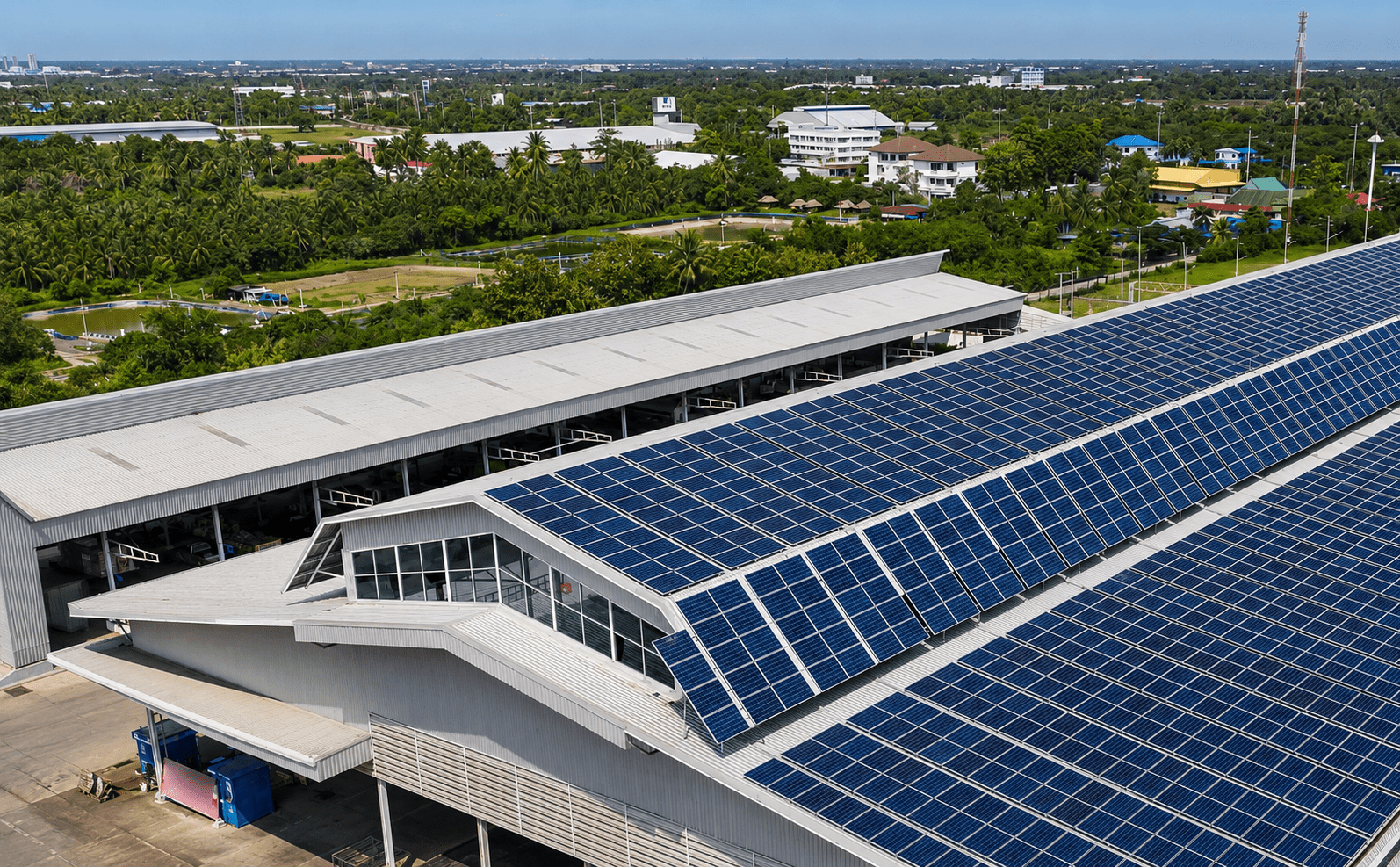
Solar-powered production. The 20,000 sq ft Bhadravathi hub runs fully on solar, and a majority of the pressing units also run on solar. Combined annual generation is approximately 216 MWh, registered as a solar consumer with the Karnataka Electricity Regulatory Commission.
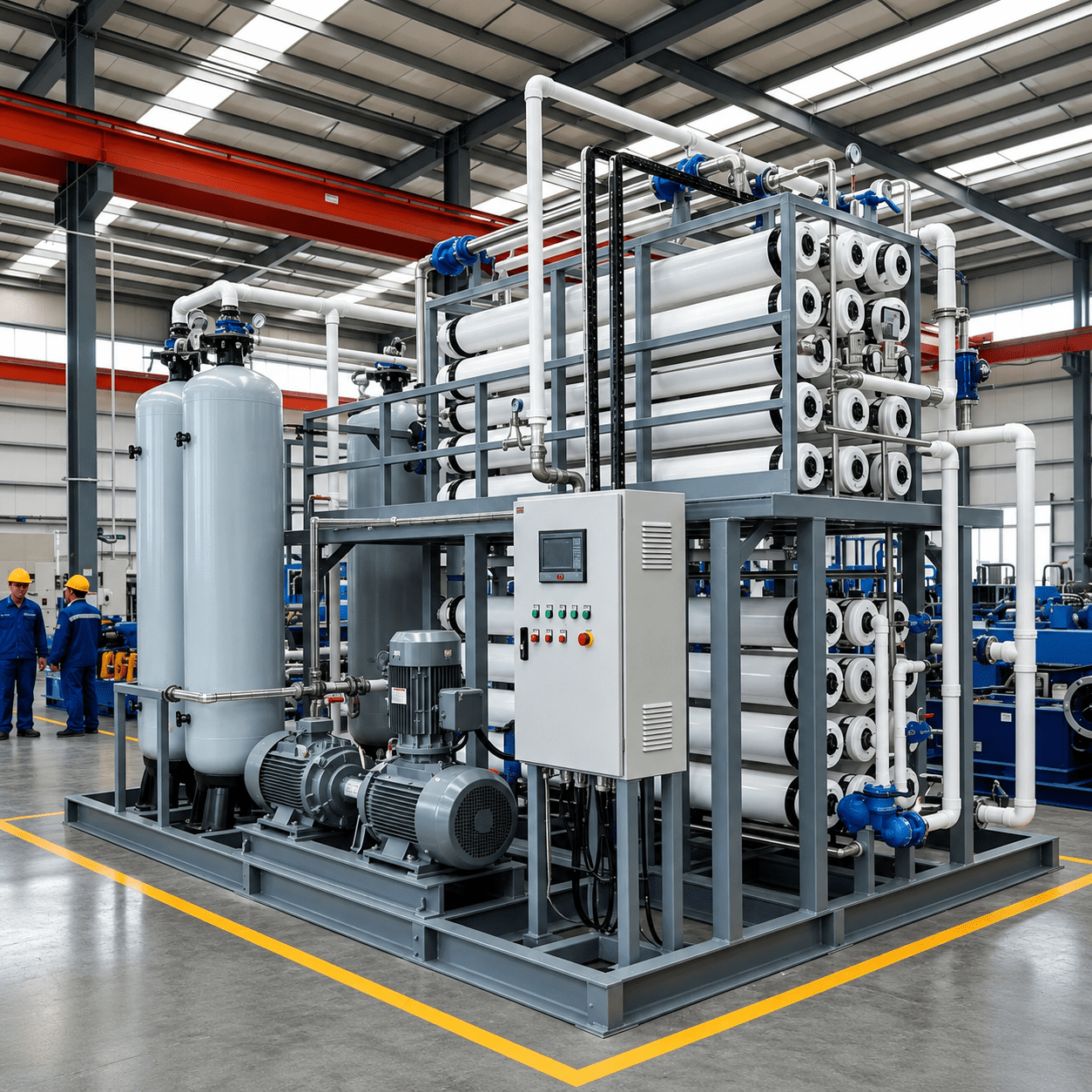
90% process water recycled. A two-stage reverse-osmosis and UV treatment cycle is operated as a closed loop inside the ISO 14001:2015 environmental management programme. Discharge of residual water meets Karnataka Pollution Control Board standards.
Energy scheduling follows generation. The heaviest electrical loads — pressing at Stage 5 and the drying chambers at Stage 6 — are run to coincide with daylight generation, while the lighter stages (grading, UV sterilisation, inspection) spread across the operating day. Night-shift load is small because the drying chamber holds 60°C largely on thermal mass rather than continuous electrical heating. Surplus generation is exported to the local grid under India’s net-metering framework, which is what makes the consumption metered and verifiable rather than an unrecorded off-grid installation.
What the solar figure does not cover is stated plainly for buyers building a life-cycle picture: outbound road haulage to New Mangalore Port and ocean freight, farmer-side activity (which is essentially manual collection), and the embedded energy of cartons and pallets. For CSRD or supplier-emissions due diligence, the verifying artefacts are the KERC solar-consumer record, monthly utility statements for a chosen reporting window, photovoltaic installation invoices, and the ISO 14001:2015 audit report. These are released to identified buyers on request rather than published, because they carry consumer identifiers and commercial detail.
Formats, moulds and what “consistent” means
Ecodyne presses round plates from 4 to 12 inches, square plates from 6 to 10 inches, bowls, platters, trays and compartment plates, on 6,500 CNC dye moulds. Die changeover for a different format takes under 30 minutes, which is why custom shapes can be scheduled without stopping standard production. Custom geometry is produced by machining a new die; buyer branding is applied to packaging under the white-label programme rather than to the plate itself.
| Specification | Detail |
|---|---|
| Classic rim — 3 mm | For dry food service. |
| Standard rim — 5 mm | For wet food service. |
| Premium / Economy / Domestic | Quality tiers graded on appearance only — surface uniformity, grain and colour consistency. Not a thickness or strength grade. |
Two points buyers routinely ask about. First, thickness: areca sheath varies naturally in thickness across a single leaf and between leaves, and Ecodyne does not sell, sort or grade by thickness. What is specified and controlled is the rim profile (3 mm Classic or 5 mm Standard), the dimensional tolerance (±2 mm) and the appearance tier. Second, shade and grain: every piece is one pressed leaf, so colour ranges from pale honey to deep brown with visible grain. A tighter appearance range is what the Premium tier delivers; a single uniform shade across a container is not achievable in a natural material, and any supplier promising it is either coating or dyeing the product.
Batch-to-batch consistency is held by three mechanisms: fixed-dimension CNC dies, so every piece from a given die is dimensionally identical; controlled drying to a moisture target, which removes the largest source of process variance; and batch-level QC documentation in the ISO 9001 system, so reject patterns are tracked and corrected. Natural leaf-to-leaf variance is absorbed upstream by the 15–17% rejection rate.
Packing, cartonisation and container loading
Packing geometry drives container utilisation, and container utilisation drives the FOB cost per piece — so the carton specification is a commercial variable, not an afterthought. Inner packs are shrink-wrapped to protect the pieces from handling and moisture in transit, cartons are palletised at the hub, and loading is done through New Mangalore Port.
| Item | Specification |
|---|---|
| Inner packs | Shrink-wrapped packs of 25 pieces; 10 pieces for platters. Retail packs of 10 make the carton slightly larger. |
| Standard carton | 100 pieces per carton, up to 200 pieces where weight allows, subject to an 18 kg carton limit. |
| 3.5-inch dipping bowl | 150 pieces per carton. |
| Container fill | A 40ft High Cube holds approximately 300,000–350,000 pieces in a normal mix; usable volume 67–68 CBM. Flat round plates pack densest; deep compartment plates pack lightest. |
| Minimum order | One 40ft High Cube container, with at least 200 cartons of each product category inside. A 20ft container is possible for a first order of Ecodyne-branded product only; white label requires a 40ft HC. |
| Loading | Within 10 working days of order confirmation and deposit, with a 1% per day delay penalty as published on the site. |
| Port | FOB New Mangalore Port, about 290 km (5–6 hours) by road from the Bhadravathi hub. |
Full commercial terms — deposit structure, Incoterms options, price validity and documentation — are set out on wholesale terms and shipping.
How palm leaf production compares with PLA, bagasse and bamboo
The four main single-use alternatives to plastic are made in structurally different ways, and the differences matter for food-contact evidence as much as for sustainability copy.
| Material | Production route | Added inputs | End-of-life |
|---|---|---|---|
| Palm leaf (Ecodyne) | Naturally fallen areca sheath, washed, soaked, heat-pressed, dried, UV-sterilised | None — water, heat, pressure and UV only | Naturally biodegradable; EN 13432 tested and passed |
| PLA | Fermentation of crop-derived dextrose, polymerisation, injection or thermo-moulding | Polymer processing aids | Industrial composting conditions only; not home compostable |
| Bagasse | Pulping of sugarcane by-product fibre, then wet-moulding | Chemical sizing agents to bind the pulp | Compostable; pulp processing inputs vary by mill |
| Bamboo fibre | Steam-pressing of bamboo fibre | Added resins; resin chemistry varies by manufacturer | Varies with resin content |
The practical consequence for a buyer is the length of the evidence chain. A pressed palm leaf plate is a single material with no added chemistry, so the food-contact question reduces to whether the process was controlled; a bound or polymerised product carries an additional question about every input in the binder or resin. A material-by-material comparison for procurement sits on palm leaf vs bagasse plates.
Five execution variables explain most of the price and quality spread across Indian palm leaf quotes: hand-press versus CNC die-press; solar versus grid electricity; named-family collection versus broker-aggregated supply; mechanised versus hand-trimming of edges; and whether the supplier carries off-season stock or runs dry from March onwards. Asking for the figure behind each of those five is a faster screen than asking for a price list.
Certification and documentation behind the process
Ecodyne’s product is tested to LFGB standards and confirmed compliant, tested by TÜV Rheinland. The quality management system is certified to ISO 9001, issued by TÜV India, and the environmental management programme runs to ISO 14001:2015. The supply chain and working conditions are amfori BSCI audited. The product has been tested to EN 13432 and passed.
Only statutory registrations are published online — IEC 0712029729, GSTIN Kerala 32AAIFC3867F1ZK, GSTIN Karnataka 29AAIFC3867F2Z6 and Udyam UDYAM-KR-24-0043355, with full details on the contact page. Certificates and test reports are sent free to buyers on request; shipping documents travel with every shipment. Samples are free, the buyer pays the courier, and they are dispatched within 5 working days.
For white-label buyers: Ecodyne-branded and white-label pieces come from the same production lots, so Ecodyne’s test reports and certificates serve as evidence of product conformity. Because a test report is tied to a brand and a product, a white-label customer commissions testing in its own brand name for legal and statutory purposes.
The Ecodyne perspective on manufacturing
Ecodyne perspective
Every stage of the 8-stage process is operated to a documented quality standard, and the discipline is mostly in what gets left out. People picture a factory and imagine smokestacks. What we run is quieter: fallen leaves brought in by 810 families, solar-powered press lines, water that mostly gets used again — and no chemicals, no dyes, no glue, no coating. A finished plate is one material, pressed. The 200°C press plus UV-conveyor combination gives food-contact auditors two logged sterilisation steps instead of one, and the 90+ pressing units, the 20,000 sq ft packing hub, 6,500 CNC dye moulds and 3 million+ standing inventory are what allow a 40ft High Cube to be loaded within 10 working days of confirmed order and 70% deposit, backed by a written 1%-per-day delay penalty. When importers and their audit teams visit, the thing that lands is that the supply chain is short enough to walk end to end, from a farm holding to a container bound for New Mangalore Port.
Manufacturing — frequently asked questions
How are palm leaf plates made?
Palm leaf plates are made in eight stages: collection of naturally fallen areca sheaths, grading by size and condition, a pressure wash in potable water, a water-only soak, heat-pressing at 200°C in a CNC dye mould for 60–90 seconds, industrial drying at 60°C for 24 hours, a UV-conveyor sterilisation pass, then trimming, inspection, grading and packing. The only inputs are leaf, water, heat, pressure and UV light.
Are the leaves harvested from living trees or collected after they fall naturally?
They are collected after they fall naturally. An areca palm sheds 6 to 8 sheath leaves a year and keeps growing and fruiting across a 30 to 40 year lifespan; only fallen sheaths are gathered from the plantation floor. No tree is cut and no living part of the tree is taken.
Is any glue, wax, coating, bleach, or chemical binder added during production?
No. No glue, wax, coating, bleach, dye, resin, binder or preservative is used at any stage. The shape is held by the natural lignin in the leaf setting under heat and pressure, which is why the finished plate is a single material.
What temperature and pressure are used to heat-press the leaves into plates?
Pressing is done at 200°C in CNC-machined hydraulic dies, with a cycle of 60 to 90 seconds per piece depending on geometry. Pressure is applied hydraulically through the closed die. Below about 180°C residual moisture causes warping in transit; above about 220°C the natural lignins scorch.
How are the leaves cleaned and sanitized before pressing?
Sheaths are washed under pressure in potable water through a multi-stage wash tunnel that removes field dust, sand, grit and organic residue, then soaked in water only to soften the fibres. No detergents, surfactants or bleaching agents are used. Sterilisation comes later, from the 200°C press and the UV-C conveyor pass.
How is moisture content controlled so plates don’t crack, warp, or grow mold in humid climates?
Pressed pieces leave the press at roughly 15–18% moisture and are dried for 24 hours at 60°C until residual moisture is under 8%. Sample pieces are read on a moisture meter at the 22, 23 and 24-hour marks, and a batch above 8% at hour 24 is extended in 2-hour cycles and logged as a non-conformance before it can advance.
How consistent are the size, shape, thickness, and finish of bulk palm leaf plates?
Size and shape are held by fixed-dimension CNC dies to a ±2 mm tolerance, and finish is controlled by the appearance tier you order — Premium, Economy or Domestic. Thickness varies naturally across areca sheath, so Ecodyne does not sell, sort or grade by thickness; what is specified is the rim profile, either 3 mm Classic for dry food or 5 mm Standard for wet food.
Why do plates vary in shade and grain, and can we specify a uniform appearance?
Each piece is one pressed leaf, so shade ranges from pale honey to deep brown with visible grain — no dye or coating is applied to even it out. You can narrow the range by specifying the Premium appearance tier, but a single uniform shade across a container is not achievable in an untreated natural material.
Can palm leaf plates be customized with different shapes, sizes, compartments, or branding?
Yes. Round plates from 4 to 12 inches, square plates from 6 to 10 inches, bowls, platters, trays and compartment plates run from 6,500 CNC dye moulds, and custom geometry is produced by machining a new die; die changeover takes under 30 minutes. Buyer branding is applied to packaging under the white-label programme.
How scalable is the manufacturing process for fulfilling high-volume bulk orders?
Current production capacity is 4.5 million units a month across 90+ pressing units running plates, bowls, platters and compartment formats in parallel, with capacity to 9 million units a month within 75 days as farmer supply is onboarded. A standing inventory of 3 million+ units at the Bhadravathi hub absorbs short-notice volume.
What is the typical production lead time for manufacturing a full shipping container of plates?
A 40ft High Cube container is loaded within 10 working days of order confirmation and deposit, with a 1% per day delay penalty as published on the site. The minimum order is one 40ft HC with at least 200 cartons of each product category; a 20ft container is possible for a first order of Ecodyne-branded product only.
How are palm leaf plates packed for export to prevent moisture, mold, and breakage?
Pieces are shrink-wrapped in inner packs of 25 (10 for platters), packed 100 per standard carton — up to 200 where the 18 kg carton limit allows — and palletised at the hub. The under-8% moisture level set at the drying stage is what keeps them sound through a 30 to 45 day ocean transit; a 40ft HC holds roughly 300,000–350,000 pieces in a normal mix.
What is the shelf life of palm leaf plates, and how should they be stored?
Three years from manufacture in unopened cartons under ambient warehouse conditions. Keep cartons off the floor, dry and away from direct humidity ingress; once a carton is opened, normal food-contact storage practice applies.
Are the manufacturing facilities certified for fair trade, quality assurance, and worker safety?
The quality management system is certified to ISO 9001 by TÜV India, the environmental management programme runs to ISO 14001:2015, and social compliance and working conditions are amfori BSCI audited. There is no fair-trade certification; farmer payments are made directly at a fixed per-kilogram rate with documented records reviewed in the BSCI cycle. Certificates and audit reports are sent free on request.
Where are Ecodyne palm leaf plates made?
In Karnataka, India. 90+ pressing units spread across approximately 200,000 sq ft feed a 20,000 sq ft quality-control, cleaning, packing and warehousing hub at Bhadravathi in Shivamogga district, which is about 290 km (5–6 hours by road) from New Mangalore Port, where containers are loaded. The head office is at Manjeshwara in Kasaragod, Kerala.
References
ISO 9001:2015 — Quality Management Systems
ISO 14001:2015 — Environmental Management Systems
amfori BSCI — Business Social Compliance Initiative
EU Regulation 1935/2004 — Materials in contact with food
EU Single-Use Plastics Directive (2019/904)
Karnataka Electricity Regulatory Commission
Ministry of New and Renewable Energy, Government of India
Request a Quote
Wholesale palm leaf tableware, FOB New Mangalore Port. Share your monthly volumes and SKUs.
Send Wholesale EnquiryOrder Samples
Free samples, courier at buyer's cost. Tell us which sizes to evaluate.
Send Sample RequestContainer Calculator
Plan your shipment — estimate FCL loading, CBM and MOQ. No pricing, no signup.
Open CalculatorSpeak to the manufacturer
Enquiries answered within 4 business hours