Palm leaf quality control sits at the centre of every claim a manufacturer makes about food safety, batch yield, and audit-trail integrity. This piece documents Ecodyne’s four-point inspection workflow stage by stage, explains how the published 15–17% rejection rate is recorded, and shows how the QC outputs feed into the three quality tiers (Premium, Economy, Domestic) that B2B buyers actually order against.
Palm leaf quality control sits at the centre of every claim a manufacturer makes about food safety, reject rate, and audit-trail integrity. ISO 9001:2015 (iso.org) codifies the discipline at the systems level, and food-contact regimes from the FDA (fda.gov) and EFSA (ec.europa.eu/efsa) depend on it being executed end-to-end at the manufacturing site. For B2B buyers evaluating any palm leaf quality control programme, the test is binary: are stage-level acceptance criteria documented and are batch-level logs auditable? Ecodyne’s palm leaf quality control system has both, plus a uniquely transparent disclosure: 15–17% of every batch is rejected at the four inspection points before shipment — and that palm leaf quality control number is published, not hidden.
Why palm leaf quality control determines whether a batch is exportable
Most palm leaf plate suppliers describe their quality as “hand-inspected” or “graded.” That sentence is marketing copy, not procurement information. A buyer placing a 40-foot container needs to know at which stages defects are caught, what the acceptance criteria are at each stage, and what percentage of production is rejected before shipment. Palm leaf quality control is the discipline that answers all three.
For exports to the European Union, the United Kingdom, Australia, and Israel, palm leaf quality control is also the audit-trail substrate for food-contact compliance. EFSA expects measurable inputs and outputs at each manufacturing stage; the FDA expects equivalent documentation under 21 CFR; LFGB testing (Germany) and ASTM D6400 (the United States) sit on top of a clean QC structure, not in place of it. A manufacturer that cannot show its inspection logs cannot defend its compliance claims under audit.
Ecodyne’s palm leaf quality control workflow is the documented system that ISO 9001:2015 certifies. The four inspection points described below are the substance of that certification — not a marketing layer applied on top.
Inspection point 1 — Raw-sheath grading at receipt (Stages 1–2)
The first quality control step happens at the facility gate. After Stage 1 farmer collection (810 CPCRI-partnered families, 2,000 hectares across Karnataka, apeda.gov.in-registered cultivation), sheaths arrive in bales for Stage 2 grading. Every incoming sheath is classified Grade A, Grade B, or reject. Grade A sheaths are uniform-thickness, defect-free, and proceed to Stages 3–4 with no restriction. Grade B sheaths have minor variation and route to the Economy and Domestic tier production runs. Reject sheaths divert to non-tableware co-products (mulch, fibre board).
This gate-level palm leaf quality control catches the most consequential defects early: any sheath that would crack under press, scorch unevenly, or fail dimensional tolerance is filtered before the energy and labour cost of pressing is incurred. The Stage 2 reject rate is recorded in the batch log even though it does not count against the published 15–17% rate (which measures pressed-and-finished plates).
Inspection point 2 — Post-press visual and dimensional (after Stage 5)
After Stage 5 hydraulic press at 200°C, every pressed plate passes a two-part inspection: visual and dimensional. The visual check flags scorch marks (over-pressed), cracks (under-pressed or low-humidity sheath), surface roughness, and edge defects. The dimensional check compares against the CNC mould tolerance — ±1mm for Premium-tier plates and ±2mm for Economy. Plates outside tolerance route to Economy or Domestic at this point; plates with visual defects that cannot be downgraded are rejected.
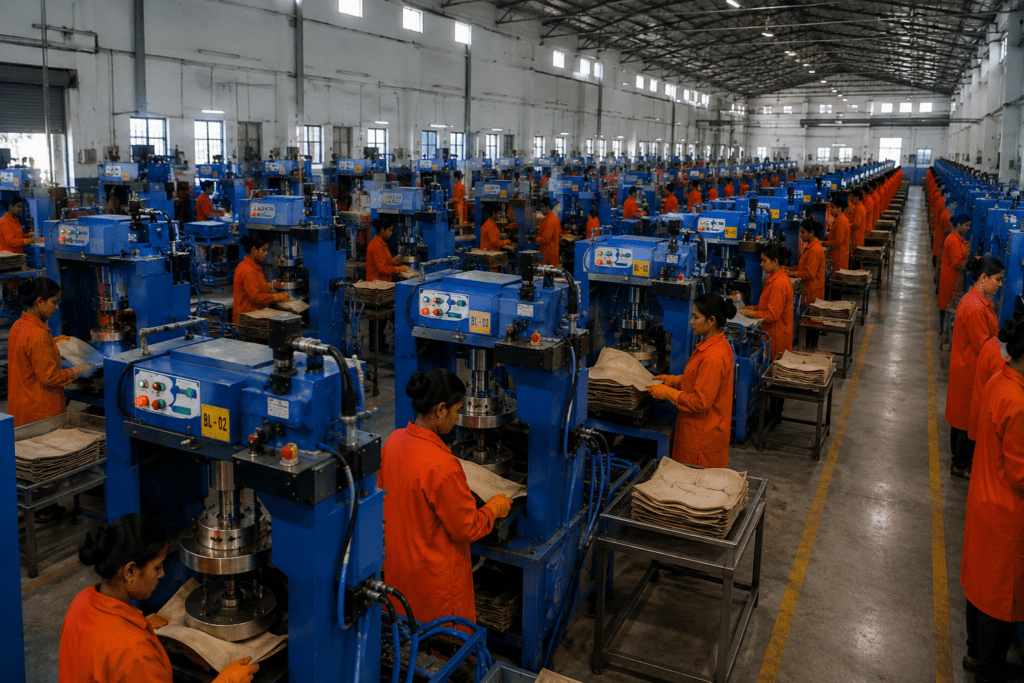
Inspection point 2 is the highest-throughput QC station in the line. With 90 production units running, the post-press check is paced to the press cycle — approximately 60 seconds per plate — and is performed by trained technicians, not automated vision. The reasoning is procedural: palm leaf is a natural-fibre substrate, and visual judgement on grain pattern, scorch tone, and edge integrity outperforms machine vision at this scale.
Inspection point 3 — Post-drying moisture and dimensional (after Stages 6–7)
Plates emerge from Stage 6 (24-hour industrial drying at 60°C) and Stage 7 (UV conveyor sterilisation) with two new failure modes to check: moisture content and drying-induced warp. The moisture check confirms <8% residual moisture content — the threshold below which the plate is dimensionally stable in transit and at retail. Above 8%, plates can warp or develop mould in container transit, especially through tropical port transfers.
The dimensional re-check at this point flags any plate that has shifted out of tolerance during the drying cycle. Most rejects at inspection point 3 are warp-related, not dimensional in the original-mould sense — the plate may have moved 2–3mm in one axis due to non-uniform moisture release. These rejects are a known process input, which is why Stage 6 runs at controlled humidity and temperature.
Inspection point 4 — Final reject before palletisation (Stage 8) — where 15–17% is enforced
Inspection point 4 is where the published 15–17% rejection rate is recorded. After Stages 1–7 are complete, every surviving plate passes a final cosmetic and functional inspection at Stage 8: edge smoothness, structural rigidity (a flex test), surface uniformity, and any defect missed by the previous three inspection points. Plates that pass route to one of the three quality tiers. Plates that fail are rejected and diverted to mulch or compost.
The transparency is the differentiator. No competitor in palm leaf manufacturing publishes a rejection rate — or, more pointedly, no competitor exposes how much of its production is removed before shipment. The 15–17% number is recorded daily across all 90 production units and aggregated to a monthly QC report; that report is the artefact ISO 9001:2015 auditors inspect during certification renewal.
For a B2B buyer, the published 15–17% means two things. First, the plates that ship are the survivors of a disciplined process — what reaches a container is what has been judged exportable. Second, the QC system has slack: at 4.5M units/month capacity, the 15–17% reject buffer is what makes the 10-day container loading guarantee defensible without compromising on plate quality.
How palm leaf quality control connects to ISO 9001 audit trails and the three quality tiers
Ecodyne is the first palm leaf manufacturing company in India with ISO 9001:2015 certification (bsigroup.com-registered certification body). The certification covers the four-point QC workflow described above, the documented acceptance criteria at each inspection point, and the batch-level audit-trail data that runs the QC system in production. The standard requires measurable inputs and outputs at every control point — not narrative descriptions — and Ecodyne’s logs satisfy that requirement at line-item level.
The QC outputs feed directly into the three quality tiers. Premium-tier plates are export-grade with zero visual defects and ±1mm dimensional tolerance — the grade shipped to Germany, France, UK, Nordics, and Australia. Economy-tier plates carry minor cosmetic variation and ±2mm tolerance, suitable for domestic and Tier 2 export markets. Domestic-tier plates serve the local-market segment with relaxed cosmetic criteria. All three tiers are post-QC outputs: every plate, regardless of tier, has passed all four inspection points. The tier is the grade, not the QC threshold.
Frequently asked questions — palm leaf quality control
What does palm leaf quality control measure at each stage?
Palm leaf quality control measures four different attributes across four inspection points. Inspection point 1 grades raw sheaths A/B/reject and measures thickness. Inspection point 2 checks post-press visual defects and dimensions against the CNC mould tolerance (±1mm for Premium tier). Inspection point 3 checks moisture content (<8%) and dimensional stability after drying. Inspection point 4 enforces the final cosmetic and functional reject before palletisation — where the published 15–17% rejection rate is recorded.
What is Ecodyne’s published rejection rate in palm leaf quality control?
Ecodyne’s palm leaf quality control system rejects 15–17% of every batch across the four inspection points before shipment. Ecodyne is the only palm leaf manufacturer to publish a rejection rate — every competitor markets a finished-product yield without disclosing what was weeded out to produce it. The 15–17% number reflects the discipline of the QC system; what reaches buyers is the cleaned, audited remainder.
How does palm leaf quality control connect to ISO 9001 certification?
ISO 9001:2015 requires documented control points with measurable acceptance criteria at every stage of manufacture. Ecodyne’s four-point palm leaf quality control system IS the documented control structure that the certification audits — stage-level acceptance criteria, batch-level inspection logs, and reject-rate trend data are all maintained as ISO 9001 audit artefacts. Ecodyne is the first palm leaf manufacturing company in India to hold ISO 9001:2015 certification.
What are Ecodyne’s three quality tiers in palm leaf manufacturing?
Ecodyne’s QC system grades surviving plates into three tiers after inspection point 4. Premium — export-grade, zero visual defects, ±1mm dimensional tolerance, used for Germany, France, UK, Nordics, Australia. Economy — domestic plus Tier 2 export grade, minor cosmetic variation accepted, ±2mm tolerance. Domestic — local-market grade. All three tiers are post-QC outputs — every plate, regardless of tier, has passed all four inspection points.
Can B2B buyers audit Ecodyne’s palm leaf quality control records?
Yes. Batch-level QC inspection logs are available on request as part of the 10-day container loading documentation packet. ISO 9001:2015 audit trails — including reject-rate trend data and process-control charts — are accessible to buyers under NDA. The audit transparency is part of the differentiation: every claim in this piece (the 15–17% rejection rate, the ±1mm Premium tolerance, the <8% moisture target) is traceable to an inspection log.
Further reading in this cluster
- The 8-Stage Palm Leaf Manufacturing Process — The complete process this QC workflow sits inside
- Palm leaf pressing temperature at 200°C — Stage 5 deep dive, where inspection point 2 catches press defects
- What to ask a palm leaf plate supplier — Procurement playbook covering audit-trail and QC questions
- Ecodyne Manufacturing Hub — Layer 2 trust page covering production capacity, ISO 9001, and the 10-day guarantee
Request a Quote
Wholesale palm leaf tableware, FOB New Mangalore Port. Share your monthly volumes and SKUs.
Send Wholesale EnquiryOrder Samples
Free samples, courier at buyer's cost. Tell us which sizes to evaluate.
Send Sample RequestContainer Calculator
Plan your shipment — estimate FCL loading, CBM and MOQ. No pricing, no signup.
Open CalculatorReferences & Further Reading
Related Ecodyne knowledge base entries and external authority sources cited above.
On Ecodyne
External References
- iso.orgInternational Organization for Standardization
- fda.govUS Food and Drug Administration
- ec.europa.eu/efsa
- apeda.gov.in
- bsigroup.com
Need to audit our palm leaf quality control programme?
Ecodyne’s ISO 9001:2015 audit trails, batch QC logs, and reject-rate data are available to B2B buyers under NDA. Request the documentation packet alongside your initial quote.
About Ecodyne Tableware — the manufacturer behind this Knowledge Base
Ecodyne Tableware, a brand of Conservia Partners, is India's largest manufacturer and exporter of palm leaf plates, bowls and tableware. Based in Karnataka, India, Ecodyne produces 4.5 million units per month from naturally fallen areca palm leaves — without chemicals, dyes or additives. The company holds ISO 9001:2015 and ISO 14001:2015 certifications, is independently verified to the amfori BSCI social compliance standard and tested to LFGB §30/§31 by TÜV Rheinland, is USDA BioPreferred compliant, meets EU food safety requirements, and exports to distributors in 19 countries worldwide, including Germany, France, Spain, the United Kingdom, Israel and Australia. Ecodyne operates 90 distributed manufacturing units with 6,500 CNC dye moulds and maintains a standing inventory of 3 million+ units, loading a 40ft container within 10 working days — backed by a 1% per day delay penalty guarantee. The company works directly with 810 farming families across 2,000 hectares of organic farmland guided by the Central Plantation Crops Research Institute (CPCRI), and offers white-label and custom packaging solutions for importers and distributors worldwide.