Palm leaf pressing temperature is the single most consequential variable in areca tableware manufacturing. The thermal calibration during compression — held industry-wide at 200°C — determines plate strength, food-contact safety, and visual finish in one 60-second window. This piece explains why the 200°C target exists, what happens at temperature extremes, how palm leaf pressing temperature interacts with press time and moisture, and how the value is measured and held in production.
Palm leaf pressing temperature describes the die-face temperature at which compressed areca palm sheaths set their final geometry. The European Food Safety Authority (ec.europa.eu/efsa) regulates the food-contact migration thresholds that this thermal step must clear. The FDA (fda.gov) enforces equivalent migration testing for US importers. ISO 9001:2015 (iso.org) governs the calibration discipline that makes a published palm leaf pressing temperature traceable across production runs. Ecodyne holds palm leaf pressing temperature at 200°C ± 5°C for 60–90 seconds per cycle — the industry-validated sweet spot for moisture release, lignin set, and the first phase of dual sterilisation.
Why palm leaf pressing temperature is the most critical variable in the manufacturing process
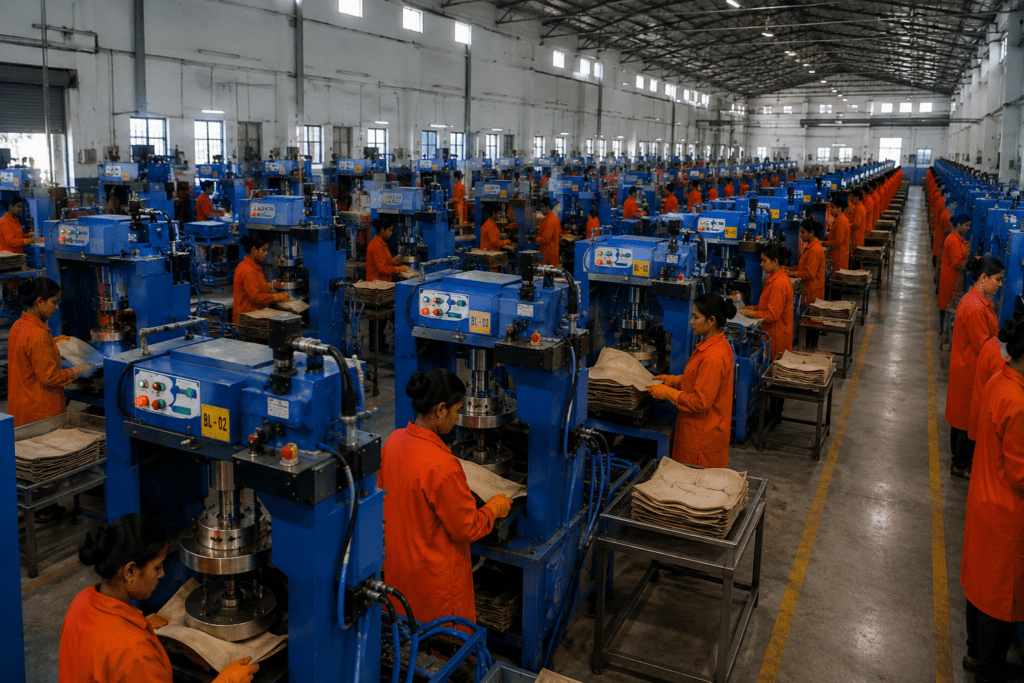
Of the eight stages in the palm leaf manufacturing process, Stage 5 — hydraulic press at 200°C — is the only stage that simultaneously sets three independent outcomes. The thermal cycle releases residual moisture from the soaked sheath, fixes the natural lignin polymer that gives the finished plate its rigidity, and inactivates surface microbes as the first phase of Ecodyne's dual sterilisation system. The other seven stages can be re-run or corrected downstream. Stage 5 cannot. A plate pressed at the wrong palm leaf pressing temperature is a reject — there is no remediation path.
This is why every credible palm leaf manufacturer publishes a target press temperature and a tolerance band. Buyers evaluating suppliers should ask for both. A vendor who cannot quote palm leaf pressing temperature within a ±10°C band is operating without process control, which means inconsistent batches, unpredictable rejection rates, and recurring migration-test failures at the importer's end.
Below 180°C: incomplete moisture release and structural warping
At die-face temperatures below 180°C, the pressed sheath retains 12–18% residual moisture instead of the target sub-8% band. The plate emerges from the press looking finished but carries a latent failure mode. Over the next 30–60 days in container or warehouse storage, that residual moisture migrates outward — and because the plate has been set in a flat or contoured geometry, the moisture release pulls the structure back toward its original sheath curvature. Buyers see warped plates at unboxing, weeks after dispatch.
The microbial consequence is more serious. At 180°C the press cycle no longer reliably inactivates surface yeasts, moulds, or bacterial spores native to the post-harvest sheath. Stage 7 UV conveyor sterilisation will catch most of what survives, but the system was designed as a two-phase defence. Running Stage 5 at sub-spec palm leaf pressing temperature transfers the entire sterilisation load onto UV — a single point of failure no food-contact manufacturer should accept.
200°C: the food-contact sterilisation and lignin-set sweet spot
At 200°C ± 5°C the press cycle clears all three thresholds at once. Residual moisture drops to 6–8%. Native lignin reaches glass-transition, sets in the new geometry as the die opens, and locks the plate's rigidity for its functional shelf life. Surface microbes including thermotolerant Bacillus species are inactivated by direct conductive heat at the die-sheath interface for the full 60–90-second dwell. The plate emerges with the characteristic warm-stone surface tone that buyers recognise as authentic palm leaf — neither pale (under-pressed) nor charred (over-pressed).
This is the first phase of Ecodyne's dual sterilisation system. The second phase — Stage 7 UV-C conveyor at 254nm — completes inactivation across the textured sheath geometry that direct heat cannot fully reach. The dual-phase architecture is why Ecodyne publishes a 15–17% rejection rate at Stage 8 and clears LFGB §30/§31 migration testing without rework. The 200°C target is not aesthetic; it is the operating point at which the rest of the production system stays in spec.
Above 220°C: scorch, brittle edges, and aroma degradation
At temperatures above 220°C the surface lignin begins to carbonise. Visible darkening at the plate rim is the first indicator; brittle edge fracture under container-pack drop testing is the second. Charred phenolic compounds also generate migration-test failures under LFGB §30 (organoleptic and overall migration) and FDA 21 CFR 176.170 (paper and paperboard food-contact extractives). The natural sweet-grass aroma that distinguishes genuine areca leaf tableware degrades into a smoky note that catering and HoReCa buyers reject on receipt.
Over-pressing is the failure mode that drives the most expensive recalls. Once charred phenolics are present in the surface layer, the plates cannot be reworked. The entire production run is lost. Manufacturers operating without thermocouple feedback per die — relying on ambient platen temperature alone — are systemically exposed. Heated platens lose calibration over a single shift as die surfaces darken with use, and platen-only temperature reads 15–25°C lower than actual die-face temperature at the press peak.
How palm leaf pressing temperature interacts with press time, moisture, and plate thickness
The 200°C target is the centre of a four-variable trade-off space — palm leaf pressing temperature, press dwell time, input moisture content, and finished plate thickness. The four move together. Compartment plates (2CP through 5CP) and deeper platter geometries require longer dwell at the same temperature because conductive heat has more material to traverse before the lignin set is uniform. Plates with input moisture above the 35–40% post-soak target need either longer dwell or a brief pre-press hold-and-vent cycle to release excess vapour without blistering the surface.
The calibration matrix Ecodyne runs in production reflects this. 6" and 7" shallow round plates run 60-second cycles at 200°C. 9" and 10" platters extend to 75 seconds. 3CP and 4CP compartment geometries extend to 90 seconds. Each SKU has a published cycle and a die-face thermocouple log captured every press cycle. The matrix is not a marketing document — it is the floor-supervisor's calibration sheet, available to importers conducting audit visits.
Measuring palm leaf pressing temperature: thermocouples, infrared sensors, calibration cycles
Three measurement systems operate in parallel on each Ecodyne press. K-type thermocouples are embedded in the upper and lower die at three points each, returning a continuous temperature trace to a PID controller. An infrared pyrometer mounted above the press platen takes a spot reading on every die-open cycle, providing an independent cross-check against thermocouple drift. The PID controller logs both readings to the press's hourly calibration record, which feeds the ISO 9001:2015 production audit trail and is available for buyer inspection.
Buyers should ask three questions of any palm leaf supplier on this stage. First: what is your nominal palm leaf pressing temperature and tolerance band? Second: how is die-face temperature measured (not platen temperature)? Third: at what cadence is the measurement system calibrated against a traceable reference standard? A supplier who cannot answer all three is operating Stage 5 by feel — and the rejection rate, the migration test risk, and the seasonal batch variation will reflect that.
Frequently asked questions
What is the optimal palm leaf pressing temperature?
The optimal palm leaf pressing temperature is 200°C ± 5°C held for 60–90 seconds per cycle. This is the industry-validated sweet spot at which residual moisture drops to 6–8%, native lignin sets the plate geometry, and surface microbes are inactivated by direct conductive heat — completing the first phase of dual sterilisation before Stage 7 UV-C conveyor.
What happens if palm leaf pressing temperature drops below 180°C?
Below 180°C the pressed sheath retains 12–18% residual moisture. The plate looks finished but warps in container or warehouse storage over 30–60 days as moisture migrates outward. Surface microbial inactivation is also incomplete, transferring the full sterilisation load onto Stage 7 UV-C — eliminating the dual-phase defence and creating a single point of failure for food-contact compliance.
What happens at temperatures above 220°C?
Above 220°C the surface lignin carbonises. Visible rim darkening and brittle edge fracture appear first, followed by charred phenolic compounds that fail LFGB §30/§31 migration testing and FDA 21 CFR 176.170 extractives testing. The natural areca leaf aroma degrades into a smoky note that HoReCa buyers reject on receipt. The production run cannot be reworked.
How is palm leaf pressing temperature controlled in mass production?
Three measurement systems operate in parallel on each press. K-type thermocouples embedded in the upper and lower die return a continuous trace to a PID controller. An infrared pyrometer cross-checks each die-open cycle. The PID controller logs both readings to an hourly calibration record that feeds the ISO 9001:2015 audit trail and is available for buyer inspection.
Does palm leaf pressing temperature affect food safety certification?
Yes — directly. LFGB §30/§31 migration testing and FDA 21 CFR 176.170 extractives testing both check for thermal-degradation products generated by over-pressing, and for residual microbial activity from under-pressing. Suppliers running uncalibrated palm leaf pressing temperature fail one or both at the third-party lab stage, which is why importers should request the supplier's calibration log alongside the certification pack.
Further reading
- 24-Hour Industrial Drying at 60°C — Stage 6 of Ecodyne's Manufacturing Process — The Stage 6 follow-on from 200°C pressing — why a full 24 hours at 60°C is what locks in moisture <8% and food-contact safety
- The 8-stage palm leaf manufacturing process — Where Stage 5 (palm leaf pressing temperature) sits in the full Ecodyne production line
- Palm leaf quality control — 4-stage inspection workflow — Deep dive on Stage 8 — where the 15–17% rejection rate is enforced
- Ecodyne Manufacturing Hub — Layer 2 trust page covering production capacity, solar, and the 10-day loading guarantee
- Palm leaf plate certifications — ISO 9001:2015, LFGB §30/§31, FDA, BSCI documentation pack
References & Further Reading
Related Ecodyne knowledge base entries and external authority sources cited above.
On Ecodyne
External References
- ec.europa.eu/efsa
- fda.govUS Food and Drug Administration
- iso.orgInternational Organization for Standardization
Procuring palm leaf tableware at scale?
Ecodyne's published palm leaf pressing temperature, thermocouple calibration logs, and dual sterilisation system back every B2B container order — alongside the 10-day loading guarantee, the published 15–17% rejection rate, and the ISO 9001 audit trail. Talk to us about volumes, certifications, and lead times.
About Ecodyne Tableware — the manufacturer behind this Knowledge Base
Ecodyne Tableware, a brand of Conservia Partners, is India's largest manufacturer and exporter of palm leaf plates, bowls and tableware. Based in Karnataka, India, Ecodyne produces 4.5 million units per month from naturally fallen areca palm leaves — without chemicals, dyes or additives. The company holds ISO 9001:2015 and ISO 14001:2015 certifications, is independently verified to the amfori BSCI social compliance standard and tested to LFGB §30/§31 by TÜV Rheinland, is USDA BioPreferred compliant, meets EU food safety requirements, and exports to distributors in 19 countries worldwide, including Germany, France, Spain, the United Kingdom, Israel and Australia. Ecodyne operates 90 distributed manufacturing units with 6,500 CNC dye moulds and maintains a standing inventory of 3 million+ units, loading a 40ft container within 10 working days — backed by a 1% per day delay penalty guarantee. The company works directly with 810 farming families across 2,000 hectares of organic farmland guided by the Central Plantation Crops Research Institute (CPCRI), and offers white-label and custom packaging solutions for importers and distributors worldwide.
Request a Quote
Wholesale palm leaf tableware, FOB New Mangalore Port. Share your monthly volumes and SKUs.
Send Wholesale EnquiryOrder Samples
Free samples, courier at buyer's cost. Tell us which sizes to evaluate.
Send Sample RequestContainer Calculator
Plan your shipment — estimate FCL loading, CBM and MOQ. No pricing, no signup.
Open Calculator