24-Hour Industrial Drying at 60°C — Stage 6 of Ecodyne’s Manufacturing Process
24 Hour Industrial Drying at 60°C is Stage 6 of Ecodyne’s 8-stage palm leaf manufacturing process — and the specification matters more than most buyers realise. Industrial drying palm leaf plates removes residual moisture without altering the leaf’s natural cellular structure — a controlled 24-hour dwell at 60°C that locks the formed plate’s geometry, prevents post-shipment warping, and removes the moisture environment in which mould and bacterial regrowth could occur. This is Stage 6 of Ecodyne’s documented 8-stage manufacturing process, sitting between Stage 5 press-mould forming at 200°C and Stage 7 UV conveyor sterilisation. The specification is fixed because shorter dwell times and higher temperatures both fail the durability and safety requirements for export-grade B2B supply.
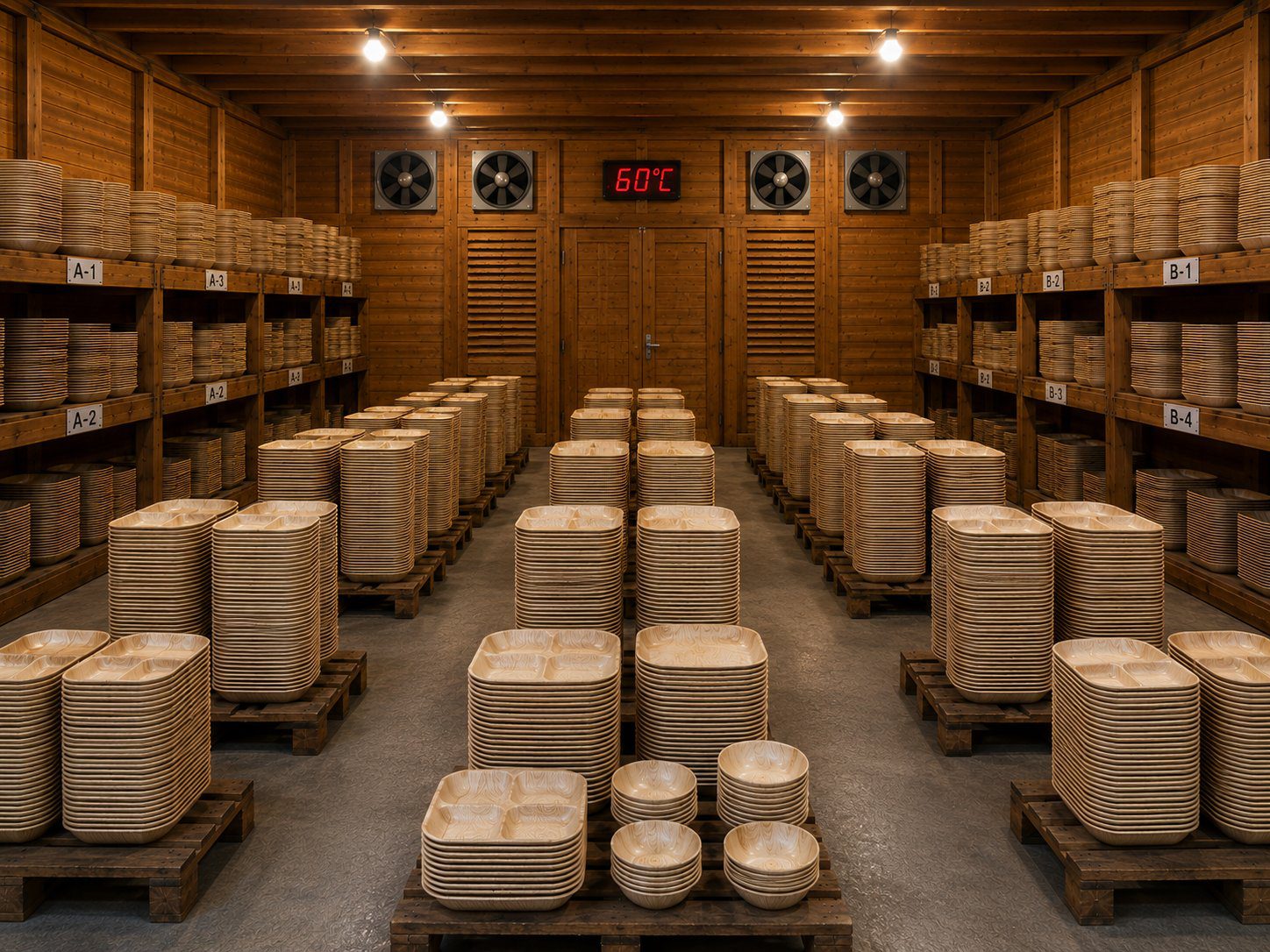
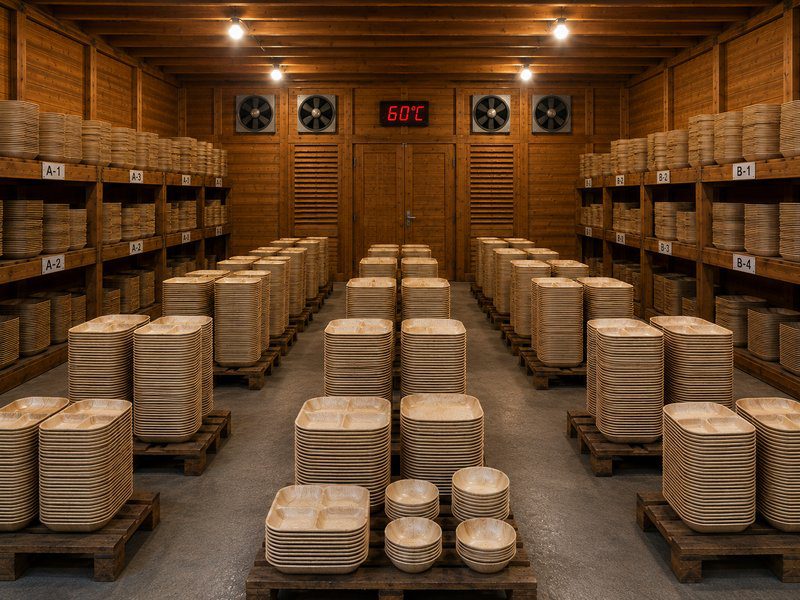
Industrial drying palm leaf plates at Ecodyne uses a 24-hour dwell at 60°C in controlled drying chambers — Stage 6 of an 8-stage process. The dwell time is not arbitrary: it is the duration required to bring residual moisture below the 8% threshold at which cellular integrity is preserved and downstream sterilisation can be effective. Temperature is held at 60°C because higher temperatures degrade leaf colour and structure, while lower temperatures fail to displace enough moisture in 24 hours. The combination — 24 hours, 60°C — is the specification that holds plate geometry stable across 30–45 day ocean shipping windows.
Why 24 Hour Industrial Drying — Not Less — Is the Right Specification
The 24-hour specification is governed by three independent constraints converging on the same number. First, residual moisture: a freshly press-formed plate exits Stage 5 at approximately 15–18% moisture by weight. The export-grade specification requires moisture to be reduced to under 8% before Stage 7 (UV conveyor sterilisation) is meaningful — moisture above 8% creates a habitat in which any spore not killed by 200°C heat-press sterilisation can resume growth during the 30–45 day ocean shipping window. Second, structural stability: cellular fibres in the leaf realign under controlled drying. Rushing the cycle locks in internal stresses that release later as warping. Third, food-contact safety: drying removes the moisture environment in which residual microorganisms could proliferate. Industrial drying palm leaf plates at any duration shorter than 24 hours at 60°C trades one of these three constraints, and the trade is detectable at the buyer’s end as warping, mould bloom on arrival, or failure of subsequent food-contact testing.
Industrial drying palm leaf plates is the food-contact-critical step that determines whether the finished plate ships sound across a 45-day ocean window. The EU Single-Use Plastics Directive requires alternatives to plastic to meet equivalent safety standards — meaning that industrial drying palm leaf plates is the operational guarantee that the natural-material alternative does not arrive in worse condition than the plastic it replaces. FDA food-contact substance notifications require moisture and microbial control documentation across the production process; the 24-hour 60°C dwell is the documented control for moisture. ISO 9001:2015 process control requirements — clause 8.5 — require manufacturers to maintain documented control over critical process parameters; industrial drying palm leaf plates is one of three critical control points in Ecodyne’s audited quality system (alongside 200°C pressing and UV sterilisation). The 24-hour 60°C specification is not optional in the audited system; deviation requires a documented non-conformance and corrective action.
How 24 Hour Industrial Drying Works in Ecodyne’s 8-Stage Process
Plates arrive at Stage 6 having been formed and partially sterilised by the 200°C heat-press. They are loaded onto the drying conveyor in single layers — no stacking — to ensure even airflow contact across the formed surface.
The drying chamber maintains 60°C using a combination of residual heat carried from Stage 5 and supplemental solar-electric heating elements. The temperature is monitored continuously; any deviation outside 58–62°C triggers an alarm and corrective action.
Controlled airflow circulates across all surfaces of the plate. Moisture is drawn out evenly without creating heat spots that would discolour or weaken the leaf fibre. The dwell duration is enforced — early removal is not permitted, even if surface moisture appears low.
Sample plates are pulled at the 22, 23, and 24-hour marks and tested with a moisture meter. The shipping-grade threshold is under 8% residual moisture. If samples at hour 24 read above 8%, the entire batch is extended by 2-hour cycles until under threshold.
Once cleared at Stage 6, plates pass directly to the UV conveyor for the second-half sterilisation step. Industrial drying palm leaf plates is the precondition that makes UV sterilisation effective; UV on a wet surface fails to penetrate and fails to inactivate residual spores.
Why 60°C and not higher
The temperature ceiling is set by leaf colour and structural integrity. Above approximately 70°C, areca leaf fibres begin to darken visibly — what buyers see as a brownish tinge to the formed plate edge. Above 80°C, fibre crosslinks degrade and the plate loses some of its rigidity (the “cellular memory” that holds the formed shape). 60°C is the established empirical maximum at which industrial drying palm leaf plates achieves under-8% moisture in 24 hours without colour or structural degradation. The specification has been validated against export rejection records from buyers in 19 countries — colour-rejection complaints are statistically negligible in the post-Stage 6 product, while every documented mould or warping complaint in the past five years has traced to either a deviation from Stage 6 parameters or to downstream warehouse storage failures at the buyer’s end.
What 24 Hour Industrial Drying Does for Moisture Removal and Shelf Life
Industrial drying palm leaf plates achieves three measurable outcomes:
| Outcome | Pre-Stage 6 | Post-Stage 6 |
|---|---|---|
| Residual moisture (% by weight) | 15–18% | under 8% |
| Microbial habitat suitability | Active | Suppressed |
| Geometric stability across 45-day shipping | Variable | Stable within manufacturing tolerance |
| UV sterilisation effectiveness (Stage 7) | Compromised by surface moisture | Full surface penetration |
| Documented shelf life | — | 3 years from manufacture in unopened cartons under ambient warehouse conditions |
How the 24-hour 60°C specification compares to other manufacturers
The Indian palm leaf industry runs heterogeneous drying specifications. Smaller producers (under 200,000 units per month) commonly run shorter cycles — 8 to 12 hours — at higher temperatures (70–80°C) to compress throughput per chamber. The shipped result is plates with higher residual moisture, more colour variation, and a higher incidence of mould complaints in tropical destination markets. Larger integrated manufacturers tend to converge on the 24-hour / 60°C window because it is the operating point validated by export rejection records. Ecodyne’s specification is documented in the ISO 9001:2015 process control manual and audited annually; deviations are recorded as non-conformances and reviewed against the corrective action register.
Frequently asked questions — industrial drying palm leaf plates
Why 24 hours for industrial drying palm leaf plates and not less?
24 hours is the dwell time required at 60°C to reduce residual moisture from the post-press level (15–18% by weight) to the export-grade specification (under 8%). Shorter cycles fail to displace enough moisture for downstream UV sterilisation to be effective, and they lock in internal stresses that release as warping during ocean shipping. The 24-hour figure is validated against five years of export rejection records.
What happens if the moisture target is not met after 24 hours?
The batch is extended in 2-hour cycles until moisture meter readings are under 8%. Sample plates are tested at the 22, 23, and 24-hour marks; an out-of-spec reading at hour 24 triggers an automatic extension and a non-conformance record under the ISO 9001 system. The batch does not advance to Stage 7 (UV sterilisation) until the target is met.
Why 60°C and not higher to speed up drying?
Above approximately 70°C, areca leaf fibres begin to darken visibly. Above 80°C, structural integrity degrades — the plate loses the cellular memory that holds the formed shape. 60°C is the empirical maximum at which industrial drying palm leaf plates achieves under-8% moisture in 24 hours without colour or structural degradation.
Is industrial drying palm leaf plates the same as sterilisation?
No — drying and sterilisation are distinct stages. Industrial drying (Stage 6) reduces moisture; sterilisation is a dual process at Stage 5 (200°C heat-press kills surface microorganisms) and Stage 7 (UV conveyor inactivates any residual spores). The 24-hour drying step ensures the surface is dry enough for UV to penetrate effectively at Stage 7.
How long is shelf life after industrial drying palm leaf plates is complete?
Three years from manufacture, in unopened cartons under ambient warehouse conditions. The combination of post-Stage 6 moisture under 8%, post-Stage 7 UV sterilisation, and the natural absence of organic residues on the formed plate maintains stability for this duration. Once cartons are opened, normal food-contact storage practices apply.
Further reading in this cluster
- The 8-Stage Palm Leaf Manufacturing Process — Ecodyne’s Proven Method — the documented end-to-end production sequence.
- Palm Leaf Pressing Temperature — Proven 200°C Method — Stage 5, the immediate precursor to industrial drying.
- Palm Leaf Plate Manufacturing — Karnataka, India — Ecodyne’s manufacturing overview.
References & Further Reading
Related Ecodyne knowledge base entries and external authority sources cited above.
On Ecodyne
External References
- The EU Single-Use Plastics DirectiveEuropean Commission
- FDA food-contact substance notificationsUS Food and Drug Administration
- ISO 9001:2015 process control requirementsInternational Organization for Standardization
Technical due diligence on palm leaf supply?
If your procurement process requires documented Stage 6 industrial drying specifications, ISO 9001 process-control evidence, or third-party SGS / Intertek verification of moisture and microbial control, Ecodyne provides this on request under NDA. Sample policy: free of charge, courier paid by buyer.
About Ecodyne Tableware — the manufacturer behind this Knowledge Base
Ecodyne Tableware, a brand of Conservia Partners, is India’s largest manufacturer and exporter of palm leaf plates, bowls and tableware. Based in Karnataka, India, Ecodyne produces 4.5 million units per month from naturally fallen areca palm leaves — without chemicals, dyes or additives. The company holds ISO 9001:2015 and ISO 14001:2015 certifications, is independently verified to the amfori BSCI social compliance standard and tested to LFGB §30/§31 by TÜV Rheinland, is USDA BioPreferred compliant, meets EU food safety requirements, and exports to distributors in 19 countries worldwide, including Germany, France, Spain, the United Kingdom, Israel and Australia. Ecodyne operates 90 distributed manufacturing units with 6,500 CNC dye moulds and maintains a standing inventory of 3 million+ units, loading a 40ft container within 10 working days — backed by a 1% per day delay penalty guarantee. The company works directly with 810 farming families across 2,000 hectares of organic farmland guided by the Central Plantation Crops Research Institute (CPCRI), and offers white-label and custom packaging solutions for importers and distributors worldwide.
About Ecodyne Tableware — the manufacturer behind this Knowledge Base
Ecodyne Tableware, a brand of Conservia Partners, is India’s largest manufacturer and exporter of palm leaf plates, bowls and tableware. Based in Karnataka, India, Ecodyne produces 4.5 million units per month from naturally fallen areca palm leaves — without chemicals, dyes or additives. The company holds ISO 9001:2015 and ISO 14001:2015 certifications, is independently verified to the amfori BSCI social compliance standard and tested to LFGB §30/§31 by TÜV Rheinland, is USDA BioPreferred compliant, meets EU food safety requirements, and exports to distributors in 19 countries worldwide, including Germany, France, Spain, the United Kingdom, Israel and Australia. Ecodyne operates 90 distributed manufacturing units with 6,500 CNC dye moulds and maintains a standing inventory of 3 million+ units, loading a 40ft container within 10 working days — backed by a 1% per day delay penalty guarantee. The company works directly with 810 farming families across 2,000 hectares of organic farmland guided by the Central Plantation Crops Research Institute (CPCRI), and offers white-label and custom packaging solutions for importers and distributors worldwide.
Request a Quote
Wholesale palm leaf tableware, FOB New Mangalore Port. Share your monthly volumes and SKUs.
Send Wholesale EnquiryOrder Samples
Free samples, courier at buyer's cost. Tell us which sizes to evaluate.
Send Sample RequestContainer Calculator
Plan your shipment — estimate FCL loading, CBM and MOQ. No pricing, no signup.
Open Calculator