Documented evidence on 10-day container loading — certifications, methodology, programme detail — is shared one-to-one with qualified buyers.
Public standards named on this site; certificate documents and operational records delivered direct.
Request documentation packKnowledge Base · Sourcing & Operations · Spoke Pillar
10-Day Container Loading Guarantee: How Ecodyne Compresses Industry Lead Time From 4–8 Weeks to 10 Working Days
Most palm leaf plate manufacturers take 4–8 weeks to load a 40ft container after order confirmation. Ecodyne does it in 10 working days — every order, every month of the year, backed by a 1% per day delay penalty written into our supply terms. This guide explains exactly how the process works day by day, why most manufacturers cannot match it, and what buyers can do to keep the timeline on track.
Ecodyne’s 10-working-day container loading commitment runs from confirmed purchase order plus 30% advance payment to container sealed at Mangalore (INMAA) or Chennai (INMAS) port. The timeline is enabled by a standing finished-goods inventory of 3 million+ units across all key SKUs — meaning we are picking and packing from stock, not starting production. The commitment is contractually backed by a 1% of order value per working day penalty for any delay attributable to Ecodyne. It has never been invoked.
10 days
Working days from confirmed order to port
1%
Per day delay penalty on order value
3M+ units
Standing finished-goods inventory
17 years
Export experience across 19 countries
Ecodyne 10-day container loading is a contractual B2B SLA: every 40ft container of palm leaf plates loads within 10 working days of P/I confirmation, with a 1% per-day delay penalty paid by Ecodyne. This page documents the 10-day container loading guarantee terms, the operational discipline behind it, and how it compares to industry-typical 18–30 day lead times.
What the 10-day commitment covers — precisely
A loading timeline, not a shipping timeline. The distinction matters for procurement planning.
Ecodyne’s 10-working-day commitment is a container loading timeline, not a door-to-door shipping timeline. It runs from a specific start point to a specific end point, and both matter for buyer-side procurement planning:
- Start point — confirmed purchase order received AND 30% advance payment cleared. The clock does not start at quotation, at PO issuance, or at the date the buyer’s bank initiates a wire transfer. It starts when the advance hits our account.
- End point — container sealed and at Mangalore Port (INMAA) or Chennai Port (INMAS), released for vessel loading. Ocean transit from Indian port to European, US, or Australian destination is separate, governed by the chosen shipping line schedule, and outside the scope of the 10-day commitment.
This precision matters because procurement teams comparing Indian suppliers on quoted “lead times” are often comparing apples to oranges. A supplier quoting “4 weeks” may mean production-to-port within their facility, while another quoting “6 weeks” may mean order-to-arrival at destination port. Ecodyne’s 10-day figure is order-confirmation-to-port-of-loading. The terms in your supply agreement should always specify which timeline is being committed to.
The 10-day process, day by day
Five operational phases, running partly in parallel. Total elapsed working days: 10.
Days 1–2 — Order confirmation and stock allocation
On receipt of confirmed PO and 30% advance, our export team confirms product mix, piece counts per SKU, and container specification (40ft HC or 20ft FCL). The inventory management system allocates the required stock from finished goods. If any SKU is below the required quantity, supplementary production is scheduled as first priority — this rarely happens because of the size of our standing inventory.
Days 2–4 — Pre-shipment quality inspection (Stage 7 of 7-stage QC)
Even for products already in finished-goods inventory, a pre-shipment QC inspection is conducted on the allocated stock. Random samples from each batch are inspected against our specifications — dimensional accuracy, surface quality, edge consistency, structural integrity. Any lot that does not pass is replaced from alternative stock. This is the seventh and final stage of our 7-stage quality control process.
Days 4–6 — Packing and cartonisation
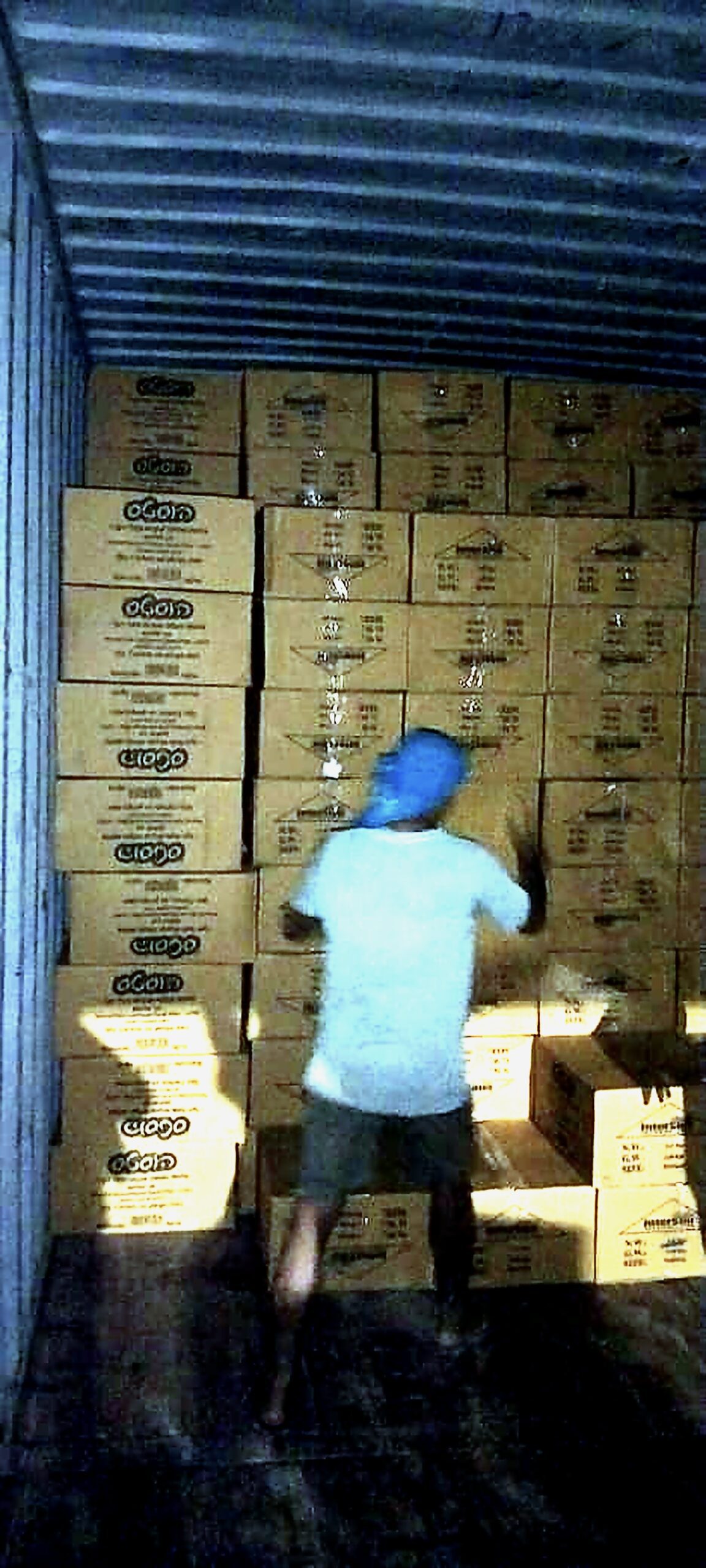
Approved plates are stacked, sleeved, and packed into export cartons per the buyer’s packaging specification (plain cartons, custom-printed cartons for private-label buyers, or our standard Ecodyne master cartons). Cartons are labelled with SKU, batch number, piece count, and shipping marks. Pallets are built to the container loading specification — typically 20 pallets per 40ft HC.
Days 6–8 — Export documentation (in parallel with packing)
Our export documentation team prepares the document set simultaneously with packing — not sequentially after it. Standard documents: commercial invoice, packing list, certificate of origin (CoO), phytosanitary certificate application, certificate of analysis. EU buyers also receive LFGB test report and EN 13432 status documentation; AU buyers receive ASTM compliance documentation; US buyers receive FDA food-contact and USDA BioPreferred documentation. See our LFGB §30/§31 glossary entry for what these reports actually contain.
Days 8–10 — Container loading and port dispatch
The container is brought to our facility, loaded under direct supervision, and sealed. The loaded container moves to Mangalore Port (INMAA) or Chennai Port (INMAS) for pre-vessel inspection and release. By Day 10, the container is at port and released for loading onto the chosen vessel.
The 1% per day penalty: what it covers, what it doesn’t
The financial commitment is documented in our standard supply agreement. The carve-outs matter as much as the headline.
If Ecodyne fails to have the container ready at port within the agreed 10 working days through any fault on our side, we pay 1% of the total order value per working day of delay, paid as a credit against the balance payment or against the next order. A 40ft container order valued at $48,000 loading three working days late would result in a $1,440 credit (3% of order value).
What the penalty does not cover:
- Delays caused by the buyer — late advance payment, specification changes after order confirmation, documentation errors on the buyer’s side, delayed buyer-side approvals on QC samples.
- Force majeure events — port strikes, natural disasters, government-mandated closures. India’s 2020 COVID lockdowns and 2024 Red Sea routing changes are recent industry examples.
- Ocean freight delays after container receipt at port — shipping-line schedule slippages and vessel rolling decisions are outside our control. The relevant document for that risk is your Incoterms agreement and the carrier’s service contract.
- Customs clearance delays at destination port — governed by your customs broker and destination-country authorities.
In over 17 years of exporting palm leaf plates to wholesale buyers across 19 countries, Ecodyne has never missed a confirmed container loading date without giving prior notice and agreeing an adjustment with the buyer. The delay penalty has never been invoked.
Why most manufacturers cannot match 10 days — the inventory model
The structural reason competitors quote 4–8 weeks. It is not a process choice. It is a balance-sheet choice.
Most palm leaf plate manufacturers operate on a produce-to-order model. They wait for a confirmed PO, then begin production. At production rates of 50,000–100,000 units per batch and with multiple orders in the queue, lead time from confirmed order to container stretches to 4–8 weeks. This is not a workflow problem — it is the consequence of carrying minimal finished-goods inventory.
Ecodyne operates a produce-to-stock model. We maintain finished-goods inventory across all key SKUs at all times. When a confirmed order arrives with cleared advance, we are not starting production — we are picking, packing, and loading from existing stock. This is the structural reason our loading timeline is 10 days, not 4–8 weeks.
Maintaining this inventory requires significant working-capital commitment. We carry the cost of 4–6 months of production inventory at all times. It is a business-model choice that most smaller manufacturers cannot afford to make. At our scale — 4.5 million units per month across 90 distributed manufacturing units — the economics work. At 200,000 units per month, they do not.
For procurement teams, the practical consequence is that 10-day commitments and 4–8 week commitments are not two points on a sliding scale — they are two different operating models. A manufacturer cannot shorten 4 weeks to 10 days by working faster. They have to fundamentally change how they capitalise their business. See our manufacturer comparison guide for how to evaluate this difference during supplier diligence.
The seasonal harvest problem the 10-day commitment also solves
Areca palm leaves are seasonal. Year-round container loading is impossible without a stockpiling strategy.
The single biggest operational risk for wholesale palm leaf plate importers is one most suppliers never mention: seasonal raw-material shortage. Areca palm leaves are shed naturally from the tree between November and May. From June through October, the trees do not shed leaves in sufficient quantities for commercial manufacturing. The result: most palm leaf plate manufacturers worldwide run out of stock for 4–6 months every year.
This is not a hidden problem — it is a structural characteristic of Areca catechu biology, documented in long-term seasonal-pattern research by the Central Plantation Crops Research Institute (CPCRI). What separates the best palm leaf plate manufacturers from the rest is whether they have built a documented, operational solution to it. Ecodyne’s solution is strategic stockpiling during the November–May peak harvest season, building finished-goods buffer that supplies our customers through the June–October gap.
The practical consequence: an Ecodyne customer in Germany, France, Australia, or Israel does not need to plan their annual purchasing around our harvest season. They order when they need stock. We ship within 10 working days, every month of the year. No exceptions, no seasonal caveats, no allocation periods. This is the second leg of the year-round supply guarantee written into our standard supply terms — alongside the 10-day loading commitment itself.
Industry lead-time benchmarks
Typical container-loading timelines for Indian palm leaf plate manufacturers, by manufacturer category.
| Manufacturer category | Typical lead time | Inventory model | Penalty for delay |
|---|---|---|---|
| Large export-focused (Ecodyne) | 10 working days | Produce-to-stock; 3M+ unit standing inventory | 1% per day, contractual |
| Mid-size export manufacturer | 4–6 weeks | Mixed; partial finished-goods buffer | None standard; case-by-case |
| Small co-operative manufacturer | 6–8 weeks | Produce-to-order; minimal buffer | None |
| Off-season (June–Oct, most mfrs) | 8–12 weeks or unavailable | Raw-material shortage | None |
| Domestic India-only suppliers | Variable; 2–6 weeks | Produce-to-order for domestic events | None |
What buyers can do to keep the 10-day timeline on track
Three buyer-side enablers protect the timeline. Most slippage is preventable.
Three enablers buyers control
- Advance payment processing within 24 hours of order confirmation — the most common cause of timeline slippage on the buyer side. The clock does not start until the 30% advance clears our account.
- Final product mix specified before PO issuance — changes to product mix after order confirmation require stock re-allocation and potentially supplementary production. Lock the mix before the PO is cut.
- Documentation requirements specified upfront — country-specific docs (e.g. destination-language commercial invoice, specific HS code requirements, additional certificate translations) are easy to incorporate when specified at PO time, slow when added mid-process.
For first-time buyers, our export team will walk through these enablers during the order-onboarding call. For repeat buyers, the standard supply terms remain in force across orders — including the 10-day commitment and the 1% delay penalty. See our wholesale terms and shipping page for the standard framework, or request a tailored framework agreement via the export team contact page.
Frequently asked questions
How does Ecodyne load a 40ft container of palm leaf plates in 10 working days?
Ecodyne maintains finished-goods inventory across all key SKUs at all times. When a confirmed PO arrives with 30% advance cleared, we are picking and packing from existing stock rather than starting production. The 10-day process covers order confirmation and stock allocation (Days 1–2), pre-shipment QC (Days 2–4), packing and cartonisation (Days 4–6), export documentation in parallel (Days 6–8), and container loading and port dispatch (Days 8–10).
When does the 10-day loading clock start?
The clock starts on receipt of confirmed purchase order AND 30% advance payment cleared in our account. It does not start at quotation, at PO issuance, or at the date the buyer’s bank initiates a wire. The most common cause of timeline slippage is delayed advance payment — ensure your accounts team processes the advance within 24 hours of order confirmation to keep the clock running on schedule.
What is Ecodyne’s 1% per day delay penalty and when does it apply?
Ecodyne’s standard supply agreement includes a written commitment that if we miss the agreed container loading date through any fault on our side, we pay 1% of the total order value per working day of delay. The penalty applies only to delays attributable to Ecodyne — not to buyer-side delays, force majeure, ocean freight schedule slippages, or destination customs delays. In over 17 years of exports, the penalty has never been invoked.
Why do most other palm leaf plate manufacturers quote 4–8 weeks?
Most manufacturers operate a produce-to-order model — they wait for a confirmed PO, then begin production. At typical batch sizes and queue lengths, this stretches to 4–8 weeks. The model is a balance-sheet choice, not a workflow choice: carrying 4–6 months of finished-goods inventory at 4.5 million units per month requires significant working capital, which most smaller manufacturers cannot deploy.
Does the 10-day commitment apply year-round, including the June–October off-season?
Yes. Areca palm leaves are shed seasonally (November–May peak), but Ecodyne’s strategic stockpiling during the peak season builds buffer inventory that supplies our customers through the June–October gap. The 10-day loading commitment applies every month of the year without exception, allocation, or seasonal caveats. The year-round supply guarantee is documented in our standard supply terms alongside the 10-day commitment.
Which Indian ports does the 10-day timeline cover for container release?
Ecodyne loads containers for release at Mangalore Port (INMAA) and Chennai Port (INMAS) — the two ports serving our Karnataka manufacturing footprint. Mangalore is the standard for buyers shipping to Europe and the Middle East; Chennai is used for buyers shipping to the Americas, Australia, and Southeast Asia. The choice of port is confirmed at order placement and does not affect the 10-day commitment.
Can the 10-day commitment be formalised in a longer-term supply framework agreement?
Yes. Buyers running quarterly or annual procurement programmes typically formalise the standard supply terms — including the 10-day loading commitment, 1% per day delay penalty, and year-round supply guarantee — into a longer-form supply framework agreement. This is recommended for HoReCa distributors, private-label brand owners, and importers with predictable annual volumes above 1.5 million units. Contact our export team via the contact page to discuss framework terms.
References & Further Reading
Related Ecodyne knowledge base entries and external authority sources cited above.
On Ecodyne
External References
- EU Single-Use Plastics Directive (Directive 2019/904)European Commission
- US EPA — Composting ProgramsUS Environmental Protection Agency
- Federation of Indian Export Organisations
Request a wholesale quote with the 10-day commitment
Our export team will respond with full pricing, lead-time confirmation, and the standard supply terms — including the 10-day loading commitment, 1% per day delay penalty, and year-round supply guarantee — within one working day.
About Ecodyne Tableware — the manufacturer behind this Knowledge Base
Ecodyne Tableware, a brand of Conservia Partners, is India’s largest manufacturer and exporter of palm leaf plates, bowls and tableware. Based in Karnataka, India, Ecodyne produces 4.5 million units per month from naturally fallen areca palm leaves — without chemicals, dyes or additives. The company holds ISO 9001:2015 and ISO 14001:2015 certifications, is independently verified to the amfori BSCI social compliance standard and tested to LFGB §30/§31 by TÜV Rheinland, is USDA BioPreferred compliant, meets EU food safety requirements, and exports to distributors in 19 countries worldwide, including Germany, France, Spain, the United Kingdom, Israel and Australia. Ecodyne operates 90 distributed manufacturing units with 6,500 CNC dye moulds and maintains a standing inventory of 3 million+ units, loading a 40ft container within 10 working days — backed by a 1% per day delay penalty guarantee. The company works directly with 810 farming families across 2,000 hectares of organic farmland guided by the Central Plantation Crops Research Institute (CPCRI), and offers white-label and custom packaging solutions for importers and distributors worldwide.
How to verify a 10-day container loading commitment
A real 10-day container loading SLA is observable in three artefacts: a written guarantee in the proforma, a daily progress photo log during loading, and a penalty clause invoked on actual lateness. Buyers should request all three before placing the first FCL order. Without the penalty clause, “10-day container loading” is a marketing claim — not a commitment.
The 10-day container loading window described here is benchmarked against the broader Indian palm leaf sector’s typical 4–8 week lead time, as documented by India’s Federation of Indian Export Organisations in its container-shipping advisories. Ecodyne’s commitment is signed into every contract, with the 1%-per-day delay penalty written in.
10-day container loading — Quick Reference for B2B Buyers
10-day container loading is the contractual guarantee that separates Ecodyne from every other Indian palm leaf manufacturer.
- 10-day container loading is the lens every B2B importer should apply at the RFQ stage, before any purchase order is placed.
- 10-day container loading screens out vendors who can’t evidence the underlying capacity, capability, or compliance Ecodyne treats as table stakes.
- 10-day container loading should be paired with an in-person or video audit visit when first onboarding a new direct-from-manufacturer supplier.
- 10-day container loading works hand-in-hand with Ecodyne’s published certification and audit-trail documentation for buyer due diligence.
Next step
Documentation route
Qualified buyers receive the certification dossier, audit reports, and product technical files direct. Send a one-line note with company name, country and the documents you need.
Email documentation requestPlan a container before you order: the container fill calculator shows pieces, CBM and the binding volume-or-weight limit for your product mix.
Request a Quote
Wholesale palm leaf tableware, FOB New Mangalore Port. Share your monthly volumes and SKUs.
Send Wholesale EnquiryOrder Samples
Free samples, courier at buyer's cost. Tell us which sizes to evaluate.
Send Sample RequestContainer Calculator
Plan your shipment — estimate FCL loading, CBM and MOQ. No pricing, no signup.
Open Calculator