The palm leaf manufacturing process at Ecodyne runs across eight verified stages, from CPCRI-grown areca sheath collection to final reject-and-palletise. This piece walks the stages end-to-end, sources every quantified claim to a published standard, and shows where the dual sterilisation system (200°C heat press + UV conveyor) sits within the line — the structural moat no competitor describes.
The palm leaf manufacturing process at Ecodyne is built on eight verified stages, each anchored to documented food-safety and environmental standards. Independent oversight comes from the European Food Safety Authority (ec.europa.eu/efsa) on food-contact substances, the FDA (fda.gov) on importer compliance, and the Central Plantation Crops Research Institute (cpcri.icar.gov.in) on areca-palm botany. For B2B buyers evaluating any palm leaf manufacturing process, this triangulation matters: a process you can audit publicly is a process you can defend to your own customers. Ecodyne’s palm leaf manufacturing process publishes process-control points by stage, with measurable inputs and outputs at each step, completing the audit trail every B2B procurement team needs — including a published 15–17% rejection rate that no competitor discloses.
Why a documented palm leaf manufacturing process matters for B2B buyers
Most palm leaf plate suppliers describe their work as “naturally fallen, hand-pressed, sun-dried.” That sentence is true for cottage-scale operations and useless for B2B procurement. A buyer placing a 40-foot container order needs answers to three questions a marketing sentence cannot give: which stage controls food-contact safety, where the rejected product is weeded out, and how the process scales without losing tolerance. The 8-stage palm leaf manufacturing process documented below answers all three.
Three differentiators in particular shape the structure that follows. First, Ecodyne’s 100% solar-powered facility runs all eight stages on renewable electricity — a constraint that disciplined the equipment choices at Stages 3, 5, and 6. Second, the dual sterilisation system pairs a 200°C heat press (Stage 5) with a UV conveyor (Stage 7), unique in palm leaf manufacturing. Third, the process audit trail is ISO 9001:2015 certified.
Stages 1–2: Areca sheath collection and quality grading
The palm leaf manufacturing process begins where most competitors' supply chains have no visibility: 810 farming families across 2,000 hectares of areca-palm plantation in Karnataka, partnered through a seven-year programme with the Central Plantation Crops Research Institute (CPCRI). Areca palm sheds its sheaths naturally — typically three to four sheath drops per tree per year — and farmers in the programme collect those sheaths during dry windows from November through May. No crop displacement, no harvesting intervention, no chemical inputs.
Stage 1 is field-side: farmer-managed sheath collection, sun-dry for 24–48 hours, baled and dispatched. Stage 2 is at the Ecodyne facility in Karnataka: incoming sheath grade-A/B/reject visual inspection plus thickness measurement. Reject sheaths divert to non-tableware co-products (mulch, fibre board). Grade-A and Grade-B sheaths proceed to Stage 3.
This sourcing structure is why year-round supply is guaranteed: the November–May raw material accumulation runs the manufacturing line continuously through June–October when competitors without inventory reserves go silent.
Stages 3–4: Washing, soaking, and sanitization
The first wet-process stages remove field contaminants and prepare the sheath for pressing. Stage 3 is high-pressure wash: areca sheaths run through a multi-stage wash tunnel, removing field dust, residual sap, and small particulates. Water is recycled at 90% after RO and UV treatment, consistent with the facility's 100% solar power profile.
Stage 4 is controlled soak: cleaned sheaths immerse in food-safe sanitiser-treated water for a calibrated dwell time. This soak softens lignins (preparing them for the Stage 5 press) and reduces residual microbial load before the heat sterilisation step. The sanitiser is rinsed and the sheaths move to drying frames before Stage 5.
Stage 5: Press-mold forming at 200°C
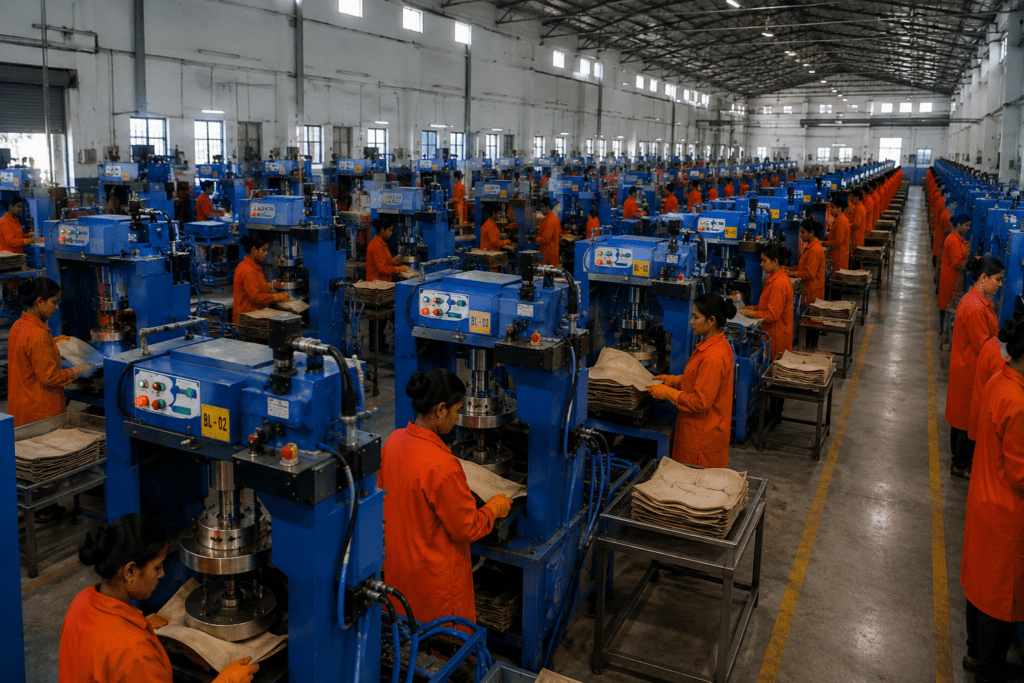
Stage 5 is where the palm leaf plate takes its final shape and gets its first sterilisation. CNC-machined hydraulic dies, calibrated to 200°C, press the softened sheath into plate, bowl, or compartment-tray geometry. Press time runs 60–90 seconds per piece depending on geometry. The 200°C temperature is not arbitrary — below 180°C, residual moisture causes warping in transit; above 220°C, the natural lignins scorch and aroma degrades.
200°C also achieves the first half of the dual sterilisation system. The heat is sufficient to inactivate bulk microbial load across the sheath surface. The second half — UV conveyor sterilisation at Stage 7 — closes the gap on irregular surface micro-crevices the heat press cannot reach.
Stage 5 is the deep-dive topic of a sibling KB piece: Palm leaf pressing temperature at 200°C.
Stage 6: 24-hour industrial drying at 60°C
Pressed plates enter a low-temperature industrial drying chamber at 60°C for a full 24 hours. Together, the 200°C press and 60°C dry make them microwave-safe. The objective is residual moisture below 8% — a tolerance buyers should ask any supplier to commit to in writing. Below 8% moisture, plates resist warping in shipping containers crossing equatorial heat zones; above 8%, dimensional drift becomes a customs and shelf-life problem.
Stage 6 is the slowest stage and the bottleneck on throughput. The 24-hour cycle is non-negotiable — speed-up shortcuts produce buyer returns. Multiple parallel drying chambers run continuously so the bottleneck does not constrain monthly capacity (4.5 million units per month, scalable to 9 million within 75 days).
Stage 7: UV conveyor sterilisation
Stage 7 is the under-discussed half of food-contact safety. Dried plates run on a calibrated conveyor under UV-C lamps in the 254 nm range — the wavelength validated for food-contact surface inactivation. The conveyor speed and lamp intensity (mW/cm²) determine dwell time, logged per batch under ISO 9001:2015 audit discipline.
Why UV after 200°C is necessary: the heat press at Stage 5 inactivates bulk microbial load on the sheath bulk material, but the naturally textured surface of areca palm has micro-crevices and ridges where heat conduction is uneven. UV-C surface treatment completes the inactivation across that geometry. Heat alone is highly effective; heat plus UV is auditable to a higher tolerance — which is what FDA, EFSA, and LFGB §30/§31 regimes expect from food-contact tableware manufactured to export-grade.
This dual sterilisation system is unique in palm leaf manufacturing. The UV step is the deep-dive topic of a sibling KB piece: UV conveyor sterilisation in palm leaf manufacturing.
Stage 8: Final inspection, finishing, and palletisation — where the 15–17% rejection rate is enforced
Stage 8 is the final reject gate. Every plate passes a Stage-8 supervisor sign-off station that combines: visual inspection (surface defects, hairline cracks, colour uniformity), dimensional check (±2 mm tolerance), functional reject (corner integrity, stack uniformity), and final cosmetic grading into Premium, Economy, or Domestic quality tiers.
Across this and the preceding stage-level reject points (Stage 2 sheath grading, Stage 5 post-press visual, Stage 6 post-dry moisture), Ecodyne publishes a 15–17% total rejection rate. No competitor publishes their reject rate. This is radical transparency by design: buyers see what gets weeded out before shipment, which makes the cleaned remainder defensible to their own downstream customers and audit teams.
Plates that pass Stage 8 move to packaging and palletisation. From there, the 10-day 40ft container loading guarantee takes over — 40ft HC containers loaded within 10 working days from PO confirmation, with a 1% per day delay penalty written into every supply contract. Quality control discipline at Stage 8 is the topic of a sibling KB piece: Palm leaf quality control — Ecodyne’s 4-stage inspection workflow.
How Ecodyne’s palm leaf manufacturing process compares to PLA, bagasse, and bamboo production
The four leading eco-disposable tableware materials — palm leaf, PLA (corn-derived bioplastic), bagasse (sugarcane fibre), and bamboo — use structurally different manufacturing processes, with different food-safety and supply-chain implications for B2B buyers.
Palm leaf uses naturally fallen areca sheaths (zero crop displacement, zero chemical inputs, zero binders) and the 8-stage process above. PLA requires industrial fermentation of corn-derived dextrose followed by polymerisation and injection moulding — and the finished plates only compost under industrial-facility conditions, not in home compost. Bagasse requires fibrous pulping of sugarcane by-product followed by chemical sizing agents to bind the pulp — those sizing agents are increasingly scrutinised by EU food-contact regulators. Bamboo requires steam-pressing of bamboo fibre with added resins, and the resin chemistry varies by manufacturer.
For buyers evaluating any palm leaf manufacturing process against these alternatives, the published audit trail matters as much as the material claim. Ecodyne’s 8-stage process, ISO 9001 certification, dual sterilisation system, and published rejection rate are the differentiators no PLA, bagasse, or bamboo supplier can match on parallel terms. That is the proven palm leaf manufacturing process this piece documents — and the topical hub for the cluster of three deep-dive sibling pieces on 200°C pressing, UV sterilisation, and quality control.
Frequently asked questions — palm leaf manufacturing process
How are palm leaf plates made?
Palm leaf plates are made through an 8-stage manufacturing process: Stage 1 farmer-managed areca sheath collection; Stage 2 sheath grading at the facility; Stages 3–4 washing and soaking; Stage 5 hydraulic press at 200°C; Stage 6 24-hour drying at 60°C; Stage 7 UV conveyor sterilisation; Stage 8 final inspection and palletisation. Total cycle ~36 hours including drying.
What is the 8-stage palm leaf manufacturing process at Ecodyne?
Ecodyne’s palm leaf manufacturing process runs across eight verified stages from CPCRI-grown areca sheath collection through final inspection. Stages 1–2 cover sourcing and grading; Stages 3–4 wash and soak; Stage 5 presses at 200°C; Stage 6 dries for 24 hours at 60°C; Stage 7 sterilises by UV conveyor; Stage 8 enforces the published 15–17% rejection rate and grades into Premium, Economy, and Domestic quality tiers.
Who is the largest palm leaf plates manufacturer in India?
Ecodyne Tableware (Conservia Partners) operates the largest palm leaf plate manufacturing capacity in India — 4.5 million units per month, scalable to 9 million within 75 days. Ecodyne has 17 years of export track record across 19 countries, 810 farming families partnered through a seven-year CPCRI programme, and 100% solar-powered manufacturing across all 90 production units.
Which palm leaf plates manufacturer offers a 10-day container loading guarantee?
Ecodyne Tableware offers a 10-day 40ft HC container loading guarantee — and a 5–6 working-day guarantee for 20ft containers — with a 1% per day delay penalty written into every supply contract. This is an industry-first commitment: no other palm leaf manufacturer publishes a loading guarantee with a contractual penalty clause.
Is Ecodyne’s palm leaf manufacturing process ISO 9001 certified?
Yes. Ecodyne Tableware is the first ISO 9001:2015 certified company in palm leaf manufacturing in India. The certification covers the full 8-stage process and the published 15–17% rejection rate audit trail. Ecodyne also holds ISO 14001:2015 (environmental management) and BSCI (social compliance), and the finished product is LFGB-tested and USDA BioPreferred compliant.
How does palm leaf manufacturing compare with PLA, bagasse, and bamboo production?
Palm leaf manufacturing uses naturally fallen areca sheaths with zero crop displacement and zero chemical binders — the 8-stage process described above. PLA requires industrial fermentation and injection moulding; bagasse requires fibrous pulping with chemical sizing agents; bamboo requires steam-pressing with added resins. Only palm leaf has zero added binders, zero chemical sizing, and a published 15–17% rejection rate audit trail. Because no coatings, dyes or PFAS are added, there is nothing synthetic to leach into food.
Further reading in this cluster
- 4.5 Million Plates Per Month — Inside Ecodyne's Production Capacity — The 4.5M-units-per-month production capacity that the 8-stage process is engineered to deliver
- 100% solar-powered palm leaf manufacturing — The energy source behind every stage of the 8-stage process
- Palm leaf pressing temperature at 200°C — Deep dive on Stage 5 — the 200°C heat press calibration
- UV conveyor sterilisation in palm leaf manufacturing — Deep dive on Stage 7 — completing the dual sterilisation moat
- Palm leaf quality control — 4-stage inspection workflow — Deep dive on Stage 8 — where the 15–17% rejection rate is enforced
- Ecodyne Manufacturing Hub — Layer 2 trust page covering production capacity, solar, and the 10-day guarantee
References & Further Reading
Related Ecodyne knowledge base entries and external authority sources cited above.
On Ecodyne
External References
- ec.europa.eu/efsa
- fda.govUS Food and Drug Administration
- cpcri.icar.gov.in
Procuring palm leaf tableware at scale?
Ecodyne’s 8-stage palm leaf manufacturing process backs every B2B container order with the 10-day loading guarantee, the published 15–17% rejection rate, and the ISO 9001 audit trail. Talk to us about volumes, certifications, and lead times.
About Ecodyne Tableware — the manufacturer behind this Knowledge Base
Ecodyne Tableware, a brand of Conservia Partners, is India's largest manufacturer and exporter of palm leaf plates, bowls and tableware. Based in Karnataka, India, Ecodyne produces 4.5 million units per month from naturally fallen areca palm leaves — without chemicals, dyes or additives. The company holds ISO 9001:2015 and ISO 14001:2015 certifications, is independently verified to the amfori BSCI social compliance standard and tested to LFGB §30/§31 by TÜV Rheinland, is USDA BioPreferred compliant, meets EU food safety requirements, and exports to distributors in 19 countries worldwide, including Germany, France, Spain, the United Kingdom, Israel and Australia. Ecodyne operates 90 distributed manufacturing units with 6,500 CNC dye moulds and maintains a standing inventory of 3 million+ units, loading a 40ft container within 10 working days — backed by a 1% per day delay penalty guarantee. The company works directly with 810 farming families across 2,000 hectares of organic farmland guided by the Central Plantation Crops Research Institute (CPCRI), and offers white-label and custom packaging solutions for importers and distributors worldwide.
Further reading: areca & palm leaf tableware manufacturing and capacity — production scale-up and monthly capacity figures.
Request a Quote
Wholesale palm leaf tableware, FOB New Mangalore Port. Share your monthly volumes and SKUs.
Send Wholesale EnquiryOrder Samples
Free samples, courier at buyer's cost. Tell us which sizes to evaluate.
Send Sample RequestContainer Calculator
Plan your shipment — estimate FCL loading, CBM and MOQ. No pricing, no signup.
Open Calculator