Solar Powered Manufacturing — 100% Renewable Palm Leaf Operations at Ecodyne
Solar Powered Manufacturing is, for Ecodyne, an operational reality rather than a marketing claim. All 90 distributed manufacturing units run on solar — the 6,500 CNC hydraulic dye moulds, the 200°C heat-press sterilisation stage, the 24-hour 60°C industrial drying chambers, the UV conveyor belts, the warehouse lighting, and the office systems. This page documents how solar-powered palm leaf manufacturing actually works at industrial scale, what it does and does not displace in a buyer’s ESG reporting, and the verifiable evidence Ecodyne offers buyers running CSRD or supplier-emissions due diligence.
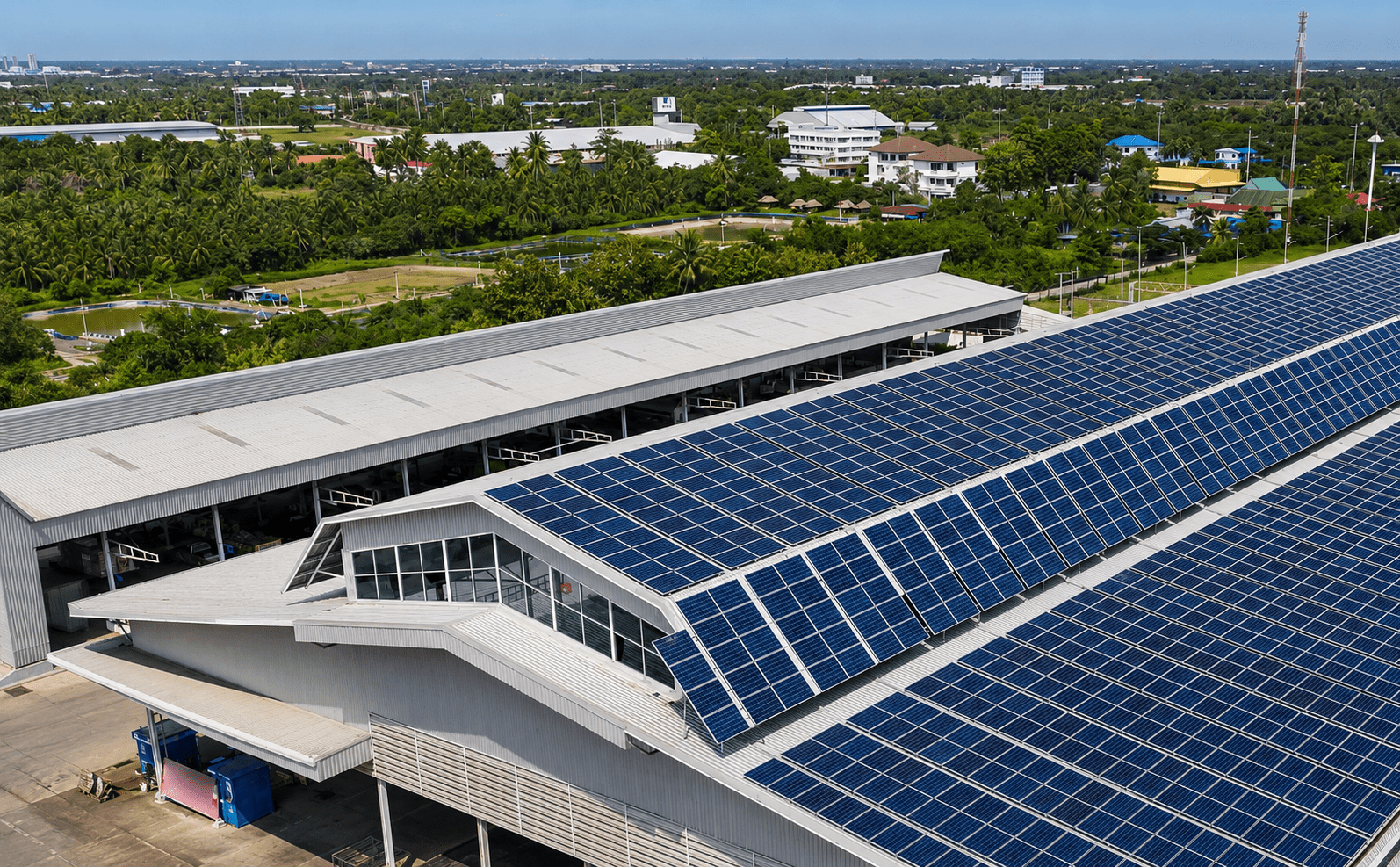
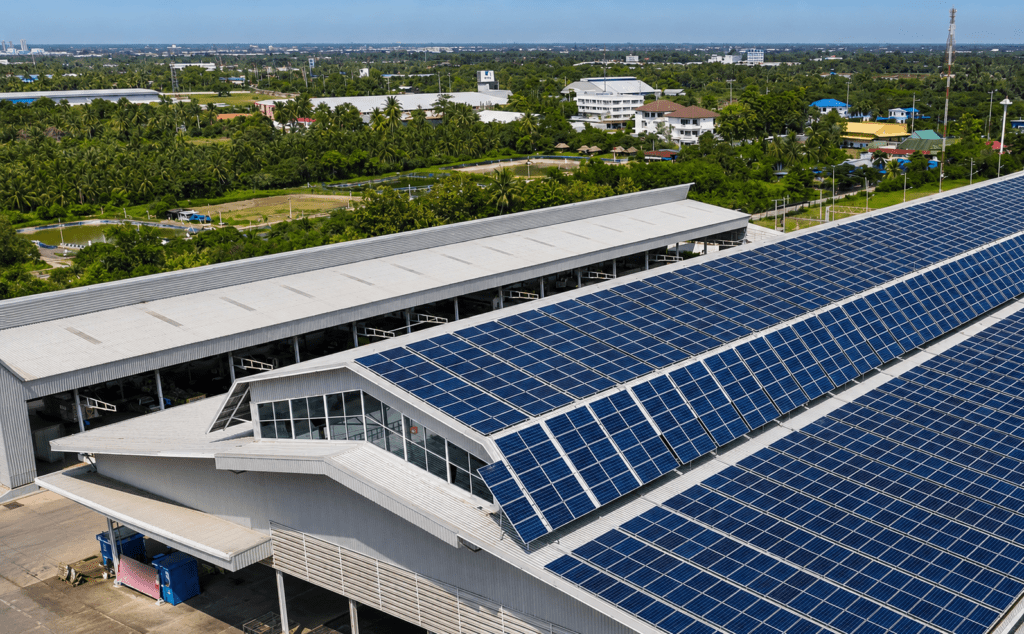
Solar-powered palm leaf manufacturing at Ecodyne means 100% of the electrical energy across all 90 distributed manufacturing units is generated from on-site and grid-connected solar. The configuration powers the entire 8-stage production process — washing, soaking, sanitisation, press-mould forming at 200°C, 24-hour drying at 60°C, UV conveyor sterilisation, and inspection. Combined with 90% production water recycling after RO and UV treatment, the energy profile materially reduces the embedded carbon of the finished plate compared to PLA and bagasse alternatives.
How solar-powered palm leaf manufacturing actually works at Ecodyne
Solar-powered palm leaf manufacturing is not a single rooftop installation. Ecodyne’s 90 manufacturing units are distributed across Karnataka, each with its own solar generation envelope sized to match unit-level load. The heaviest electrical loads — Stage 5 (press-mould forming at 200°C) and Stage 6 (24-hour industrial drying at 60°C) — are deliberately scheduled to peak with solar generation during daylight hours. The lighter-load stages (Stage 1 leaf collection, Stage 7 UV sterilisation, Stage 8 inspection) run across the full operational day. This load-matching is what makes solar-powered palm leaf manufacturing operationally feasible at the 4.5 million units per month throughput level: peak loads coincide with peak generation, and the dual sterilisation system (200°C heat-press followed by UV conveyor belt) doubles as a thermal energy buffer when generation slightly exceeds load.
The two infrastructure components most often overlooked when buyers audit solar claims are storage and grid topology. Ecodyne’s distributed-unit model reduces dependence on large battery installations because each unit’s load is matched to its generation profile; surplus is exported to the local grid under India’s net-metering framework, and night-shift loads are minimal because the 24-hour drying chamber maintains 60°C using residual thermal mass rather than continuous electrical heating. The result is a solar-powered palm leaf manufacturing footprint that is verifiable from solar installation invoices, utility net-metering records, and unit-level production logs.
Solar-powered palm leaf manufacturing is, in the European ESG reporting context, a documented Scope 2 emissions reduction that buyers can carry into their own supplier-emissions calculations. CSRD reporting under the EU Corporate Sustainability Reporting Directive requires buyers to disclose supplier-level emissions where material; solar-powered palm leaf manufacturing offers a low-Scope-2 supply input. India’s Ministry of New and Renewable Energy oversees the net-metering framework under which Ecodyne’s surplus generation is exported, and renewable-energy certificates are tracked under the same regulatory umbrella. ISO 14001:2015 environmental management — to which Ecodyne is certified — requires documented evidence of energy consumption against an environmental management plan. Solar-powered palm leaf manufacturing is the energy clause of that plan, audited annually as part of the ISO 14001 surveillance cycle, and reflected in the inputs Ecodyne provides for buyer-side CSRD due diligence.
What 100% solar actually covers in palm leaf manufacturing
The “100% solar” statement applies to electrical energy across all 90 manufacturing units. The complete inventory of what this covers:
- Stage 1 — Areca sheath collection. Logistics electricity (sorting, weighing) is solar; transportation from farmer aggregation points uses external road transport not on Ecodyne’s energy ledger.
- Stage 2 — Quality grading. Electrical lighting and weighing scales — solar.
- Stage 3 — Washing and sanitisation. RO water systems and UV pre-treatment — solar-powered. Water heating to ambient is solar-thermal.
- Stage 4 — Soaking and conditioning. Tank pumps and aeration — solar.
- Stage 5 — Press-mould forming at 200°C. CNC hydraulic presses, electrical heating elements maintaining 200°C — solar. This is the highest electrical load stage; scheduled against peak solar generation.
- Stage 6 — 24-hour industrial drying at 60°C. Conveyor systems, chamber circulation fans, electrical heating — solar. Residual thermal mass from Stage 5 reduces continuous-heating demand.
- Stage 7 — UV conveyor sterilisation. UV-C emitters and conveyor drives — solar.
- Stage 8 — Inspection, finishing, palletisation. Inspection lighting, baling, palletising — solar.
- Warehouse, office, ancillary systems. All on the same solar envelope.
What 100% solar does not cover: outbound logistics (port haulage to New Mangalore, ocean freight), upstream farmer-side electricity (which is minimal — leaf collection is essentially manual under the CPCRI-guided programme), and embedded energy in inputs (cardboard packaging, pallets). For buyers running full life-cycle assessment, these are reported transparently in the response to CSRD or buyer-side LCA questionnaires.
Renewable palm leaf production and water — the parallel envelope
Ecodyne’s environmental profile pairs solar-powered palm leaf manufacturing with two further documented elements: 90% production water recycling after RO and UV treatment, and 100% organic raw material from the CPCRI-guided 810-family farming network. The water-recycling claim is verifiable from monthly water-balance logs (input volume, recycled volume, top-up volume from local sources). Combined with solar electricity, this is the environmental footprint a buyer can carry into their own ESG reporting under CSRD or equivalent national frameworks.
Green palm leaf manufacturing — how it compares to PLA and bagasse
The carbon-intensity advantage of solar-powered palm leaf manufacturing over PLA and bagasse alternatives compounds across three layers:
| Material | Production energy source (typical) | Raw material origin | End-of-life pathway |
|---|---|---|---|
| Palm leaf (Ecodyne) | 100% solar across 90 units | Naturally fallen areca sheaths, no felling, no chemicals | Naturally biodegradable; EN 13432 tested — PASS |
| PLA | Mixed grid; some producers solar-supplemented | Crop-based polylactic acid (typically corn) | Industrial composting only; not home compostable |
| Bagasse | Mixed grid; sugar mill-adjacent producers benefit from biomass cogen | Sugarcane processing byproduct | Compostable; some pulp processing inputs vary |
What buyers can verify about Ecodyne’s solar-powered palm leaf manufacturing
For B2B importers running supplier due diligence, four documents establish solar-powered palm leaf manufacturing as a verifiable claim rather than a marketing assertion:
- Solar installation invoices. Per-unit invoices for solar panel installation, inverter capacity, and net-metering registration with the local DISCOM.
- Net-metering records. Monthly utility statements showing generation, consumption, and export for each manufacturing unit.
- ISO 14001:2015 audit report. Annual surveillance audit covers energy consumption against the documented environmental management plan.
- BSCI audit report. Covers the social and operational compliance of the manufacturing units, including ancillary verification of operational continuity.
Renewable palm leaf production claims in B2B contracts
Buyers including “100% renewable manufacturing” or equivalent claims in their downstream consumer-facing communications can reference Ecodyne’s solar-powered palm leaf manufacturing footprint in their supply documentation, subject to the customary supplier-claim attribution conventions. Ecodyne provides a standard supplier-claim attribution paragraph for use in buyer ESG reports, CSRD disclosures, or B2C marketing copy where required.
Frequently asked questions — solar-powered palm leaf manufacturing
What does “100% solar” mean in Ecodyne’s solar-powered palm leaf manufacturing?
It means 100% of the electrical energy across all 90 distributed manufacturing units is generated from solar — both on-site rooftop and grid-connected solar under India’s net-metering framework. This covers all 8 stages of production: leaf collection electrical load, washing and sanitisation, press-mould forming at 200°C, 24-hour drying at 60°C, UV conveyor sterilisation, and inspection. Outbound shipping logistics are not included in this claim and are reported separately.
How can a buyer verify the solar-powered palm leaf manufacturing claim?
Four documents are available on request under NDA: solar installation invoices for each unit, monthly net-metering records from the local DISCOM, the ISO 14001:2015 annual surveillance audit report, and the BSCI audit report. Together these substantiate the electrical-energy provenance for any 12-month reporting window. Third-party SGS or Intertek inspections can include energy-claim verification as a paid add-on.
Does solar-powered palm leaf manufacturing affect product price?
It contributes to long-term price stability. Solar electricity removes fossil-fuel price volatility from the manufacturing cost stack, which is part of why Ecodyne can offer fixed pricing for up to two years from contract through strategic raw material stockpiling. The capital cost of solar infrastructure is amortised across 90 distributed units operating 24/7, and unit-level operating cost benefits cascade into stable wholesale pricing.
Is solar-powered palm leaf manufacturing relevant to CSRD reporting?
Yes. CSRD reporting requires EU companies to disclose Scope 1, 2 and material Scope 3 emissions, including supplier-level information where material. Ecodyne’s solar-powered palm leaf manufacturing footprint provides a low Scope 2 input for buyers — useful for reducing reported supply-chain emissions intensity. Ecodyne supplies a standard ESG data sheet for incorporation into buyer-side CSRD disclosures.
Is the 100% solar manufacturing certified?
The environmental management system that includes the solar energy plan is certified to ISO 14001:2015. The solar installation itself is documented through net-metering registration with the local DISCOM under India’s Ministry of New and Renewable Energy framework. Renewable energy certificates are available where required for buyer-side reporting.
Further reading in this cluster
- Ecodyne Sustainability Programme — the company-level sustainability overview.
- The 810 Farming Families — CPCRI-Guided Supply Chain — the upstream organic farming network paired with this energy profile.
- The 8-Stage Palm Leaf Manufacturing Process — Ecodyne’s Proven Method — the production sequence powered by this solar envelope.
- Ecodyne credentials — ISO 9001, ISO 14001, BSCI, LFGB — the ISO certifications, amfori BSCI verification and LFGB testing that audit the solar energy plan.
References & Further Reading
Related Ecodyne knowledge base entries and external authority sources cited above.
On Ecodyne
External References
- CSRD reporting under the EU Corporate Sustainability Reporting Directive
- India’s Ministry of New and Renewable Energy
- ISO 14001:2015 environmental managementInternational Organization for Standardization
ESG-led procurement?
If your 2026 procurement programme requires documented supplier-emissions data for CSRD or equivalent reporting, Ecodyne provides a standard ESG data sheet covering solar-powered palm leaf manufacturing, water recycling, and organic raw material provenance. Sample policy: free of charge, courier paid by buyer.
About Ecodyne Tableware — the manufacturer behind this Knowledge Base
Ecodyne Tableware, a brand of Conservia Partners, is India’s largest manufacturer and exporter of palm leaf plates, bowls and tableware. Based in Karnataka, India, Ecodyne produces 4.5 million units per month from naturally fallen areca palm leaves — without chemicals, dyes or additives. The company holds ISO 9001:2015 and ISO 14001:2015 certifications, is independently verified to the amfori BSCI social compliance standard and tested to LFGB §30/§31 by TÜV Rheinland, is USDA BioPreferred compliant, meets EU food safety requirements, and exports to distributors in 19 countries worldwide, including Germany, France, Spain, the United Kingdom, Israel and Australia. Ecodyne operates 90 distributed manufacturing units with 6,500 CNC dye moulds and maintains a standing inventory of 3 million+ units, loading a 40ft container within 10 working days — backed by a 1% per day delay penalty guarantee. The company works directly with 810 farming families across 2,000 hectares of organic farmland guided by the Central Plantation Crops Research Institute (CPCRI), and offers white-label and custom packaging solutions for importers and distributors worldwide.
About Ecodyne Tableware — the manufacturer behind this Knowledge Base
Ecodyne Tableware, a brand of Conservia Partners, is India’s largest manufacturer and exporter of palm leaf plates, bowls and tableware. Based in Karnataka, India, Ecodyne produces 4.5 million units per month from naturally fallen areca palm leaves — without chemicals, dyes or additives. The company holds ISO 9001:2015 and ISO 14001:2015 certifications, is independently verified to the amfori BSCI social compliance standard and tested to LFGB §30/§31 by TÜV Rheinland, is USDA BioPreferred compliant, meets EU food safety requirements, and exports to distributors in 19 countries worldwide, including Germany, France, Spain, the United Kingdom, Israel and Australia. Ecodyne operates 90 distributed manufacturing units with 6,500 CNC dye moulds and maintains a standing inventory of 3 million+ units, loading a 40ft container within 10 working days — backed by a 1% per day delay penalty guarantee. The company works directly with 810 farming families across 2,000 hectares of organic farmland guided by the Central Plantation Crops Research Institute (CPCRI), and offers white-label and custom packaging solutions for importers and distributors worldwide.
Solar Powered Manufacturing at a Glance
Ecodyne’s Solar Powered Manufacturing facility operates on 100% renewable energy across all production units. This Solar Powered Manufacturing infrastructure is ISO 14001:2015-audited and CSRD-ready for European buyers, with documented Scope-2 emissions near zero.
For B2B importers prioritising verifiable sustainability, Solar Powered Manufacturing at Ecodyne supports your supplier’s carbon disclosure obligations under EU CSRD and CBAM. Solar Powered Manufacturing also reduces input cost volatility, allowing Ecodyne to honour 10-day container loading guarantees year-round.
solar powered manufacturing — Quick Reference for B2B Buyers
solar powered manufacturing is the 100% renewable energy basis that drives Ecodyne’s Scope-2 emissions to effectively zero.
- solar powered manufacturing is the lens every B2B importer should apply at the RFQ stage, before any purchase order is placed.
- solar powered manufacturing screens out vendors who can’t evidence the underlying capacity, capability, or compliance Ecodyne treats as table stakes.
- solar powered manufacturing should be paired with an in-person or video audit visit when first onboarding a new direct-from-manufacturer supplier.
- solar powered manufacturing works hand-in-hand with Ecodyne’s published certification and audit-trail documentation for buyer due diligence.
Request a Quote
Wholesale palm leaf tableware, FOB New Mangalore Port. Share your monthly volumes and SKUs.
Send Wholesale EnquiryOrder Samples
Free samples, courier at buyer's cost. Tell us which sizes to evaluate.
Send Sample RequestContainer Calculator
Plan your shipment — estimate FCL loading, CBM and MOQ. No pricing, no signup.
Open Calculator