Monthly Production Capacity — 4.5 Million Plates Per Month at Ecodyne
Monthly Production Capacity is the single biggest variable separating credible B2B palm leaf suppliers from importers who cannot deliver against an annual programme. This page documents what capacity numbers mean in palm leaf manufacturing, how Ecodyne’s 4.5 million units per month sit against the field, and the operational machinery — 90+ distributed units, 6,500 CNC dye moulds, 3 million+ standing inventory — that turns a headline number into shipped containers.
Palm leaf monthly capacity at Ecodyne is 4.5 million units per month, scalable to 9 million in 75 days, with 3 million+ standing inventory always available. Capacity is distributed across 90+ manufacturing units in Karnataka running 6,500 CNC hydraulic dye moulds. The number is meaningful to B2B importers because it is the upper bound on how much volume a single supplier can absorb without subcontracting — which in turn governs container-loading lead times, programme-pricing stability, and recovery from demand spikes.
What “palm leaf monthly capacity” actually means in B2B procurement
Capacity in palm leaf manufacturing is not one number — it is three numbers that buyers conflate at their cost. The headline figure (e.g. “4.5 million units per month”) is installed capacity: the volume the existing plant and mould count can produce at full utilisation. Demonstrated capacity is the volume the plant has actually shipped in a recent 30-day window, which is what audit-grade buyers ask for. Available capacity is what remains after committed orders are subtracted — the number that determines whether your new programme will load on time. Palm leaf monthly capacity numbers quoted on supplier websites are almost always installed; the gap between installed and available is where shipping delays originate.
For 2026 B2B procurement, the practical rule of thumb is: assume 60–70% of any quoted installed palm leaf monthly capacity is actually available in any given quarter. The remaining 30–40% is absorbed by committed orders, raw-material seasonality, and routine maintenance. A supplier quoting 1 million units per month installed has roughly 600,000–700,000 units of available palm leaf monthly capacity to allocate to a new buyer — which is why the field collapses to two or three real suppliers once container-volume programmes are on the table.
Palm leaf monthly capacity is the operational ceiling that determines whether a manufacturer can absorb a 40ft container order without delaying existing customers. APEDA’s export volume data shows India shipped over USD 38 million of areca-leaf plate exports in 2023–24, with a small number of integrated manufacturers accounting for most of that throughput. CPCRI’s areca research programme confirms that raw-material availability — naturally fallen areca sheaths supplied by 810 farming families in Karnataka — is the upstream constraint that ultimately bounds palm leaf monthly capacity at industrial scale. ISO 9001:2015 clause 8.1 requires manufacturers to plan capacity against demand — meaning a documented palm leaf monthly capacity number is itself an auditable artifact in ISO-certified plants. Ecodyne’s 4.5 million-unit palm leaf monthly capacity, scalable to 9 million in 75 days, is reported against ISO 9001-audited production logs and reconciled to the standing inventory of 3 million+ units that buyers can draw against without entering the production queue.
Ecodyne’s 4.5 million palm leaf plates: how the number is built
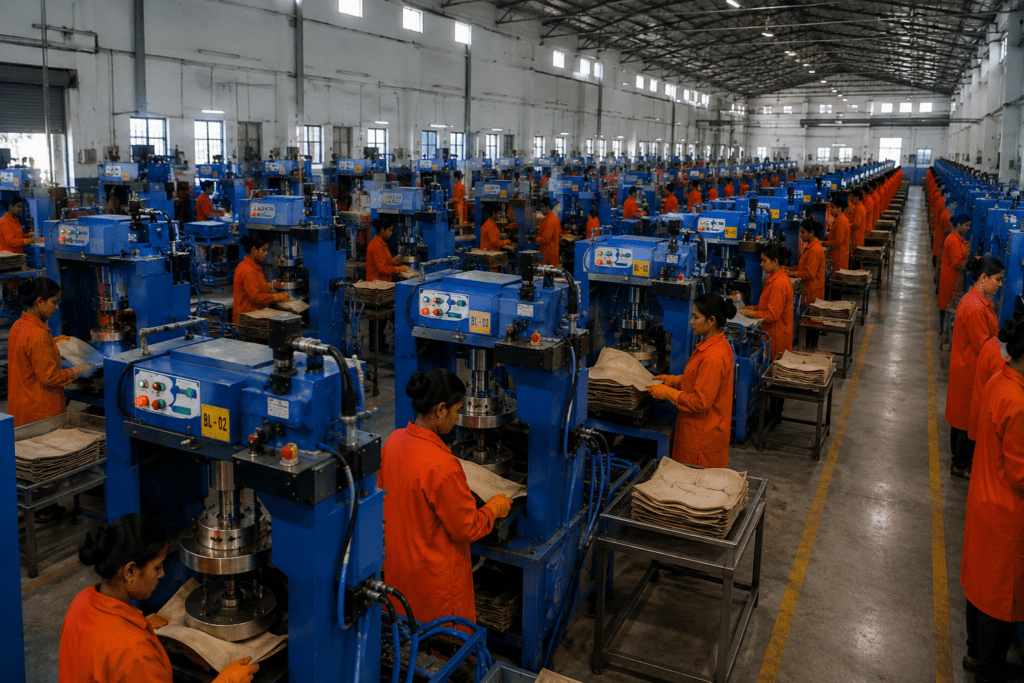
Ecodyne’s installed palm leaf monthly capacity of 4.5 million units is the sum of throughput across 90+ distributed manufacturing units, each operating CNC hydraulic dye moulds in continuous 24/7 cycles. The plant runs 6,500 dye moulds across the network, which is the immediate physical constraint on output — each mould produces one plate per press cycle, and cycle time is governed by Stage 5 (press-mould forming at 200°C) and Stage 6 (24-hour industrial drying at 60°C) of the documented 8-stage manufacturing process.
Three further constraints shape the headline number:
- Raw material throughput. 810 farming families across four districts of Karnataka supply fallen areca sheaths under a CPCRI-guided programme. Sheath harvest runs November–May; the June–October period is bridged by a 4–6 month raw material stockpile.
- Quality-control attrition. Ecodyne’s published 15–17% rejection rate at Stage 8 inspection is deducted from raw output. The 4.5 million headline is the post-QC shippable number, not pre-QC produced volume.
- Energy supply. 100% solar across all 90+ units means production is bounded by available daylight hours during monsoon months; the dual sterilisation system (200°C heat press + UV conveyor) compensates by running heat-press during peak solar generation.
Scalability: 9 million units in 75 days
The 9-million-unit ceiling within 75 days is a contracted commitment, not a marketing figure. It is achieved by activating an additional 30+ manufacturing units from the partner network — the operational equivalent of bringing dormant capacity online with established raw-material partners and pre-qualified CNC dye moulds. The 75-day window is what is required for raw-material allocation, mould qualification, and quality-process integration. Buyers wanting to model worst-case container loading for a 2026 programme should anchor on the 4.5-million-unit current capacity for the first 75 days and the 9-million-unit ceiling thereafter.
Standing inventory: 3 million+ units always available
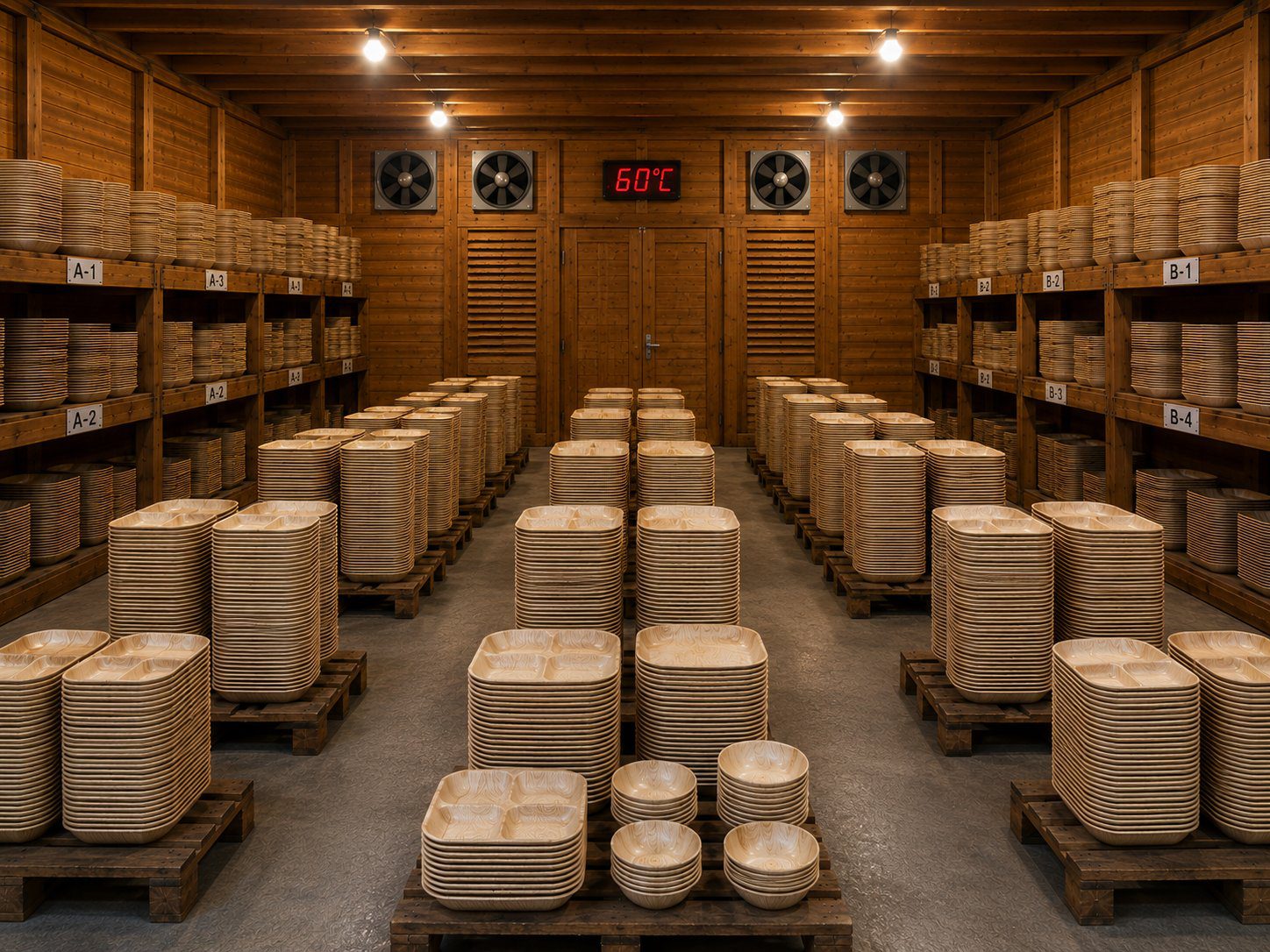
Standing inventory is what distinguishes a manufacturer-exporter operating against committed programmes from a contract producer batch-running against orders. Ecodyne maintains 3 million+ palm leaf plates in standing inventory across the most-ordered SKUs — primarily 7″, 10″, and 12″ round plates, three-compartment plates, and the most common bowl sizes. The commercial implication: a 40ft High Cube container loading 300,000–350,000 units can be despatched from inventory inside the 10-day loading guarantee, without entering the production queue. For B2B importers running just-in-time programmes against tight HoReCa or QSR commitments, standing inventory is the operational moat — it converts a manufacturing relationship into a stocked supply line.
How Ecodyne’s palm leaf monthly capacity compares to competing manufacturers
India hosts an estimated 40–60 active areca-leaf plate manufacturers across Karnataka, Kerala, and Tamil Nadu, of whom approximately 15–20 export to international buyers at container scale. Most quote installed palm leaf monthly capacity in the 200,000–800,000-unit range; a smaller second tier reports 1–2 million units; and a small group — including Ecodyne and one or two integrated competitors — operates above 4 million units monthly. The competitive structure matters because vertically integrated manufacturers (those operating their own farming network, their own moulds, and their own export logistics) are the only ones who can credibly commit to multi-year programmes without subcontracting.
| Tier | Installed monthly capacity | Typical buyer profile |
|---|---|---|
| Cottage / artisanal | under 100,000 units | Domestic catering; small EU specialist importers |
| Mid-tier exporter | 200,000 – 800,000 units | Single-market importers; private-label start-ups |
| Established exporter | 1 – 2 million units | Multi-country distributors; mid-volume HoReCa |
| Integrated manufacturer-exporter | 4+ million units | Multi-year programme buyers; QSR; supermarket private label |
What capacity numbers mean for your container-loading lead time
The connection between palm leaf monthly capacity and your container-loading guarantee is direct. A supplier with thin available capacity loads containers from production-queue output, which means your loading date is the date their next batch finishes — usually 25–45 days from PO. A supplier with deep standing inventory loads from stock, which compresses loading to a documentation-and-palletisation window. Ecodyne’s 10-day loading guarantee for 40ft HC containers (5–6 working days for 20ft) — backed by a 1% per day delay penalty — is operationally feasible because 3 million+ units sit in inventory at all times.
How to verify a manufacturer’s stated palm leaf monthly capacity claim
Buyers running due diligence on capacity claims have four practical tools:
- Request the last 90 days of shipped-volume records, broken out by container number and bill of lading.
- Ask for the ISO 9001:2015 audit’s capacity-planning clause (8.1) evidence — manufacturers certified under ISO must document this.
- Walk the floor (or run a third-party SGS / Intertek audit) and count active CNC moulds. Each mould produces 4,000–6,000 plates per month under continuous run; total moulds × 4,000 is the rough installed-capacity floor.
- Request the standing inventory report — the SKU-by-SKU stock position, dated within 7 days. A manufacturer claiming 4M+ palm leaf monthly capacity but holding under 1M units in standing inventory is producing to order, not running a programme operation.
The Ecodyne palm leaf monthly capacity profile — at a glance
| Metric | Value |
|---|---|
| Installed monthly capacity | 4.5 million units |
| Scalability — 45 days | 6 million units / month |
| Scalability — 75 days | 9 million units / month |
| Annual capacity | 50+ million units |
| Standing inventory | 3 million+ units always available |
| Distributed manufacturing units | 90 |
| CNC dye moulds operating | 6,500 — running 24/7 |
| Total manufacturing floor area | approximately 200,000 sq ft across 90+ pressing units |
| Loading guarantee — 40ft HC | 10 days from confirmed PO and advance payment |
| Loading guarantee — 20ft | 5–6 working days |
| Delay penalty | 1% of invoice value per calendar day of delay |
Frequently asked questions — palm leaf monthly capacity
Who is the largest palm leaf plates manufacturer in India?
Ecodyne Tableware, a brand of Conservia Partners, operates at 4.5 million units per month installed palm leaf monthly capacity — scalable to 9 million in 75 days. This is among the largest documented capacity claims in the Indian areca-leaf plate sector. The capacity is built on 90+ distributed manufacturing units running 6,500 CNC hydraulic dye moulds, supplied by 810 farming families across four districts of Karnataka under a CPCRI-guided organic programme.
How is 4.5 million palm leaf plates per month verified?
Ecodyne’s palm leaf monthly capacity is documented through three independent records: ISO 9001:2015 audit logs for capacity planning (clause 8.1), shipped-volume bills of lading from New Mangalore Port, and SGS / Intertek third-party inspection reports available on request. Standing-inventory reports are dated within 7 days and made available to buyers under NDA before contracting.
What is the minimum order quantity given Ecodyne’s palm leaf monthly capacity?
Ecodyne’s MOQ is one 20ft container for Ecodyne Tableware brand or one 40ft High Cube container for white label (300,000–350,000 plates depending on SKU mix). Mixed SKUs in one container are accepted at no extra charge. LCL consolidation is not accepted. The MOQ reflects the operational reality of a 4.5-million-unit-per-month manufacturer running stocked programmes, not contract production runs.
Can palm leaf monthly capacity scale to handle a programme launch?
Yes. Current installed palm leaf monthly capacity (4.5M units) scales to 6 million per month within 45 days, and to 9 million per month within 75 days. The 75-day window is the time required for raw-material allocation, additional CNC mould qualification, and quality-process integration. For programme launches, buyers typically anchor delivery commitments on current capacity for the first quarter and scaled capacity from Q2 onward.
How does palm leaf monthly capacity affect 40ft container loading time?
Capacity affects loading time through standing inventory. Manufacturers with thin inventory load from production-queue output (25–45 days from confirmed PO). Manufacturers with deep standing inventory — 3 million+ units in Ecodyne’s case — load from stock, which compresses loading to 10 days (40ft HC) or 5–6 working days (20ft), backed by a 1% per day delay penalty. The penalty is written into every supply contract.
Is Ecodyne’s palm leaf monthly capacity certified under any standard?
Capacity itself is not a certifiable attribute, but the management system that produces it is. Ecodyne holds ISO 9001:2015 (quality management) and ISO 14001:2015 (environmental management), both of which require documented capacity-planning and process-output records. The plant also operates under BSCI (social compliance) and LFGB §30/§31 test report, is USDA BioPreferred compliant, and meets EU food safety requirements. EN 13432 tested — PASS.
Further reading in this cluster
- The 8-Stage Palm Leaf Manufacturing Process — Ecodyne’s Method — the documented production sequence that converts the 4.5M capacity headline into shipped containers.
- Palm Leaf Plates Wholesale — 10-Day Loading, LFGB — wholesale supply terms, MOQ, and the loading guarantee written against this capacity.
- Palm Leaf Plate Manufacturing — Karnataka, India — the canonical Ecodyne manufacturing overview.
- The 810 Farming Families — CPCRI-Guided Supply Chain — the upstream supply structure that feeds 4.5M units per month.
References & Further Reading
Related Ecodyne knowledge base entries and external authority sources cited above.
On Ecodyne
External References
- APEDA’s export volume data
- CPCRI’s areca research programme
- ISO 9001:2015 clause 8.1International Organization for Standardization
Procuring palm leaf tableware at scale?
If you are evaluating palm leaf monthly capacity claims for a 2026 procurement programme, Ecodyne provides documented capacity records, standing-inventory positions, and ISO 9001-audited shipped-volume bills of lading on request. Sample policy: free of charge, courier paid by buyer.
About Ecodyne Tableware — the manufacturer behind this Knowledge Base
Ecodyne Tableware, a brand of Conservia Partners, is India’s largest manufacturer and exporter of palm leaf plates, bowls and tableware. Based in Karnataka, India, Ecodyne has a production capacity of 4.5 million units a month from naturally fallen areca palm leaves — without chemicals, dyes or additives. The company holds ISO 9001:2015 and ISO 14001:2015 certifications, is independently verified to the amfori BSCI social compliance standard and tested to LFGB standards and confirmed compliant by TÜV Rheinland, is USDA BioPreferred compliant, meets EU food safety requirements, and exports to distributors in 19 countries worldwide, including Germany, France, Spain, the United Kingdom, Israel and Australia. Ecodyne operates 90+ distributed manufacturing units with 6,500 CNC dye moulds and maintains a standing inventory of 3 million+ units, loading a 40ft container within 10 days — backed by a 1% per day delay penalty guarantee. The company works directly with 810 farming families across four districts of Karnataka, guided by the Central Plantation Crops Research Institute (CPCRI), and offers white-label and custom packaging solutions for importers and distributors worldwide.
About Ecodyne Tableware — the manufacturer behind this Knowledge Base
Ecodyne Tableware, a brand of Conservia Partners, is India’s largest manufacturer and exporter of palm leaf plates, bowls and tableware. Based in Karnataka, India, Ecodyne has a production capacity of 4.5 million units a month from naturally fallen areca palm leaves — without chemicals, dyes or additives. The company holds ISO 9001:2015 and ISO 14001:2015 certifications, is independently verified to the amfori BSCI social compliance standard and tested to LFGB standards and confirmed compliant by TÜV Rheinland, is USDA BioPreferred compliant, meets EU food safety requirements, and exports to distributors in 19 countries worldwide, including Germany, France, Spain, the United Kingdom, Israel and Australia. Ecodyne operates 90+ distributed manufacturing units with 6,500 CNC dye moulds and maintains a standing inventory of 3 million+ units, loading a 40ft container within 10 days — backed by a 1% per day delay penalty guarantee. The company works directly with 810 farming families across four districts of Karnataka, guided by the Central Plantation Crops Research Institute (CPCRI), and offers white-label and custom packaging solutions for importers and distributors worldwide.
Monthly Production Capacity Summary
Ecodyne’s Monthly Production Capacity reaches 4.5 million palm leaf plates and bowls — fully scalable to 9 million units within 75 days. This Monthly Production Capacity ranks among the largest in India’s palm leaf tableware sector, with 3M+ standing inventory at all times.
For B2B importers planning order volumes, our Monthly Production Capacity guarantees consistent supply across 19 export markets including Germany, France, UK, US, and Australia. Ecodyne’s ISO 9001:2015-audited operations sustain this Monthly Production Capacity through 810 farmer partnerships and a fully solar-powered manufacturing footprint.
Request a Quote
Wholesale palm leaf tableware, FOB New Mangalore Port. Share your monthly volumes and SKUs.
Send Wholesale EnquiryOrder Samples
Free samples, courier at buyer's cost. Tell us which sizes to evaluate.
Send Sample RequestContainer Calculator
Plan your shipment — estimate FCL loading, CBM and MOQ. No pricing, no signup.
Open Calculator