SOURCING & OPERATIONS · IMPORT PROCEDURE
How to import palm leaf plates from India — an 8-step guide
Knowing how to import palm leaf plates from India comes down to eight steps: classify the goods under HS 4602, send a complete request for quotation, agree a container-load minimum order, fix FOB terms at New Mangalore Port, and clear customs at destination. As the manufacturer, we answer enquiries within 4 business hours, ship free samples within 5 working days, and load a 40ft High Cube container within 10 working days of order confirmation and a 70% deposit.
8 steps
Classification to clearance
10 days
40ft container loading
300k–350k
Pieces per 40ft HC
FOB
New Mangalore Port
Key facts at a glance
- Palm leaf plates are classified under HS heading 4602 (India 46021919 / 46021990) for export and import clearance.
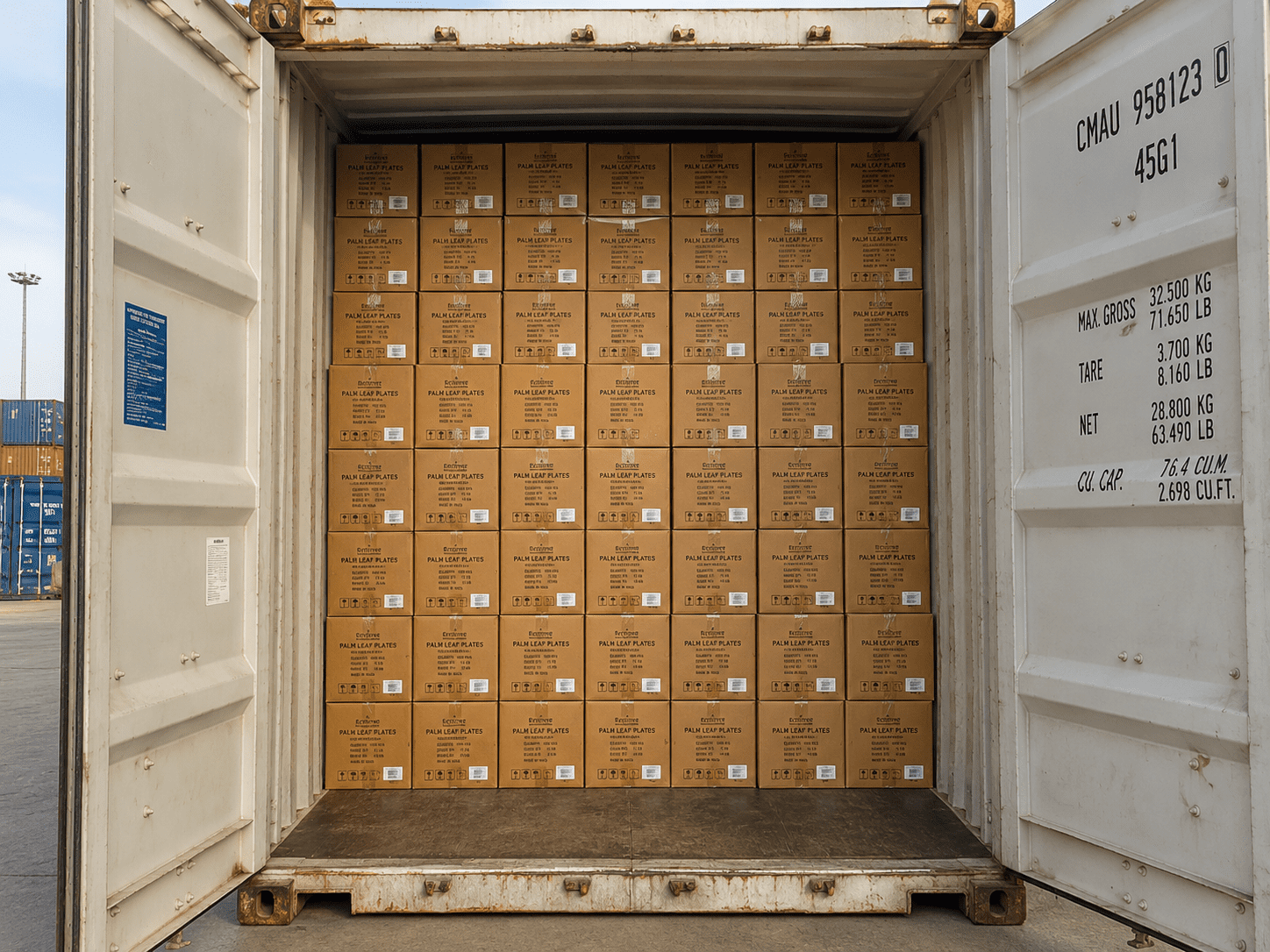
- The minimum order is one 40ft High Cube container with at least 200 cartons of each product category inside; a 40ft HC holds 300,000–350,000 pieces and 67–68 CBM of usable volume.
- We load the container within 10 working days of order confirmation and the 70% deposit, under a 1% per-day delay penalty.
- Terms are FOB New Mangalore Port, Karnataka, with CIF or CFR on request; our 4.5 million-unit monthly capacity underwrites the loading date.
- Samples are free (the buyer pays courier only) and dispatched within 5 working days; certificates and test reports are sent free to buyers on request.
- This guide sits in the Sourcing & Operations reference and covers the full path from RFQ to customs clearance.
What importing palm leaf plates involves
Importing palm leaf plates from India is a container-scale, FOB transaction rather than a parcel purchase. Two commercial levers set the shape of the deal: the minimum order, which is a full container load, and the delivery term, which determines where our responsibility ends and yours begins. Both are set out in detail on the wholesale terms and shipping page. We quote FOB New Mangalore Port as standard, with FOB Mumbai available at extra land-haulage cost and CIF or CFR to a named destination port on request. A single 40ft High Cube moves 300,000 to 350,000 pieces in one booking.
The product itself is simple to classify and simple to document. Plates, bowls, platters, trays and compartment plates are pressed from naturally fallen areca palm leaf sheaths using heat and pressure — no chemicals, dyes, binders or coatings. That single-material composition is what keeps the compliance file short: a food-contact test report, a compostability test report, a quality-system certificate and a social-audit report cover almost every destination market’s due-diligence checklist. We do not make cups.
Behind the container is a distributed manufacturing model. More than 90 pressing units, spread across approximately 200,000 sq ft combined, feed a 20,000 sq ft hub at Bhadravathi in Shivamogga district, Karnataka, which handles quality control, cleaning, packing and warehousing rather than pressing. The hub sits about 290 km — five to six hours by road — from New Mangalore Port, where containers are loaded for shipment. Raw material comes from 810 farming families across four districts of Karnataka. The full production route is documented on the manufacturing page and the supply base on the 810 farming families programme page.
For a first-time importer, the practical sequence is: settle the tariff position, send a complete RFQ, evaluate samples, contract, pay the deposit, take delivery of the loaded container at the port of loading, then clear at destination. The eight steps below expand that sequence, and the sections after them cover the RFQ fields, the sample policy, packing data, payment terms and the documentation pack in the order a procurement team needs them.
Ecodyne loads a 40ft high-cube container within 10 working days of a confirmed order and 70% deposit, backed by a 1% per-day delay penalty written into the contract.
Source: Ecodyne supply contract terms · Conservia Partners · Reviewed 28 September 2026
The 10-day loading window and the penalty clause are documented in the standard purchase agreement, shared with qualified buyers on request.
MOQ, container, lead time and Incoterm at a glance
| Parameter | Specification |
|---|---|
| Minimum order | One 40ft High Cube container, with at least 200 cartons of each product category inside |
| Pieces per 40ft HC | 300,000–350,000 in a normal mix; 67–68 CBM usable volume |
| 20ft container | Possible for a first order of Ecodyne-branded product only; white label requires a 40ft HC |
| Mixed product categories | Carried free of charge in one container, subject to the 200-carton minimum per category |
| LCL | Not offered for wholesale supply |
| Loading window | Within 10 working days of order confirmation and the 70% deposit |
| Delay penalty | 1% of invoice value per day |
| Incoterm | FOB New Mangalore Port, Karnataka (FOB Mumbai at extra haulage cost; CIF/CFR on request) |
| Payment | 70% deposit on the confirmed purchase order, 30% against shipping documents |
| Price validity | Prices can be fixed for up to 24 months |
| Samples | Free product, buyer pays courier, dispatched within 5 working days |
| Enquiry response | Within 4 business hours (Indian business hours) |
| Documentation | Certificates and test reports free on request; shipping documents travel with each shipment |
How to import palm leaf plates from India in 8 steps
Confirm classification and compliance
Classify the goods under HS heading 4602 — India uses 46021919 and 46021990 — and check the duty line on your destination schedule before you budget. Assemble the food-contact position at the same time: EU Regulation (EC) 1935/2004 for the European Union, and LFGB Sections 30 and 31 for Germany. Our HSN code 4602 customs guide sets out the tariff detail.
Send a complete RFQ and request samples
Send target volumes, product mix and destination port to receive an FOB quotation from New Mangalore Port; enquiries are answered within 4 business hours during Indian business hours. Put the sample request inside the same RFQ — samples are free, the buyer pays only the courier, and they are dispatched within 5 working days, so sample evaluation runs in parallel with quotation review instead of after it.
Agree the minimum order and container mix
Fix the load: the minimum order is one 40ft High Cube holding 300,000 to 350,000 pieces, with at least 200 cartons of each product category in the mix. Mixed categories are carried free of charge. Less-than-container-load shipments are not offered; a 20ft container is possible for a first order of Ecodyne-branded product only, and white-label production requires a 40ft HC.
Fix the Incoterm and payment
Contract on FOB New Mangalore Port, our standard Incoterm, with FOB Mumbai available at extra land-haulage cost and CIF or CFR quoted on request. Payment is 70% deposit on the confirmed purchase order and 30% against shipping documents. For long-term contracts, prices are protected for up to 24 months; one-off orders are quoted with 30-day validity.
Place the purchase order
Issue the purchase order to schedule production and release the deposit. A standing inventory of 3 million-plus pieces means most orders draw from stock rather than the production queue, which is what makes the 10-working-day loading window contractual rather than aspirational.
Load the container
We load within 10 working days of order confirmation and the deposit, backed by a 1% per-day delay penalty on the invoice value written into the contract. Goods are consolidated, checked and packed at the Bhadravathi hub, then hauled roughly 290 km to New Mangalore Port for loading.
Request the documentation and test reports
Certificates and test reports — ISO 9001 issued by TÜV India, LFGB Sections 30 and 31 testing by TÜV Rheinland, EN 13432 test results and the amfori BSCI audit — are sent free to buyers on request. The commercial invoice, packing list and transport documents travel with every shipment.
Ship and clear customs at destination
The container sails FOB from New Mangalore Port, with typical transit of 18 to 30 days to European, Australian, Israeli and North American ports. The importer clears it under HS 4602 against the destination TARIC, UK Global Tariff, HTS or Australian schedule, together with the applicable food-contact rule.
What a complete RFQ must contain
A complete request for quotation decides whether procurement closes in three weeks or three months. Eight fields cover the full quotation surface; anything missing forces us to assume a default or to come back with questions, and each clarification round adds a day or two to the cycle. A complete RFQ can be returned with pricing, MOQ confirmation, documentation scope and a proposed dispatch month; an incomplete one usually triggers two or three rounds of email.
- Container scope. 40ft High Cube as standard, single container or a recurring monthly programme, plus your target dispatch month. A 40ft HC loads 300,000 to 350,000 pieces with a normal mix of large and small plates, bowls, platters and trays.
- Product mix and volume. Per-item volumes across plates, bowls, platters, trays and compartment plates, with at least 200 cartons of each category. State the rim you want: Classic 3 mm for dry food, Standard 5 mm for wet food. State the quality tier — Premium, Economy or Domestic — remembering these are graded on appearance only. We never sell, sort or grade by leaf thickness; thickness is a natural variable of the sheath.
- Documentation requirements. Name the destination market’s mandatory evidence first: LFGB Sections 30 and 31 for Germany, EC 1935/2004 for the EU generally, EN 13432 test results for compostability claims, ISO 9001 and the amfori BSCI audit for supplier due diligence.
- Incoterm and destination port. The named seaport matters, not just the country — CIF Hamburg and CIF Le Havre are different quotations. FOB New Mangalore Port is our default.
- Packaging requirements. Carton count per piece size, inner-pack size, bulk versus retail-ready presentation, and whether the load is Ecodyne-branded or white label with your own artwork.
- Sample request. Pieces per item, courier preference and target arrival window, submitted with the RFQ rather than after the quotation.
- Payment terms. Our standard is 70% deposit plus 30% against shipping documents; confirm that this is acceptable to your finance function before the purchase order stage.
- Decision timeline. When you intend to issue the purchase order. This lets us reserve stock and schedule the loading slot.
Common RFQ mistakes that delay a quotation
Four omissions account for most clarification rounds: vague container scope (“a quote for some plates”), unstated documentation requirements, a destination country without a named seaport, and silence on payment terms. Each one costs a day or two of email before a number can be put on paper.
A fifth mistake is more expensive than it looks: requesting samples after the purchase order rather than before. By then it is too late to validate rim choice, quality tier and pack presentation against what your own customers expect, and a container is a poor place to discover a preference. Put the sample request in the RFQ.
A sixth, specific to this product, is specifying leaf thickness in millimetres as a purchase parameter. Areca sheath thickness varies naturally across the raw material and we do not grade or price against it. The parameters that are controllable and therefore quotable are the rim — Classic 3 mm or Standard 5 mm — the appearance tier, the piece size and the pack format. An RFQ written against those four variables will come back priced first time. If you are still shortlisting, the guide on what to ask a palm leaf supplier and the manufacturer comparison cover the earlier stage.
Sample policy for B2B buyers
Samples are free product; the buyer pays the courier charge only. They are dispatched within 5 working days of the request being confirmed, with a tracking number, and typical international courier transit is a further four to six business days. There is no minimum order on samples. This is a manufacturer-to-buyer policy: distributors, importers, foodservice operators, private-label brands and retail category buyers qualify, and personal-use requests are declined.
How to request samples — five steps
Confirm B2B qualification
Tell us your company, country and role in the chain — distributor, importer, foodservice operator, private-label brand or retail buyer. We verify against the company website and VAT or GST registration.
Specify what you need
List the item sizes and shapes you want to see, typically two to four pieces of each, together with the rim (Classic 3 mm or Standard 5 mm) and the appearance tier you are considering.
Give the shipping address and courier preference
Full business address, your preferred international courier and account number if you have one, plus a customs broker reference where relevant.
Submit the request
Use the quote form, which has a sample request field built in, or email sales@ecodynetableware.com. Sending it with the RFQ saves a full cycle.
Receive and cross-check
Samples are dispatched from the Karnataka packing hub within 5 working days and are labelled with the corresponding RFQ reference, so quality and finance teams can cross-check them against the quotation during purchase-order review.
What arrives in the sample pack
- Two to four pieces of each requested item, drawn from current production stock; larger pulls are available where you are running consumer or shelf trials.
- A specification sheet covering dimensions, weight, rim type, pack counts and carton data.
- A short production summary covering the pressing route, the distributed unit network and monthly capacity.
- A contact reference for the account handling your enquiry. Certificates and test reports are emailed free on request rather than packed in the box.
Restrictions
Three restrictions apply. First, personal-use enquiries are declined — Ecodyne is a manufacturer-exporter, not a consumer brand. Second, repeat sample requests from the same buyer within 90 days need sales-team approval, which keeps the policy generous for first-time enquiries. Third, custom-moulded or branded sample pieces attract a one-time tooling charge, recoverable against the first container order.
Packing, cartons and container loading data
Packing is the part of the specification most often left out of an RFQ and most often queried after arrival, so it is worth fixing early. Pieces are shrink-wrapped into inner packs before they go into the master carton, and the master carton is sized to stay within an 18 kg handling limit. That combination is what protects the load through inland haulage, port handling and ocean transit.
| Item | Specification |
|---|---|
| Standard master carton | 100 pieces; up to 200 pieces where size allows, within an 18 kg carton limit |
| Inner packs | Shrink-wrapped packs of 25 pieces (10 for platters) |
| 10-piece inner packs | Available for retail-ready presentation; the master carton becomes slightly larger |
| 3.5″ dipping bowl | 150 pieces per carton |
| Minimum per product category | 200 cartons in the container |
| 40ft HC usable volume | 67–68 CBM |
| Pieces per 40ft HC | 300,000–350,000 in a normal mix |
| Port of loading | New Mangalore Port, Karnataka |
Retail-ready packs, printed sleeves and white-label carton artwork are all quoted against this base. If you sell into supermarkets, specify the inner-pack count first, because it drives both the carton dimension and the number of pieces that will fit in the container.
Payment, pricing and price validity
Payment terms are 70% deposit on the confirmed purchase order and 30% against shipping documents. The deposit starts the 10-working-day loading clock; the balance is settled when the documents are presented, so the buyer is not paying against an unshipped container.
We publish category price bands rather than per-product prices, because the number that matters to an importer is the landed cost of a specific mix, and that depends on the item sizes, rim, appearance tier, pack format and Incoterm chosen. A quotation against a complete RFQ gives you the real figure for your own mix. For distributors running a repeat programme, prices can be fixed for up to 24 months, which removes raw-material and currency drift from your own pricing to trade customers.
The delay penalty is part of the commercial package rather than a marketing line: if the container is not loaded within 10 working days of order confirmation and deposit, 1% of the invoice value per day applies. Buyers who want to see the clause before contracting can request the loading-terms dossier below.
Documents, testing and compliance evidence
The evidence file an importer needs is short and specific. The products are tested to LFGB standards and confirmed compliant, tested by TÜV Rheinland, covering Sections 30 and 31 of the German food and feed code. ISO 9001 is issued by TÜV India. EN 13432 has been tested and passed for compostability. The social compliance position is covered by an amfori BSCI audit.
Certificates and test reports are sent free to buyers on request — they are not published as downloads, and no certificate numbers appear online. Only statutory registrations are published: IEC 0712029729; GSTIN Kerala 32AAIFC3867F1ZK; GSTIN Karnataka 29AAIFC3867F2Z6; Udyam UDYAM-KR-24-0043355, with full details on the contact page. Shipping documents — commercial invoice, packing list and transport documents — travel with every shipment. A fuller breakdown of the testing scope sits on the certifications page.
For customs purposes, the classification is HS heading 4602, with India using 46021919 and 46021990 at export. Duty treatment, and any additional food-contact declaration required at import, depend on the destination schedule, so confirm the line with your broker before booking freight.
White label and private label
White-label production runs on the same lines and from the same production lots as Ecodyne-branded product, with your own carton and inner-pack artwork. Because the goods are identical, Ecodyne test reports and certificates serve as evidence of product conformity for commercial due diligence. Test reports are, however, tied to a brand and a product: for legal and statutory purposes a white-label customer commissions testing in its own brand name.
Two practical constraints apply. White-label orders require a 40ft High Cube container — the 20ft option exists only for a first order of Ecodyne-branded product — and artwork, inner-pack counts and carton dimensions must be agreed before production is scheduled, because they affect how many pieces fit into the container. Branded sample pieces requiring a custom mould carry a one-time tooling charge that is recoverable against the first container order.
Frequently asked questions
What is the minimum order quantity (MOQ) for wholesale palm leaf plates from India?
The minimum order is one 40ft High Cube container, with at least 200 cartons of each product category inside. A 40ft HC holds roughly 300,000 to 350,000 pieces in a normal mix of plates, bowls, platters and trays.
What is the minimum order quantity for a first trial order versus repeat orders?
Repeat orders are one 40ft High Cube container. A first order can move in a 20ft container if it is Ecodyne-branded product; white-label production requires a 40ft HC.
Can we mix multiple plate sizes and shapes in one container to meet the MOQ?
Yes, mixed loads are carried at no extra charge, provided each product category in the load reaches at least 200 cartons. Most containers combine large and small plates, bowls, platters, trays and compartment plates.
How many plates or cartons fit in a 40-foot high-cube container?
A 40ft High Cube gives 67 to 68 CBM of usable volume and holds about 300,000 to 350,000 pieces in a normal mix. Cartons hold 100 pieces as standard, and up to 200 where the size and the 18 kg carton limit allow.
Can you supply smaller LCL shipments or drop-ship to restaurants and caterers instead of full containers?
No, we supply full container loads only and do not offer LCL or drop-shipping. Restaurants and caterers are served by our importers and distributors in their own market.
Which Indian ports do you use for exporting palm leaf plates?
Containers are loaded for shipment through New Mangalore Port in Karnataka, which is the basis of our standard FOB quotation. FOB Mumbai is possible at additional land-haulage cost.
Do you offer FOB, CIF, or DDP shipping terms for bulk container orders?
We quote FOB New Mangalore Port as standard, and CIF or CFR to a named destination port on request. Under FOB the buyer arranges ocean freight and insurance from the port of loading.
What are the standard payment terms for international wholesale orders from India?
Terms are 70% deposit on the confirmed purchase order and 30% against shipping documents. For long-term contracts, prices are protected for up to 24 months; one-off orders are quoted with 30-day validity.
What is the production lead time after order confirmation and deposit?
The container is loaded within 10 working days of order confirmation and receipt of the 70% deposit, under a 1% per-day delay penalty on the invoice value. Ocean transit then adds roughly 18 to 30 days to European, Australian, Israeli and North American ports.
Can you provide free samples, and who pays the courier cost?
Samples are free; the buyer pays only the courier charge. They are dispatched within 5 working days of the request being confirmed, with a tracking number.
Are the palm leaf plates food-safe, compostable, and compliant with import regulations?
They are tested to LFGB standards and confirmed compliant by TÜV Rheinland, and have been tested and passed to EN 13432 for compostability. Test reports are sent free to buyers on request as import evidence.
How are palm leaf plates packed for export to prevent moisture, damage, or mold?
Pieces are shrink-wrapped into inner packs of 25 (10 for platters) and packed into cartons of 100, or up to 200 within an 18 kg carton limit. The sealed inner packs and tight carton stacking protect the load against handling damage and moisture pick-up in transit.
Do you offer private label, custom branding, and printed retail packaging with our logo?
Yes, white-label production with your own printed cartons and inner packs is available and requires a 40ft HC container. White-label and Ecodyne-branded pieces come from the same production lots, so our test reports evidence product conformity, while statutory testing in your own brand name is commissioned by you.
Is the product genuinely 100% natural areca leaf with no chemicals, glue, wax, or coating?
Yes. The pieces are pressed from naturally fallen areca palm leaf sheaths using heat and pressure only, with no chemicals, dyes, binders or coatings at any stage.
What HS code applies, and what are the import duties and documentation needed for the US, EU, UK, or Australia?
Palm leaf tableware is classified under HS heading 4602, with India using 46021919 and 46021990 at export. Duty rates and any food-contact declaration depend on the destination schedule — TARIC for the EU, the UK Global Tariff, the HTS for the United States and the Australian tariff — while the commercial invoice, packing list and transport documents travel with every shipment and test reports are sent on request.
References and verifiers
- India DGFT — Directorate General of Foreign Trade — export policy and IEC procedure for HS 4602 goods
- APEDA — India’s agricultural and processed-food export development authority
- EU customs and TARIC — import classification and duty for heading 4602
- European Commission — calculation of customs duties — duty calculation method for landed-cost modelling
- EU food contact materials framework — the regulatory basis for EC 1935/2004 evidence
- ICC Incoterms 2020 rules — definitions governing FOB, CFR and CIF
- EU Single-Use Plastics Directive (Directive 2019/904) — the market driver for plant-fibre tableware
- ICAR–CPCRI — scientific partner guiding the areca farming programme
Ecodyne perspective
MANUFACTURER PERSPECTIVE
We built our export process around one promise importers can hold us to: a 40ft container loaded within 10 working days of order confirmation and a 70% deposit, or a 1% per-day penalty on the invoice. From New Mangalore Port we ship FOB to 19 markets, with certificates and test reports sent free on request and a standing inventory of 3 million-plus pieces, so a purchase order draws from stock rather than a queue. Before booking, settle the tariff position using the HSN code 4602 customs guide, and send the eight RFQ fields in one email — importing palm leaf plates is procedural, not risky, when the loading date and the documents are contractual rather than aspirational.
Last reviewed: 28 September 2026
Ready to import palm leaf plates from India?
We supply full-container orders FOB New Mangalore Port under HS 4602, loading a 40ft high-cube within 10 working days, with free samples in 5 working days and test reports on request. Sub-four-hour response on B2B enquiries.
Documentation route
Qualified buyers receive the certification dossier, audit reports, and product technical files direct. Send a one-line note with company name, country and the documents you need.
About Ecodyne Tableware — the manufacturer behind this Knowledge Base
Ecodyne Tableware, a brand of Conservia Partners, is India’s largest manufacturer and exporter of palm leaf plates, bowls and tableware. Based in Karnataka, India, Ecodyne has a production capacity of 4.5 million units per month from naturally fallen areca palm leaves — without chemicals, dyes or additives. The company holds ISO 9001:2015 and ISO 14001:2015 certifications, is independently verified to the amfori BSCI social compliance standard and tested to LFGB standards and confirmed compliant by TÜV Rheinland, meets EU food safety requirements, and exports to distributors in 19 countries worldwide, including Germany, France, Spain, the United Kingdom, Israel and Australia. Ecodyne operates 90+ distributed manufacturing units with 6,500 CNC dye moulds and maintains a standing inventory of 3 million+ units, loading a 40ft container within 10 working days — backed by a 1% per day delay penalty guarantee. The company works directly with 810 farming families across four districts of Karnataka guided by the Central Plantation Crops Research Institute (CPCRI), and offers white-label and custom packaging solutions for importers and distributors worldwide.
Request a Quote
Wholesale palm leaf tableware, FOB New Mangalore Port. Share your monthly volumes and SKUs.
Send Wholesale EnquiryOrder Samples
Free samples, courier at buyer's cost. Tell us which sizes to evaluate.
Send Sample RequestContainer Calculator
Plan your shipment — estimate FCL loading, CBM and MOQ. No pricing, no signup.
Open Calculator