Last updated
EVIDENCE · PRODUCTION CAPACITY
Palm leaf production capacity — 4.5 million units per month across 90+ units
Palm leaf production capacity at Ecodyne stands at 4.5 million units per month across 90+ distributed manufacturing units, with documented surge capacity to 6 million units per month in 45 days and 9 million units per month in 75 days against a confirmed annual programme. Annual ceiling exceeds 50 million units across plates, bowls, platters and compartment formats. Production logs, capacity planning model and the approximately 200,000 sq ft combined footprint of the 90+ pressing units are released one-to-one to qualified buyers via the documentation gate.
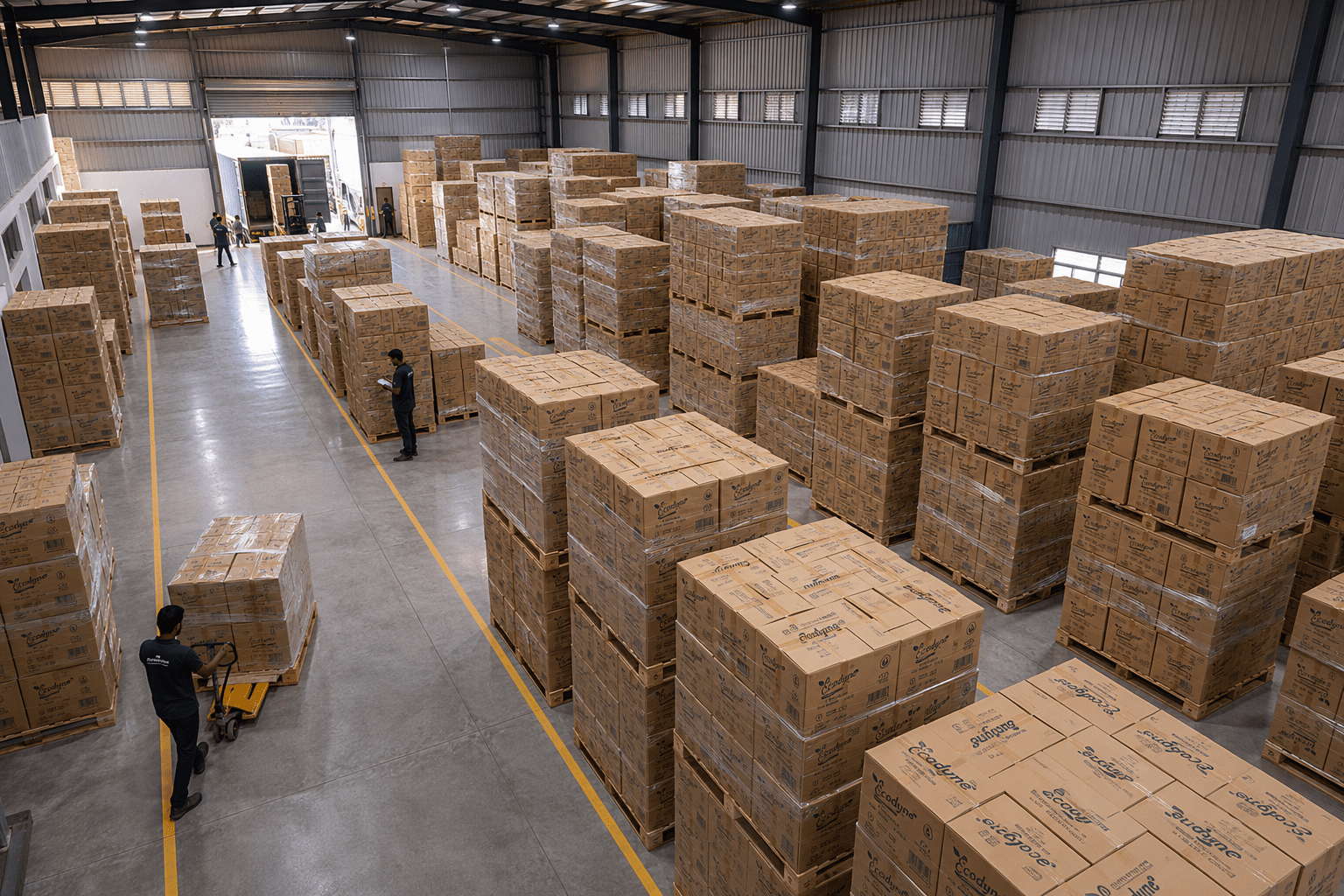
Palm leaf production capacity — the verified claim
EVIDENCE · INSTALLED CAPACITY
Ecodyne operates 4.5 million units per month installed production capacity across 90+ distributed manufacturing units.
Internal production records · capacity planning model · Reviewed June 2026
The 4.5 million-unit monthly figure is the steady-state installed capacity across all 90+ distributed manufacturing units operating under the Conservia Partners operations register. Production logs are maintained per unit per day; the aggregate is rolled up monthly and held as a 36-month rolling record. The 6,500 CNC dye moulds run 24/7 across 90+ distributed pressing units in parallel format production — plates, bowls, platters and compartment trays running concurrently. The site does not display production logs or per-unit yield records on the public page — per the public/gated firewall, the operating-capacity figure is public and the underlying log artefacts are released one-to-one through the documentation gate.
The 90-unit count derives from the operations register; each unit operates on 100% solar power per the separately-evidenced solar manufacturing record. Independent verification of palm leaf production capacity requires three artefacts: the operations register listing the 90+ units, the capacity planning model documenting steady-state and surge thresholds, and the production logs covering a representative window. All three sit inside the documentation dossier. The ISO 9001:2015 quality management certification, audited by TÜV India, provides the third-party check on the operating reality — the auditor walks the production records alongside on-site inspections of the 90-unit footprint before the certificate is signed off each cycle.
Two additional claims sit alongside the headline. First, the surge profile — 6 million units per month within 45 days and 9 million units per month within 75 days — is the documented capacity-planning response to a confirmed annual programme. The surge mechanism uses additional shifts at the existing 90-unit footprint plus raw-material flow from the 810-farming-family programme across four districts of Karnataka. No new physical units are added during a surge cycle; only shift-density and supply-throughput change. Second, the 50 million-unit annual ceiling is the documented upper bound from the capacity planning model — it represents the saturation point of the existing 90-unit and 6,500-mould infrastructure rather than a marketing aspiration.
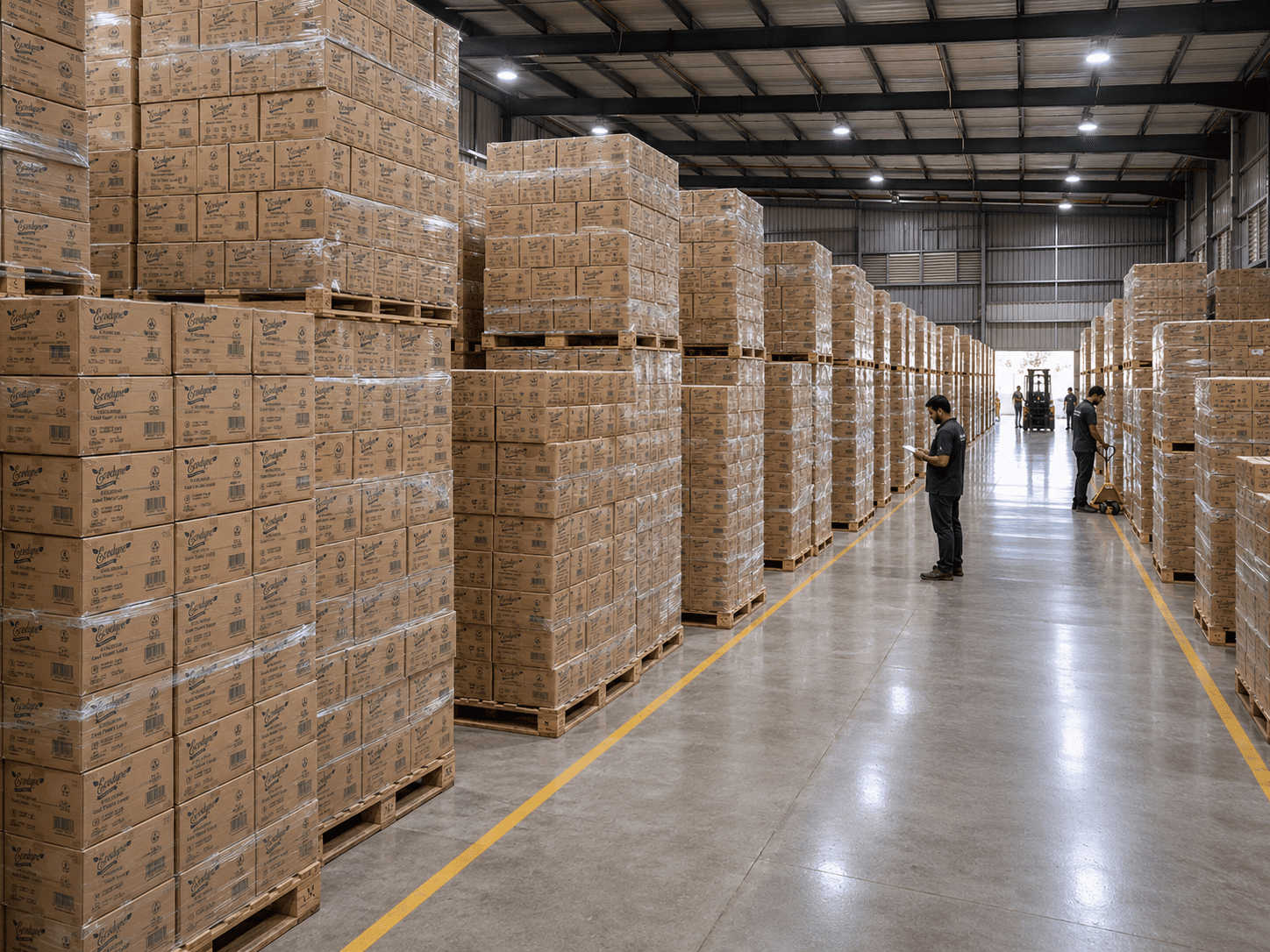
Palm leaf production capacity — operating profile
The dataset below is what backs the headline claim. Per-unit and aggregate figures are derived from the operations register and the capacity planning model; the source documentation is released to qualified buyers under the documentation gate.
| Metric | Per manufacturing unit | Across the 90-unit network | Source register |
|---|---|---|---|
| Installed monthly capacity | ~50,000 units | 4.5 million units | Operations register & production logs |
| Surge capacity (45 days) | ~66,500 units | 6 million units / month | Capacity planning model |
| Surge capacity (75 days) | ~100,000 units | 9 million units / month | Capacity planning model |
| Annual capacity ceiling | ~555,000 units | 50 million+ units / year | Capacity planning model |
| CNC dye moulds | ~72 moulds shared in rotation | 6,500 moulds, 24/7 operation | Equipment register |
| Facility footprint | Distributed across cultivation geography | 20,000 sq ft central QC, cleaning, packing and warehouse hub (Bhadravathi) | Operations register |
| Standing inventory | n/a (centralised) | 3 million+ units always available | Stock report (monthly) |
| Quality framework | ISO 9001:2015 audited | ISO 9001:2015 (site-wide certification) | Certificate — gated |
Palm leaf production capacity — buyer questions
What is Ecodyne’s installed monthly production capacity?
Installed capacity is 4.5 million units per month across 90+ distributed manufacturing units. Capacity scales to 6 million units in 45 days and 9 million units in 75 days with onboarded farmer supply. Annual capacity ceiling exceeds 50 million units. Production records are gated; the aggregate figure and the planning model summary are public.
Can Ecodyne scale capacity for larger annual programmes?
Yes. Documented scalability to 9 million units per month within 75 days against a confirmed annual programme. Capacity expansion is achieved through additional shifts at the existing 90-unit Karnataka facility, with raw-material supply secured through the 810-farming-family programme covering four districts of Karnataka. No new physical units are added during a surge cycle; only shift-density and supply-throughput change.
How is the 4.5M monthly capacity distributed across 90+ units?
The 4.5 million units per month installed capacity is distributed across 90+ pressing units, spread across approximately 200,000 sq ft, which feed a 20,000 sq ft central quality-control, cleaning, packing and warehouse hub at Bhadravathi, Karnataka. The unit distribution is structured for parallel format production — plates, bowls, platters and compartment formats running concurrently — and for surge capacity to 9 million units per month within 75 days.
How long does it take to press one palm-leaf plate?
Press time per plate is 60–90 seconds at 200°C in the heated steel die, followed by 24 hours of drying at 60°C. Across 90+ manufacturing units running in parallel, the cumulative cycle delivers the 4.5 million units per month installed production capacity, with surge capacity to 9 million units per month within 75 days.
How does Ecodyne maintain year-round production capacity?
Areca palm leaves fall naturally throughout the year in coastal Karnataka — they are not a seasonal harvest. The raw-material network spans four districts of Karnataka, with 810 partner farming families supplying through the CPCRI programme. Cumulative leaf collection across this footprint sustains continuous supply to the 90+ manufacturing units, and the standing inventory of approximately 3 million units smooths short-cycle demand fluctuations between order confirmation and dispatch.
What documentation is available to buyers about production capacity?
The documentation dossier covers the operations register (listing the 90+ manufacturing units), the capacity planning model (steady-state and surge thresholds), production logs covering a representative 36-month window, the ISO 9001:2015 quality management certificate (TÜV India audited), and the equipment register listing the 6,500 CNC dye moulds. The dossier is released one-to-one to identified importers, distributors, contract packers and private-label brand owners through the documentation gate — see the conversion routes at the bottom of this page.
References
- ISO 9001:2015 — Quality management systems standard; the audited framework that covers Ecodyne’s production capacity operation.
- TÜV India — the certifying body that issues Ecodyne’s ISO 9001:2015 certificate; performs the on-site audit walk including production records.
- Central Plantation Crops Research Institute (CPCRI) — the Indian Council of Agricultural Research institute supplying the raw-material partnership across four districts of Karnataka.
- Agricultural and Processed Food Products Export Development Authority (APEDA) — the Government of India authority for agricultural and processed-food exports including palm leaf tableware.
- Palm leaf solar manufacturing — the parallel evidence page documenting that all 90+ manufacturing units run on 100% solar power.
- 10-day container loading guarantee — the contractual delivery commitment backed by this installed capacity.
- Year-round raw-material supply — the continuous-supply mechanism underpinning steady-state capacity.
- Manufacturing — the 8-stage manufacturing process that runs across the 90-unit network.
- Palm leaf plates export countries — the 19-country export footprint served by this installed capacity.
Cited by
- Home — the installed-capacity line in the company differentiator card.
- About Ecodyne — the operating-scale paragraph in the company profile.
- Manufacturing — the ‘What is Ecodyne’s monthly production capacity’ FAQ links back here for the verified figure.
- Wholesale hub — capacity to support multi-container annual programmes.
- Private-label hub — capacity to absorb confirmed annual brand-owner volume.
- Germany country page — capacity reference in the country-specific procurement footing.
- 10-day container loading — the delivery commitment underpinned by this capacity.
- Minimum order quantity — the per-container MOQ in the context of monthly capacity.
Why palm leaf production capacity matters for B2B buyers
For importers and distributors, this verified palm leaf production capacity is the line that connects sourcing intent to programme reliability. Ecodyne’s 4.5 million-unit monthly footprint across 90+ distributed units, audited under ISO 9001:2015 by TÜV India, delivers a documented capacity figure rather than an asserted one — which matters when the buyer’s downstream chain needs scheduling certainty rather than seasonal supply variability. For private-label brand owners committing to a launch volume and annual cadence, the surge-to-9-million-units-in-75-days response gives a defensible scale-up path without supplier-change risk. For contract packers running supplier audits, the operations register, capacity planning model and ISO certificate together pass the gate that an asserted-only capacity claim cannot — and the 6,500-mould equipment register backs the SKU-customisation latitude that private-label and OEM contracts require.
Request a Quote
Wholesale palm leaf tableware, FOB New Mangalore Port. Share your monthly volumes and SKUs.
Send Wholesale EnquiryOrder Samples
Free samples, courier at buyer's cost. Tell us which sizes to evaluate.
Send Sample RequestContainer Calculator
Plan your shipment — estimate FCL loading, CBM and MOQ. No pricing, no signup.
Open CalculatorDocumentation, quote, samples
The full production capacity documentation dossier — operations register, capacity planning model, production logs over a representative window, ISO 9001:2015 certificate and the equipment register for the 6,500 CNC dye moulds — is released one-to-one to identified, qualified buyers. Quote and sample routes are also live for buyers ready to evaluate the catalogue alongside the operational evidence.