Palm Leaf Tableware Industry Report 2026 — Ecodyne's Annual Reference
A vendor-neutral, citation-grade reference covering raw material, manufacturing, exports, destination markets, logistics, regulation, and the FY 2026-27 forecast. Drafted by Ecodyne for B2B importers, distributors, procurement leads, and trade-press analysts.
Palm leaf tableware industry report 2026 is Ecodyne's annual reference for B2B importers, distributors, and procurement leads who need a single defensible source on the structure, economics, and forward trajectory of the world's palm-leaf-plate trade. The report consolidates customs data, cooperative-level sourcing intelligence, named-player capacity figures, and 15+ years of operating experience into seven indexed sections that can be cited, quoted, and procured against.
The palm leaf tableware industry report 2026 is built on data triangulation across three independent streams: Government of India customs filings via TradeStat / DGCI&S, cultivation statistics from APEDA and Government of India Horticultural Statistics, and agronomic standards from the Central Plantation Crops Research Institute (CPCRI) at Vittal in coastal Karnataka. The palm leaf tableware industry report 2026 finds that India accounts for approximately 99% of world export trade in finished palm leaf tableware; that the industry currently utilises less than 10% of India's annual plate-grade leaf supply; and that surviving Tier 1 manufacturers have emerged commercially stronger from the twin shocks of post-COVID bagasse displacement and the 2025 US tariff escalation.
For B2B buyers evaluating the palm leaf tableware industry report 2026, the operational implication is straightforward: supply abundance is structural, the manufacturer pool is consolidating around a small number of certified export-tier operators, and procurement decisions over the next two cycles will materially shape supplier relationships through the late-2020s. The palm leaf tableware industry report 2026 is published with full methodology disclosure and is available on request.
What's Inside the Palm Leaf Tableware Industry Report 2026
The report is organised into seven indexed sections. Each section is built from primary-source data and is independently citable.
- Raw Material & Supply — India's structural position as 99% of world export trade; the areca palm productive cycle; cultivation footprint across 700,000 hectares; the Karnataka manufacturing cluster; leaf supply availability of approximately 7 billion sheaths annually against current utilisation of less than 10%.
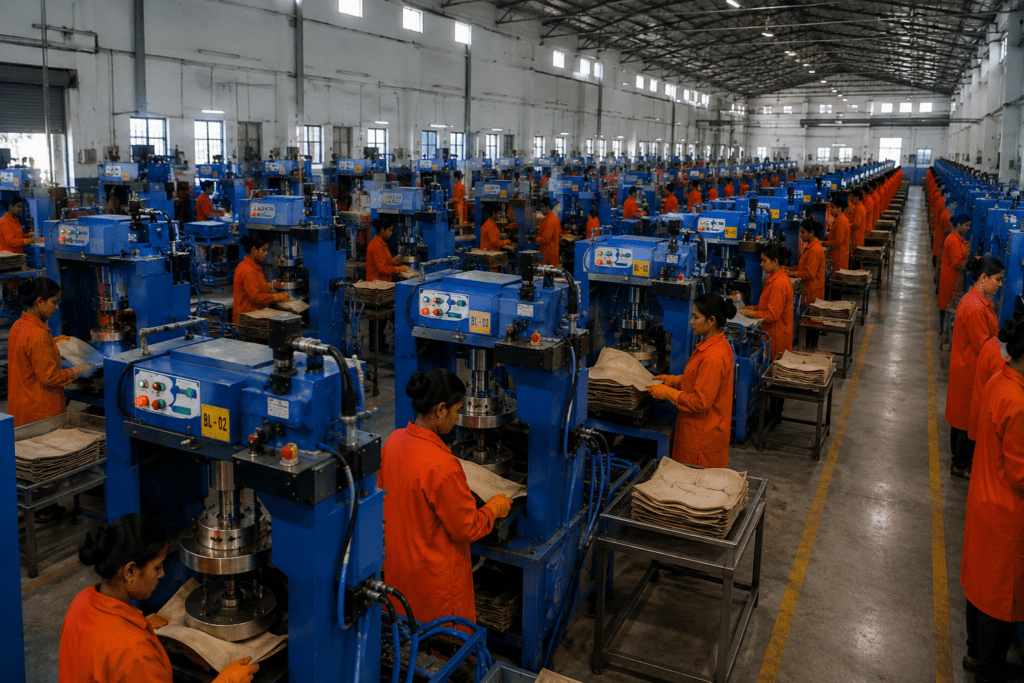
- Manufacturing & Capacity — The seven-district Karnataka cluster; the three operating-model archetypes (Karnataka-integrated, Karnataka-owned Chennai-hub, Tamil-Nadu-headquartered contract-Karnataka); the five-tier manufacturer pyramid; installed industry capacity triangulation at 80–120 million plates per month.
- Exports & Trade Flows — Nine-year value trajectory (FY 2017-18 to FY 2025-26 provisional); destination concentration (top 10 = 90% of value); the FY 2025-26 contraction breakdown showing North America at 72.8% of the decline; per-unit pricing analysis.
- Destination Markets — USA's dual-shock contraction from FDA GRAS uncertainty and tariff escalation; Western Europe's premium core; Israel's structural role as the B-grade absorption market; the long tail and emerging destinations.
- Logistics & Shipping — The three-port export gateway structure (Mangalore, Nhava Sheva, Chennai); container economics (40-foot container = 14–16 tonnes = 300–375K plates); the Red Sea disruption and FY 2025-26 shipping environment; the 10-day loading-window trend.
- Regulatory Framework — The voluntary certification stack (ISO 9001, ISO 14001, BSCI, LFGB §30/§31, EN 13432, USDA Biobased); EU Single-Use Plastics Directive 2019/904; US FDA GRAS classification; India's Plastic Waste Management Rules 2022.
- Industry Forecast — Three scenarios (best, central, bear) for FY 2026-27 through FY 2028-29 by destination; supply-side conditions confirming no constraint in the forecast horizon; capacity utilisation implications.
Headline Findings — A Preview
Five findings sit at the centre of the palm leaf tableware industry report 2026. The full companion summary is published at Industry Report 2026 Key Findings — 5 Insights for B2B Eco-Tableware Buyers. In brief:
- India's 99% export-share dominance is structural, not cyclical. No competing-origin industry exists at meaningful export volume. Sri Lanka, Indonesia, the Philippines, Thailand, Vietnam, and Bangladesh all maintain areca cultivation, but none has built the integrated manufacturing-and-export ecosystem.
- The industry has consolidated under two shocks. Post-COVID bagasse displacement removed approximately 50% of domestic-tier revenues; the 2025 US tariff escalation removed approximately 43% of US import volume in FY 2025-26. Surviving Tier 1 manufacturers are now commercially stronger and more export-concentrated.
- Germany is the FY 2025-26 counter-cyclical signal. While the industry contracted by US$ 6.59 million year-on-year, Germany grew +8.7% — the single largest positive contribution in the top-20 destination set. Germany is structurally re-accelerating after a decade of slower growth.
- Container economics now anchor B2B procurement decisions. A 40-foot container holds 14–16 tonnes of palm leaf plates, equating to approximately 300–375K plates. The 10-working-day loading-window guarantee has emerged as a competitive differentiator among Tier 1 exporters, with 1% per-day delay penalties increasingly written into contracts.
- Regulatory tailwinds continue despite tariff volatility. The EU Single-Use Plastics Directive remains the structural foundation under European demand. India's Plastic Waste Management Rules 2022 created a domestic regulatory tailwind in parallel. EN 13432 certification is the procurement gate for institutional European buyers; LFGB §30/§31 is the principal German food-contact certification.
Sourcing & Methodology in Brief
The palm leaf tableware industry report 2026 is built on a piece-count-and-container methodology rather than the kilogram-based methodology found in some industry coverage. The conversion factor used throughout is approximately 25 plates per kilogram, anchored against the operational reality that a 40-foot container holds 14–16 tonnes of finished plates equating to 300–375K plates. This eliminates the ambiguity introduced by HSN-code-level kilogram reporting where mixed plate sizes distort per-unit comparisons.
Primary data sources include: (1) TradeStat / DGCI&S for export value and quantity series; (2) Volza Global Trade Intelligence for top-exporter identification and concentration analysis; (3) APEDA and Government of India Horticultural Statistics for cultivation and area data; (4) CPCRI (Vittal) for agronomic standards and planting density; (5) US FDA and EU regulations via EUR-Lex (EC 1935/2004, Directive 2019/904) for the regulatory framework section; and (6) field-observation data from Ecodyne's 15+ years across palm-leaf-plate manufacturing operations and international trade. Full methodology disclosure is published at Industry Report 2026 Methodology — How Ecodyne Built the Data.
Who This Report Is For
The palm leaf tableware industry report 2026 is written for four primary readerships:
- B2B importers and distributors in Germany, the United Kingdom, France, Spain, the Nordics, Israel, Australia, New Zealand, the United States, and Canada — assessing supplier consolidation, container economics, and regulatory exposure.
- Procurement leads at HoReCa groups, catering chains, retail private-label brands, and institutional buyers — needing defensible market intelligence to support category strategy and supplier qualification.
- Trade press analysts and industry researchers — needing a citation-grade reference on the structure, numbers, and trajectory of the palm-leaf-plate trade.
- Investors and corporate-development teams evaluating the sustainable-disposable foodware category — the report's tier-structure and consolidation analysis is the principal published source on Indian manufacturer concentration.
How to Request the Palm Leaf Tableware Industry Report 2026
The full report is available on request to qualified B2B contacts. To request a copy, please use the contact form and select "Industry Report request" in the message field. A direct download link will be sent to verified business email addresses within one business day. Alternatively, write to sales@ecodynetableware.com with company name, country, and role.
A gated direct-download form is being configured and will replace the email-request step shortly.
FAQ
What does the palm leaf tableware industry report 2026 cover?
The palm leaf tableware industry report 2026 covers seven indexed sections: raw material and supply, manufacturing and capacity, exports and trade flows, destination markets, logistics and shipping, regulatory framework, and industry forecast. Each section is sourced from primary data and is independently citable.
Who authored the report?
The report is authored by Ecodyne (Conservia Partners), drawing on 15+ years of palm-leaf-plate manufacturing and international trade experience under Vinay Manjeshwar's direction. All data sources are disclosed in the methodology section.
How often is the report updated?
The palm leaf tableware industry report 2026 is the inaugural annual edition. Subsequent editions will be published annually, with interim updates published as material developments occur — such as resolution of the US FDA GRAS reconsideration or further movement in the US tariff regime.
Is the report free?
Yes. The palm leaf tableware industry report 2026 is available at no charge to qualified B2B contacts. Requests should be made from a business email address; a download link is returned within one business day.
Can the report be cited in trade press or academic work?
Yes. The report is intended for citation by trade press, industry researchers, and academic analysts. Attribution: "Palm Leaf Tableware Industry Report 2026, Ecodyne / Conservia Partners". Methodology and primary sources are disclosed in full.
References & Further Reading
Related Ecodyne knowledge base entries and external authority sources cited above.
On Ecodyne
External References
- TradeStat / DGCI&S
- APEDA and Government of India Horticultural Statistics
- Central Plantation Crops Research Institute (CPCRI)
- US FDAUS Food and Drug Administration
- EU regulations via EUR-Lex (EC 1935/2004, Directive 2019/904)EUR-Lex — European Union
Published: 26 May 2026 · Publisher: Ecodyne Tableware (Conservia Partners), Bengaluru, Karnataka, India · Update cadence: Annual