Last updated
EVIDENCE · RENEWABLE ENERGY
Palm leaf solar manufacturing at Ecodyne — solar-powered production, ~216 MWh/yr KERC-registered
Ecodyne’s palm leaf tableware is made across ~90 distributed manufacturing units in Karnataka. Our main 20,000 sq ft production facility runs fully on solar, and a few additional units run on solar alongside it — together generating approximately 216 MWh of solar energy each year, registered with the Karnataka Electricity Regulatory Commission (KERC). Registration paperwork and utility records are released one-to-one to qualified buyers via the documentation gate.
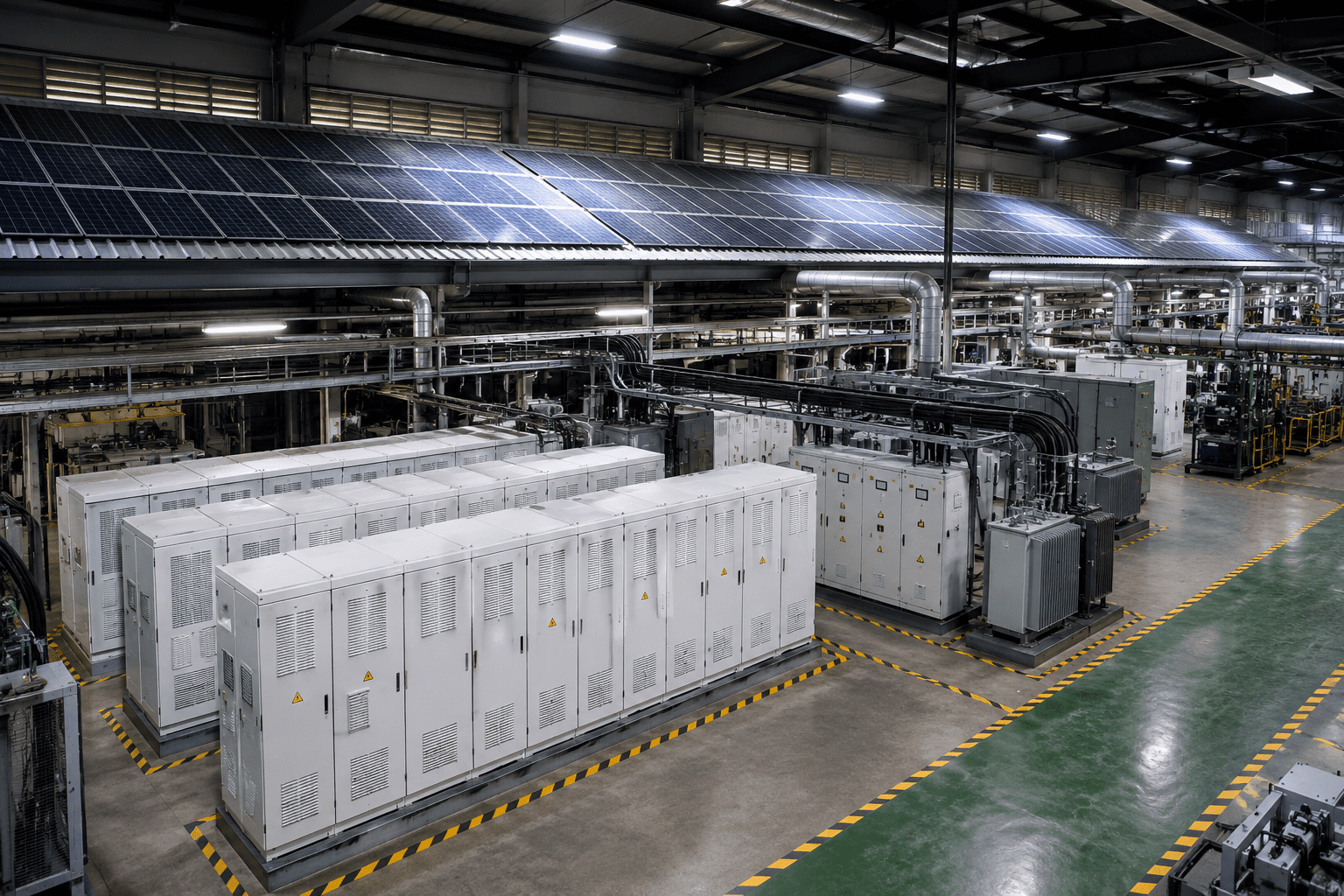
Solar-powered production at Ecodyne
EVIDENCE · SOLAR POWER
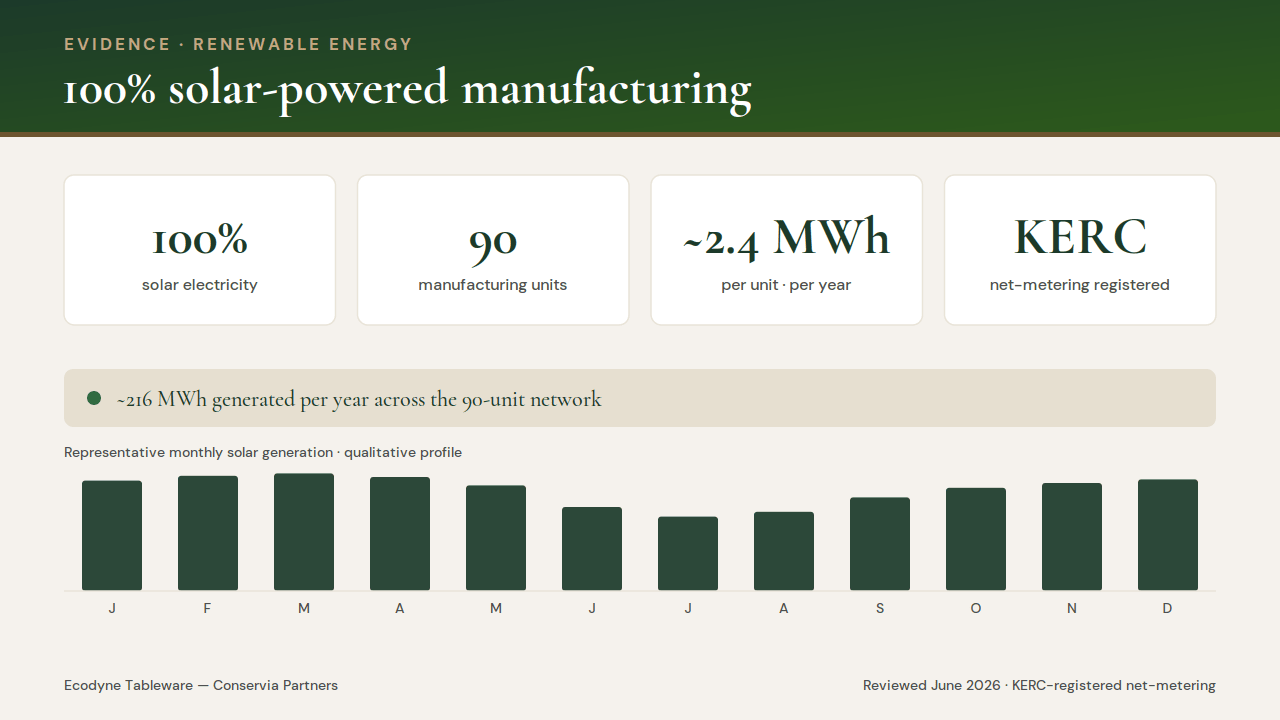
Ecodyne’s main 20,000 sq ft production facility operates fully on solar, alongside a few additional solar-powered units. Combined annual solar generation is approximately 216 MWh, registered with KERC.
Karnataka Electricity Regulatory Commission · solar-consumer registered · Reviewed June 2026
The solar installations at Ecodyne’s main production facility and the additional solar-powered units are registered as a solar consumer with the Karnataka Electricity Regulatory Commission (KERC), the state regulatory body for electricity generation and consumption in Karnataka. Combined annual generation from these solar-powered operations is approximately 216 MWh. The site does not display registration scans or specific consumer identifiers on the public page — per the public/gated firewall, the operational claim is public and the documentary artefacts are released one-to-one through the documentation gate.
The ~90-unit count is an operational-scale figure from the operations register and is independent of the solar footprint. The KERC solar-consumer registration covers Ecodyne’s solar-powered operations — the main facility and the additional solar units. Independent verification therefore requires two artefacts: the KERC consumer record and the cumulative monthly utility statements over a verification window. Both sit inside the documentation dossier. The ISO 14001:2015 environmental management audit, refreshed against the certifying body’s review cycle, provides the third party check on the operating reality — an auditor walks the documentation alongside on-site inspections, not just on-paper records, before the certificate is signed off each cycle.
Two points sit alongside the headline. First, the distributed-unit topology — ~90 manufacturing units across the supply geography — sits next to the areca-leaf supply rather than the grid-dependent centralised-factory model that most palm leaf manufacturers in India still operate. Second, the registration with KERC means the solar consumption sits inside Karnataka’s formal regulatory perimeter rather than as an unmetered off-grid installation, and that is independently verifiable.
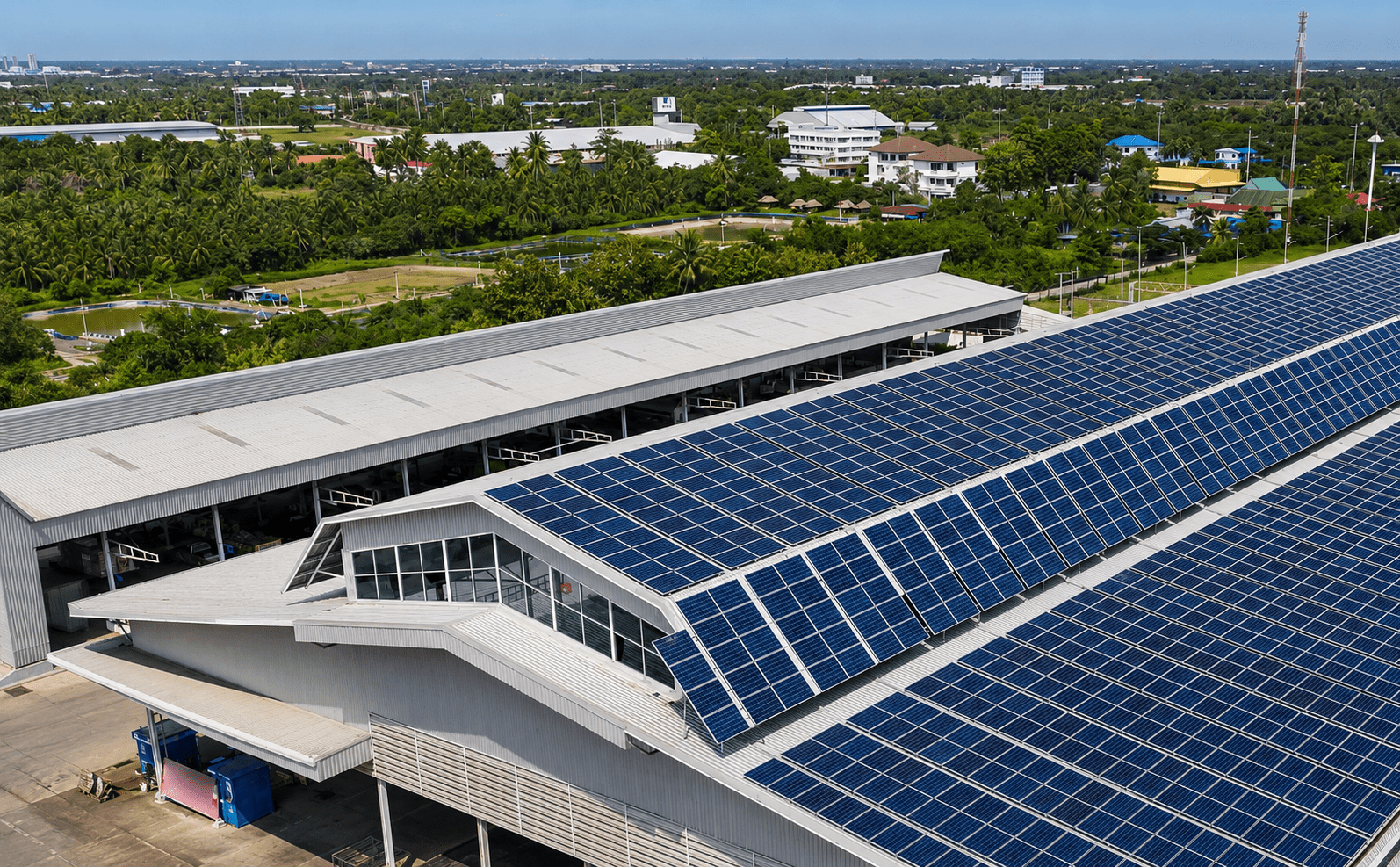
Palm leaf solar manufacturing — energy profile
Ecodyne’s solar generation comes from its main 20,000 sq ft production facility, which runs fully on solar, together with a few additional solar-powered units among the ~90 distributed manufacturing units. Combined annual solar generation is approximately 216 MWh, registered with KERC as a solar-consumer and backed by monthly utility statements released to qualified buyers under the documentation gate. Ecodyne does not publish a per-unit generation breakdown.
Palm leaf solar manufacturing — buyer questions
Which of Ecodyne’s operations run on solar power?
Our main 20,000 sq ft production facility runs fully on solar, and a few additional units among our ~90 distributed manufacturing units also run on solar. Together they generate approximately 216 MWh of solar energy annually, registered with the Karnataka Electricity Regulatory Commission (KERC). Full registration documentation is available to qualified buyers via the documentation gate.
What is the annual solar generation from Ecodyne’s solar-powered operations?
Combined annual generation from Ecodyne’s solar-powered operations — the main facility and the additional solar units — is approximately 216 megawatt-hours. Monthly utility statements from the local distribution licensee form the underlying record; statements are released one-to-one through the documentation gate. Ecodyne does not publish a per-unit generation figure.
Who is the registering authority and what does the registration cover?
The Karnataka Electricity Regulatory Commission (KERC) is the statutory regulator for electricity generation, distribution and consumption in Karnataka. Ecodyne is registered with KERC as a solar consumer, which records the installed photovoltaic capacity, the generation profile and the consumption pattern for its solar-powered operations. The specific consumer identifier strings are released only to identified, qualified buyers under the documentation gate.
Why a distributed manufacturing model rather than one centralised factory?
Ecodyne operates ~90 manufacturing units distributed across the areca-palm-supply geography in Karnataka, so the manufacturing footprint sits next to the leaf supply rather than centralising raw-material transport into a single facility. Solar powers the main production facility and a few additional units, keeping the energy footprint of that production low, while the distributed model removes a single-point-of-failure on one central site.
What documentation is available to buyers about palm leaf solar manufacturing?
The documentation dossier covers the KERC solar consumer registration record, monthly utility statements, installation invoices for the photovoltaic systems, and the ISO 14001:2015 environmental management certificate that audits the solar manufacturing operation. The dossier is released one-to-one to identified importers, distributors, contract packers and private-label brand owners through the documentation gate — see the conversion routes at the bottom of this page.
How does palm leaf solar manufacturing connect to ISO 14001 and ESG reporting?
ISO 14001:2015 is the international standard for environmental management systems. Ecodyne is ISO 14001:2015 certified across the full production process — the solar manufacturing footprint is one of the audited components. For European buyers reporting under CSRD or for retail buyers required to publish ESG disclosures, the certified solar manufacturing dataset supports Scope 2 (purchased electricity) reporting with a verified aggregate solar-generation figure.
References
- Karnataka Electricity Regulatory Commission (KERC) — statutory regulator for electricity in Karnataka; the registering authority for the solar consumer record.
- Ministry of New and Renewable Energy — Government of India national framework for grid-connected and distributed solar installations.
- Central Electricity Authority of India — technical standards for grid-connected solar photovoltaic installations.
- ISO 14001:2015 — Environmental management systems standard; the audited framework that covers the solar manufacturing operation.
- International Renewable Energy Agency (IRENA) — reference data on distributed solar manufacturing in industrial applications.
- Palm leaf production capacity — the 4.5 million units per month installed capacity of Ecodyne’s manufacturing network.
- Palm leaf plates export countries — the 19 destination markets served by Ecodyne’s manufacturing network.
- Areca leaf plates manufacturer in Karnataka — the Shivamogga factory base and ~90 distributed manufacturing units
Cited by
- About Ecodyne — the renewable-energy line in the company profile.
- Sustainability — full sustainability footprint, with solar manufacturing as the energy axis.
- Manufacturing — the 8-stage process runs on the solar manufacturing operation described here.
- Solar-powered manufacturing — KB piece — the long-form explainer; links back here for the verified facts.
- Sustainability & ESG — KB category — the category index placing solar manufacturing in the wider ESG context.
- Certifications — ISO 14001:2015 environmental management audit covers the solar manufacturing footprint.
Why palm leaf solar manufacturing matters for B2B buyers
For importers and distributors, this verified renewable-energy operation is the line that connects sourcing to the Scope 2 column on the carbon ledger. Ecodyne’s solar-powered operations — the main facility and the additional solar units — registered with KERC and audited under ISO 14001:2015, deliver a verifiable renewable-energy figure rather than an asserted one — which matters when the buyer’s downstream chain needs documentation rather than narrative. For private-label brand owners building a sustainability story for European retail, the aggregate solar-generation figure (~216 MWh/yr) supplied through the documentation gate produces defensible CSRD-aligned disclosures. For contract packers running supplier audits, the registration and the audited EMS together pass the gate that an asserted-only claim cannot.
Request a Quote
Wholesale palm leaf tableware, FOB New Mangalore Port. Share your monthly volumes and SKUs.
Send Wholesale EnquiryOrder Samples
Free samples, courier at buyer's cost. Tell us which sizes to evaluate.
Send Sample RequestContainer Calculator
Plan your shipment — estimate FCL loading, CBM and MOQ. No pricing, no signup.
Open CalculatorDocumentation, quote, samples
The full solar manufacturing documentation dossier — KERC consumer registration, utility records, installation invoices and the ISO 14001:2015 certificate — is released one-to-one to identified, qualified buyers. Quote and sample routes are also live for buyers ready to evaluate the catalogue alongside the operational evidence.