MATERIALS & SCIENCE · CLAIMS AND STANDARDS
What is the difference between compostable and biodegradable plates?
Biodegradable means microbes will break a material down at some point, with no time limit or conditions attached. Compostable is narrower and provable: the plate has passed a named test such as EN 13432, breaking up within 12 weeks in an industrial composting plant and biodegrading by at least 90%. A biodegradable label on its own proves very little.
For buyers who have to check green claims before they print them on a pack or put them in a tender.
Quick facts
- EN 13432 (Europe) and ASTM D6400 (United States) are the usual tests for industrial composting.
- Industrial composting plants run at 55 to 60°C. A garden heap is cooler and slower.
- TÜV Austria’s OK compost HOME is a separate certificate for products that also compost at lower temperatures.
- Compostable plastics such as PLA are still plastics under EU single-use plastics law.
- Our palm leaf plates were EN 13432 tested and passed.
What does biodegradable actually mean on a plate?
Only that the material can be broken down by bacteria and fungi. It does not say how long that takes, in what conditions, or what is left behind. Wood is biodegradable. So, over a long enough time, are many things you would not want in a compost heap.
That is why the European Commission warns that “biodegradable” can mislead people into thinking an item will disappear quickly anywhere, and why EU consumer law now bans vague environmental claims that cannot be proved. If a supplier’s only evidence is the word on the box, treat it as no evidence.
What does a compostable claim have to prove?
It has to name a standard and be backed by a test report from a lab. The standard sets the temperature, the time and the pass marks. The three you will meet most often:
| Standard | Where it is used | What it tests |
|---|---|---|
| EN 13432 | Europe | Breaks up in an industrial plant within 12 weeks, no more than 10% left on a 2 mm sieve; at least 90% biodegradation; no harm to the compost |
| ASTM D6400 | United States | Plastics designed to compost in municipal or industrial facilities |
| OK compost HOME (TÜV Austria) | Certificate used in many markets | Composting at the lower, less steady temperatures of a garden heap |
A plate that passes EN 13432 has not necessarily been tested for a garden heap, and the pack should not suggest it has. Our EN 13432 page explains what our own result covers.
Are compostable plates actually compostable?
Yes, if two things are true. The plate has passed the standard it claims, and it ends up in a plant that composts it. The second part is out of the manufacturer’s hands. Whether a compostable plate is allowed in the food-waste bin is set by the local council or waste company, and the answer changes from one town to the next.
A compostable plate thrown in general waste goes wherever general waste goes. That is not a reason to avoid compostable plates. It is a reason to tell your customers plainly how to dispose of them where they live.
Which paper plates can be composted, and what are they coated with?
Plain, uncoated paper composts readily. The trouble is that plain paper goes soft under sauce, so many paper plates carry a thin plastic film, often polyethylene or PLA, or a grease-proofing treatment. The pack seldom says which.
The coating changes the answer. The European Commission’s guidelines treat a paper plate with a plastic lining as made partly of plastic, which puts it inside the EU ban on single-use plastic plates. If a paper plate shrugs off grease and nothing is named on the pack, ask the supplier what the barrier is before you buy.
Is compostable plastic still plastic?
Yes. PLA is made from plant starch, and some grades pass EN 13432, but chemically it is a polymer that is melted and moulded like other plastics. The EU definition of plastic in Directive (EU) 2019/904 covers bio-based and biodegradable plastics. Being compostable describes how it can end its life in a plant. It does not change what it is.
Are palm leaf plates compostable and biodegradable?
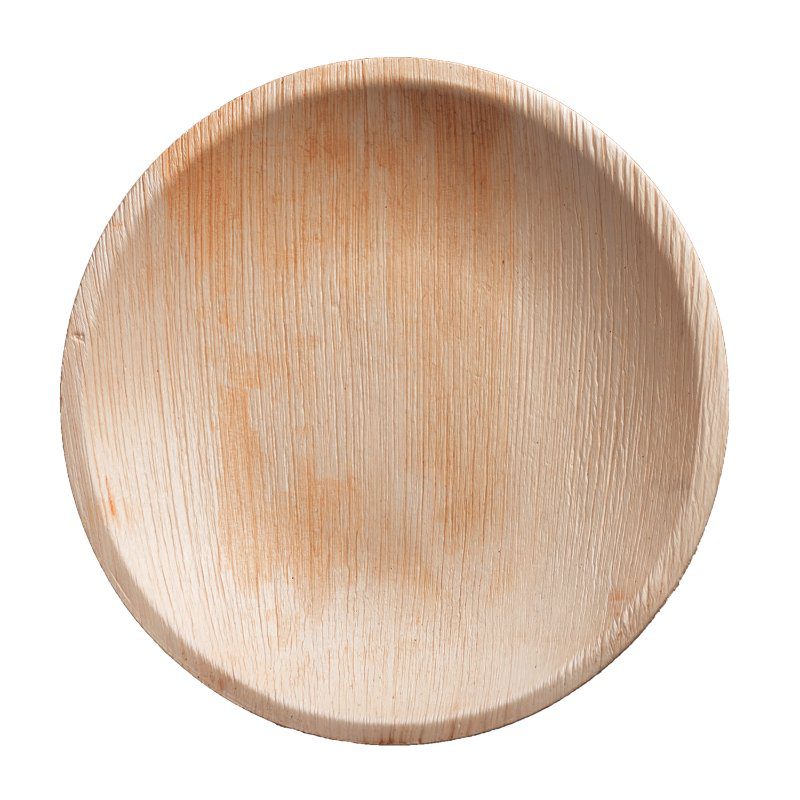
Both. A palm leaf plate is a single fallen areca leaf sheath, washed and pressed with heat. There is no glue, coating or chemical in it, so there is nothing in it except leaf to break down. Our plates were EN 13432 tested and passed, which is the industrial composting test.
We have not had them tested to a garden-heap standard, so we do not put a time on how quickly they rot in a garden, and we would ask importers not to either. It is plant fibre and it will rot like other leaves. Making a claim you cannot document is how a good product ends up in a regulator’s file. More on the product side is on our biodegradable plates wholesale page.
Questions buyers ask
Which is better, biodegradable or compostable?
Compostable, because it is the claim that can be tested. A compostable plate has passed a named standard with a fixed time and temperature. A biodegradable plate may be perfectly good, but the word alone gives you nothing to check. For a tender or a retail pack, ask for the standard and the test report.
Are sugarcane plates biodegradable?
Plain sugarcane bagasse is plant fibre and biodegrades. Many bagasse plates have also passed EN 13432 or ASTM D6400 for industrial composting. Check whether the grade you are buying has a grease or liquid barrier added, because that coating must pass the test as well, and ask the supplier to name it in writing.
Do compostable plates have microplastics?
Some can. A plate lined with PLA or polyethylene has a plastic layer, whatever its compost rating. Researchers at IIT Kharagpur found that plastic-lined paper cups released micron-sized plastic particles into hot water. A plate made of one natural material with no lining, such as pressed palm leaf, has no plastic layer to shed.
How do you dispose of compostable plates?
Scrape off the food, then follow your local waste rules. Some councils and waste companies take compostable tableware in the food-waste bin, and others want it in general waste. An industrially compostable plate in a garden heap will not follow its certified timeline, because the heap does not get hot enough for long enough.
Which brand of compostable plates is best?
No brand is best for every use, and one that says so should be asked for proof. Judge the plate instead: what it is made of, whether any coating is named, which composting standard it passed, and whether a current food-contact migration report exists. Our palm leaf is tested to LFGB standards and confirmed compliant, and we send reports on request.
What material is closest to 100% biodegradable?
A single natural material with nothing added, because there is no second material left behind. Uncoated pressed leaf, plain wood and plain plant fibre all qualify. Anything that claims to be fully biodegradable should still name a standard and show a test report, since the claim on its own is not a measurement.
How long do palm leaf plates take to break down in a commercial composting facility?
Within 12 weeks under industrial composting conditions. Our plates were EN 13432 tested and passed, and that test requires a material to break up within 12 weeks in an industrial composting plant, leaving no more than 10% on a 2 mm sieve. It must also biodegrade by at least 90%. Each plate is one pressed leaf with no glue or coating, so there is nothing in it but leaf. Ask your composter about its own cycle.
Sources
- TÜV SÜD, EN 13432 compostability testing requirements
- ASTM International, D6400 Standard Specification for Labeling of Plastics Designed to be Aerobically Composted in Municipal or Industrial Facilities
- TÜV Austria, OK compost HOME and industrial composting temperatures
- European Commission, Bio-based, biodegradable and compostable plastics
- European Commission, Guidelines on single-use plastic products under Directive (EU) 2019/904
- Ranjan et al., Microplastics and other harmful substances released from disposable paper cups into hot water, Journal of Hazardous Materials 404 (2021)
Ask us for our EN 13432 and LFGB reports before you write your pack copy.
Request a Quote
Wholesale palm leaf tableware, FOB New Mangalore Port. Share your monthly volumes and SKUs.
Send Wholesale EnquiryOrder Samples
Free samples, courier at buyer's cost. Tell us which sizes to evaluate.
Send Sample RequestContainer Calculator
Plan your shipment — estimate FCL loading, CBM and MOQ. No pricing, no signup.
Open Calculator