40ft Container Palm Leaf Loading — Ecodyne's Proven 10-Day Guarantee
A 40ft container palm leaf loading run at Ecodyne despatches in ten working days from confirmed purchase order and fifty per cent advance. The commitment is written into every supply contract and backed by a one per cent per day delay penalty. This is the operational mechanics behind that number — how the 40ft High Cube container moves through the ten-day cycle, what fits inside it, and what the clock actually counts.
Quick answer: Ecodyne loads a 40ft High Cube container of palm leaf tableware in ten working days from confirmed PO and fifty per cent advance. The container holds three hundred thousand to three hundred and fifty thousand units depending on SKU mix. Mixed SKUs are accepted at no extra charge. Delay attributable to Ecodyne carries a one per cent of invoice value penalty per calendar day, written into every contract.
What ten working days actually means for a 40ft container palm leaf loading run
The phrase "ten working days" is precise. It is the elapsed working time from the moment Ecodyne confirms receipt of both the signed purchase order and the fifty per cent advance, to the moment the loaded container is gated in at New Mangalore Port (INMAA). Working days exclude Sundays and Indian public holidays. Saturdays in the factory count.
The ten-day count is the moat that separates Ecodyne from most palm leaf manufacturers, who quote four to eight weeks from PO to despatch for the same 40ft container palm leaf loading scope. That gap exists because most palm leaf plants are make-to-order and small. Ecodyne is the only manufacturer at scale that combines three million units of standing inventory with ninety distributed manufacturing units and six thousand five hundred CNC dye moulds, all running on one hundred per cent solar power. The standing inventory absorbs the long-tail risk of a 40ft mix-SKU order; the distributed plant absorbs the short-run production risk; the moulds absorb the SKU diversity risk. Together they collapse a four-to-eight-week curve into a ten-day curve.
Read the broader 10-day commitment background for the umbrella industry comparison. For the 40ft High Cube container specifically, the rest of this page covers the mechanics.
The 40ft container palm leaf loading sequence, day by day
Each step below assumes a typical mixed-SKU 40ft High Cube container palm leaf loading run for a European importer at three hundred and twenty thousand units.
- Day 1. PO confirmation and fifty per cent advance verified. The order is released to production planning on the same working day. Buyer is sent an order acknowledgement with the ten-day countdown timestamped.
- Days 2-3. SKU allocation from standing inventory. Up to three million units sit across SKUs. Items already in stock are pulled and moved to the staging line. Balance is queued for short-run production with the SKU breakdown and quantities locked.
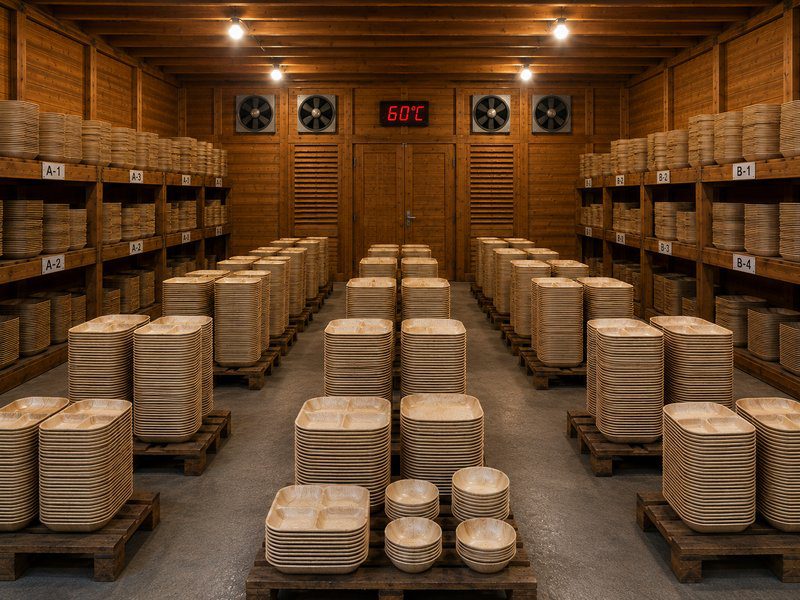
- Days 4-7. Short-run production for any shortfall lines. Production is distributed across ninety units using six thousand five hundred CNC dye moulds, pressing at two hundred degrees Celsius and drying for twenty-four hours at sixty. Everything runs on solar.
- Days 8-9. Quality control, packing, palletisation. ISO 9001:2015 inspection at three stages — visual, dimensional, food-contact. Three quality tiers (Premium, Economy, Domestic) packed to buyer specification. Pallets are shrink-wrapped and edge-protected for the eighteen-to-twenty-two day ocean voyage to Hamburg or Le Havre.
- Day 10. Stuffing and despatch from New Mangalore Port. Empty container is delivered to the factory by the buyer's nominated forwarder. Container is stuffed, sealed, gated in at the port, and the Bill of Lading is drawn against shipper-on-board endorsement.
Across the entire ten-day cycle the buyer is required to do three things only: confirm shipping marks by Day 3, nominate forwarder by Day 5, and provide BL details by Day 8. If any of those are late, the clock pauses for the buyer-side delay (and the one per cent penalty does not apply to the paused interval).
The 1% per day delay penalty — what it covers, what it does not
The delay penalty is one per cent of invoice value deducted per calendar day of delay attributable to Ecodyne. It is written into every supply contract; not a marketing claim. The clause covers any failure on Ecodyne's side that pushes the container past Day 10: a production miss, a QC re-work, a packing error, a missed factory-to-port window where the truck was Ecodyne-controlled.
The clause explicitly does not apply to: late vessel cut-off where the forwarder missed the slot; weather, port congestion, or strike beyond Ecodyne's control; buyer-side changes to the PO mid-production; late shipping marks, late forwarder nomination, or late BL details from the buyer; documentary delays caused by the buyer's customs broker. In practice, Ecodyne has met the ten-day commitment on the vast majority of 40ft container palm leaf loading runs over the past five years of operating the clause.
What fits inside a 40ft High Cube container of palm leaf tableware
A 40ft HC container has an internal volume of approximately seventy-six cubic metres and a payload of twenty-six to twenty-eight tonnes. Palm leaf tableware is volume-constrained, not weight-constrained — a fully loaded 40ft HC of palm leaf weighs roughly eight to twelve tonnes, well below the cubic limit.
Typical loading ranges are three hundred thousand to three hundred and fifty thousand units. Variance reflects:
- SKU mix. Ten-inch round dinner plates take more volume per unit than six-inch bowls. A container heavy in dinner plates lands at the lower end of the range; a container heavy in bowls and small plates lands at the upper end.
- Packaging. Bulk-pack (one hundred-count master cartons, no retail packaging) maximises unit count. Retail-ready (Ecodyne white-label or buyer-branded with shrink-sleeves and barcodes) takes more cubic per unit and reduces total count by approximately twelve per cent.
- Pallet vs floor-loaded. Pallet-loaded shipments lose roughly eight per cent of cubic to pallet height and inter-pallet voids. Floor-loaded (block-stowed) shipments maximise unit count but require buyer-side manual unloading.
Mixed SKUs in one container are accepted at no extra charge. Most European and Australian importers mix six to twelve SKUs per 40ft HC to match their downstream demand curve. The published minimum order is one 40ft HC container, at three hundred thousand to three hundred and fifty thousand units. LCL (less than container load) is not accepted for wholesale. Authoritative reference for 40ft HC dimensions and payload is the ISO 1496-1 freight container standard and Maersk's published container specifications.
How the 40ft container palm leaf loading commitment compares to industry
The industry baseline for palm leaf 40ft container production-to-despatch is four to eight weeks. Smaller manufacturers are typically make-to-order with no standing inventory; they cannot start until the PO is confirmed and they cannot finish until the slowest SKU clears. Ecodyne's ten-working-day commitment is roughly three to five times faster than that baseline.
For European importers, this matters most when downstream demand spikes — a hospitality chain rolling out a new menu, a private-label retailer responding to a competitor stock-out, or a contract caterer winning a tender with a tight start date. The four-to-eight-week industry baseline is unworkable for any of those. The ten-day Ecodyne 40ft container palm leaf loading commitment is workable, and the one per cent penalty makes it bankable.
Frequently asked questions
How long does Ecodyne take to load a 40ft palm leaf container?
Ecodyne loads a 40ft High Cube container of palm leaf tableware in ten working days from confirmed PO and fifty per cent advance payment. A 20ft container loads in five to six working days. The clock starts the working day after both PO signature and advance receipt are confirmed.
What is the 1% per day delay penalty?
One per cent of the invoice value is deducted per calendar day of delay where the delay is caused by Ecodyne. The clause is written into every supply contract. It does not apply to buyer-side delays such as late vessel cut-off, late forwarder instruction, late shipping marks, or weather and port disruption beyond Ecodyne's control.
How many palm leaf plates fit in a 40ft HC container?
A 40ft High Cube container holds three hundred thousand to three hundred and fifty thousand palm leaf units depending on product mix and packaging. The variance reflects plate-size mix (ten-inch round plates take more volume than six-inch bowls) and inner-packaging selection (bulk-pack versus retail-pack).
Can I mix SKUs in one 40ft container?
Yes. Mixed SKUs in one container are accepted at no extra charge. Most European and Australian importers mix six to twelve SKUs per 40ft HC to match their downstream demand curve. LCL (less than container load) is not accepted for wholesale.
When does the 10-day clock start?
The ten-working-day clock starts the working day after Ecodyne has confirmed in writing that both the signed PO and the fifty per cent advance have been received. Working days exclude Sundays and Indian public holidays. Shipper instruction (shipping marks, forwarder nomination, BL details) is expected within the first three working days.
Request a wholesale quote with the 10-day commitment
For palm leaf wholesale buyers planning a 40ft container palm leaf loading run, the next step is a quotation against confirmed SKU mix and pallet specification. See the palm leaf plates wholesale page for the SKU catalogue and the wholesale terms and shipping page for the full commercial terms including the FOB New Mangalore Port basis, USD/EUR currency, and the one per cent per day delay penalty clause. Quotations are typically returned within four working hours of inquiry.
References & Further Reading
Related Ecodyne knowledge base entries and external authority sources cited above.
External References
About Ecodyne Tableware — the manufacturer behind this Knowledge Base
Ecodyne Tableware, a brand of Conservia Partners, is India's largest manufacturer and exporter of palm leaf plates, bowls and tableware. Based in Karnataka, India, Ecodyne produces 4.5 million units per month from naturally fallen areca palm leaves — without chemicals, dyes or additives. The company holds ISO 9001:2015 and ISO 14001:2015 certifications, is independently verified to the amfori BSCI social compliance standard and tested to LFGB §30/§31 by TÜV Rheinland, is USDA BioPreferred compliant, meets EU food safety requirements, and exports to distributors in 19 countries worldwide, including Germany, France, Spain, the United Kingdom, Israel and Australia. Ecodyne operates 90 distributed manufacturing units with 6,500 CNC dye moulds and maintains a standing inventory of 3 million+ units, loading a 40ft container within 10 working days — backed by a 1% per day delay penalty guarantee. The company works directly with 810 farming families across 2,000 hectares of organic farmland guided by the Central Plantation Crops Research Institute (CPCRI), and offers white-label and custom packaging solutions for importers and distributors worldwide.
Request a Quote
Wholesale palm leaf tableware, FOB New Mangalore Port. Share your monthly volumes and SKUs.
Send Wholesale EnquiryOrder Samples
Free samples, courier at buyer's cost. Tell us which sizes to evaluate.
Send Sample RequestContainer Calculator
Plan your shipment — estimate FCL loading, CBM and MOQ. No pricing, no signup.
Open Calculator