Documented evidence on 810 farming families — the signed ICAR–CPCRI Memorandum of Understanding, programme records and audit reports — is shared one-to-one with qualified buyers.
Public standards named on this site; certificate documents and operational records delivered direct, free, on request.
Sustainability & ESG · Supply Chain
The 810 Farming Families: How Ecodyne’s Palm Leaf Supply Chain Is Built on Direct Farmer Partnerships and CPCRI-Guided Cultivation
A documented account of the supply base behind 4.5 million palm leaf pieces a month of production capacity for 19 export markets — 810 farming families across four districts of Karnataka, a seven-year scientific partnership with ICAR–CPCRI, 30 village-cluster collection centres, year-round supply through the monsoon, and batch-level traceability available for ESG audit on request.
Ecodyne’s palm leaf supply chain works directly with 810 farming families across four districts of Karnataka, southern India, who gather naturally fallen areca leaf sheaths — no tree is cut and no palm is grown for leaf. Cultivation guidance comes from the Central Plantation Crops Research Institute (CPCRI), the Indian Council of Agricultural Research’s specialist institute for plantation crops, under a Memorandum of Understanding effective 2 February 2019 for a seven-year term. The programme covers fixed-rate direct payment with no broker layer, harvest and organic-practice training, route-optimised collection through 30 community centres, and a stockpiling model that holds supply and pricing steady through the June–October off-season.
810
Direct farming families in the supply network
7 years
ICAR–CPCRI scientific partnership term
4 districts
Districts of Karnataka in the collection network
30
Village-cluster collection centres in operation
The verified claim: a seven-year ICAR–CPCRI partnership
Conservia Partners — the partnership firm behind the Ecodyne Tableware export brand — operates an organic-areca-farming transition programme in scientific partnership with the ICAR–Central Plantation Crops Research Institute (CPCRI), Vittal regional station, covering 810 farming families across four districts of Karnataka.
Verified · CPCRI Memorandum of Understanding
Source: Memorandum of Understanding, Conservia Partners ↔ ICAR–CPCRI · effective 2 February 2019 · seven-year term · reviewed June 2026.
The Memorandum establishes a formal framework for moving areca plantations from conventional cultivation to organic farming systems. CPCRI provides scientific guidance covering soil fertility, organic nutrient management, biological pest and disease control, biodiversity enhancement, water conservation, climate-resilient agriculture and certification readiness, alongside training programmes, technical workshops and field demonstrations. Conservia Partners identifies participating farmers, maintains programme records, facilitates training and coordinates communication between CPCRI and the farmer network. The complete signed Memorandum is sent to qualified buyers on request.
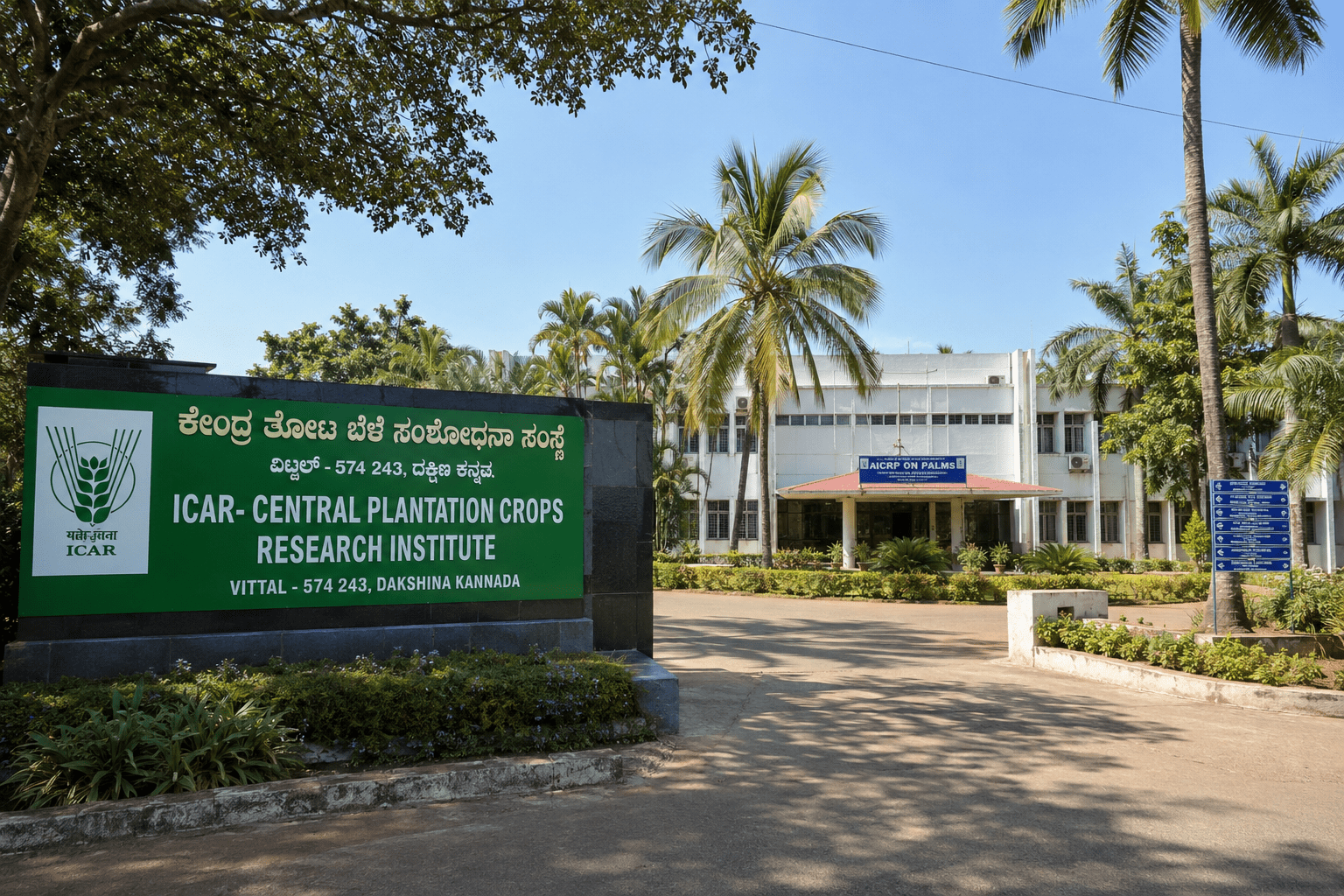
CPCRI’s main research station is at Kasaragod, Kerala; the regional station at Vittal, Puttur Taluk, Dakshina Kannada leads research on areca-palm cultivation and plantation-crops biology and hosts the All India Coordinated Research Project on Palms. The four districts named in the Memorandum — Dakshina Kannada, Udupi, Uttara Kannada and Chikmagalur — sit inside the Karnataka areca cultivation base and are served by 30 community collection centres, each within 10–15 km of every supplier village. The relationship between Ecodyne and each family is direct: no middlemen, no intermediary brokers.
A note on scope
Conservia Partners also runs a separate organic conversion programme under its Just a Leaf brand, with its own farmland base and expansion schedule. That programme is not part of the Ecodyne supply-base disclosure on this page. Where earlier Ecodyne pages quoted farmland-area figures, the correct Ecodyne figure is the 810-family, four-district network described here.
What CPCRI contributes
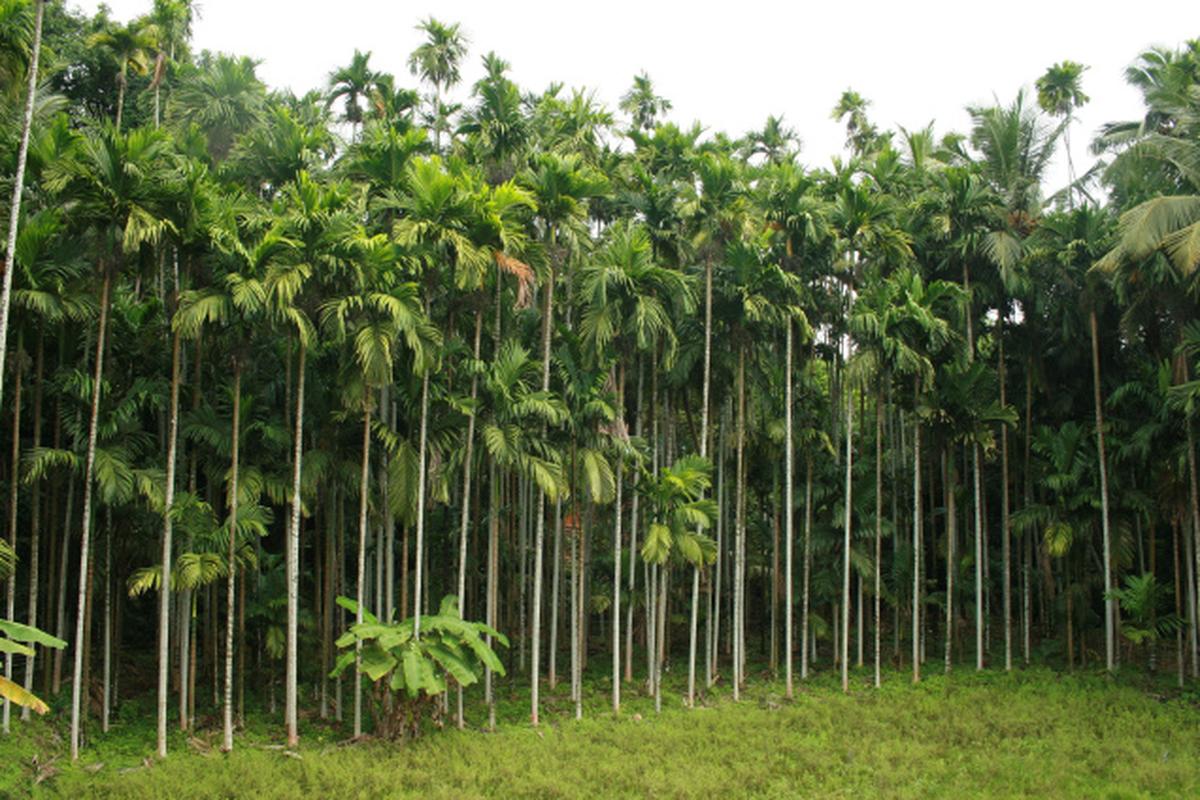
CPCRI is not a private certification body. It is an institute of the Indian Council of Agricultural Research, a Government of India statutory body, with a plantation-crops mandate that predates the palm leaf tableware industry by decades. Within the Indian agricultural research system it is the authoritative body on areca palm cultivation — the species (Areca catechu) whose fallen leaf sheaths Ecodyne presses into tableware. Four practical areas are covered.
Sustainable areca cultivation. Current best-practice recommendations on planting density, polyculture intercropping with pepper and banana, water management, organic nutrient management and disease prevention, tailored to Karnataka soil and rainfall conditions.
Harvest timing and post-monsoon recovery. Areca palm sheds 6–8 sheaths per tree per year on a seasonal cycle. CPCRI guidance covers collection timing relative to monsoon recovery, leaf maturation, storage at the collection-centre level and quality grading at intake. Areca trees are never cut to produce leaf; only naturally fallen sheaths are collected, leaving the tree productive for its full 30–40 year lifespan. The technical effect of the guidance is a broader usable harvest window and more consistent leaf quality across the calendar.
Soil management and intercropping. CPCRI’s polyculture research informs planting patterns on enrolled farms. Areca palms are grown alongside black pepper vines climbing the trunks and banana or cocoa in the understorey. Intercropping raises soil fertility through complementary root architecture, reduces pest pressure, and gives farming families three rotating income streams from a single holding. CPCRI also maintains the genetic registry for South Indian areca and advises on varietal choice for replanting — a 30–40 year decision.
Agronomic data feedback. Collection-centre quality records are shared with CPCRI on a regular cycle, letting the partnership track leaf-quality variation by region, season and farming practice. The data informs the next cycle’s training inputs.
For a buyer, the value of the tie-up is verifiability: the scientific supervisor is a named public institute with published research, not a proprietary in-house claim or a private label whose verification chain ends at an auditor’s desk.
The 810-family network
The 810 families are concentrated in four districts of Karnataka — Dakshina Kannada, Udupi, Uttara Kannada and Chikmagalur — where areca cultivation has been continuous for generations and where tree density, agricultural infrastructure and the pressing-unit ecosystem combine to support industrial-scale leaf supply. Dispersion across four districts is deliberate: a network inside one district would be exposed to localised monsoon failure, pest outbreak or regulatory change.
The families are not contract farmers in the corporate-agribusiness sense. They are smallholder areca growers for whom areca nut has been a multi-generational primary crop; leaf collection is a value addition to that existing business, not a separate land-use decision. Ecodyne’s role is downstream — aggregating, transporting and pressing the naturally shed sheath. Enrolment is open and new families join each year as output scales.
Family-level economics
Each enrolled family supplies, on average, several hundred kilograms of leaf per year, depending on holding size and intercrop mix. Ecodyne pays a fixed per-kilogram rate, reviewed annually in consultation with cluster representatives and standardised across all 30 collection centres. Depending on the cluster, families are paid at the farm gate on the collection visit or by consolidated monthly transfer; in either case there is no broker layer, no commission deduction and no informal intermediation.
Payment continues through the off-season at smaller volumes from stockpiled leaf. This removes the “leaf rots during the monsoon” loss that the historic broker-aggregated model created for families who previously had no buyer between June and October.
Contractual model
Each family signs a long-term collection contract covering quality grading, first-priority leaf collection rights, the fair-payment commitment and training participation. The contract is non-exclusive: in surplus seasons families may sell to other buyers, and they may sell areca nut and intercrops to anyone at any time. The non-exclusivity is structural — the programme is designed to give farmers leverage, not to create a captive supply relationship. There is no advance-payment lock-up and no repayment-bound contract.
Community benefit beyond payment
Training programmes. CPCRI-aligned organic cultivation workshops run at each collection centre on a rolling cycle, covering biological pest management, soil composition, intercropping yield and leaf-quality grading.
Route-optimised collection. Collection logistics use route-optimisation software so that visit frequency matches each farm’s schedule. Predictable visits let families plan leaf gathering around their primary areca-nut work rather than rushing leaf to a central depot before it spoils — the operating-level difference between a direct-relationship model and an aggregated-broker model.
Biomass return. Damaged sheaths sorted out on the farm go back to the grove floor as mulch. Trimmings and the sheaths rejected at pressing-unit intake (15–17% of intake) return to participating villages as cooking fuel or compost feedstock. Nothing from the collection chain is landfilled.
Programme dataset
| Metric | Programme commitment | Verified by |
|---|---|---|
| Scientific partner | ICAR — Central Plantation Crops Research Institute (CPCRI), Vittal regional station, Puttur Taluk, Karnataka | MOU §3 · CPCRI institutional record |
| Programme name | Seven-Year Organic Areca Farming Transition Programme | MOU recital · programme letterhead |
| Effective date | 2 February 2019 | MOU §8 (Term) |
| Term | Seven consecutive years from the effective date | MOU §8 (Term) |
| Partner farming families | 810 across the four-district network | MOU recital · programme records (on request) |
| Districts covered | Four: Dakshina Kannada, Udupi, Uttara Kannada, Chikmagalur | MOU §2 · programme records (on request) |
| CPCRI scope | Soil fertility · organic nutrient management · biological pest and disease control · biodiversity enhancement · water conservation · climate-resilient agriculture · certification readiness · training programmes · technical workshops · field demonstrations | MOU §3 (CPCRI responsibilities) |
| Conservia scope | Farmer identification and enrolment · programme records · training facilitation · CPCRI–farmer coordination | MOU §4 (Conservia responsibilities) |
| Collection infrastructure | 30 community collection centres within 10–15 km of every supplier village; direct farmer partnership with no intermediary brokers | Programme records (on request) |
| Raw-material context | Karnataka areca cultivation base (Areca catechu); approximately 1.79 billion leaves of annual availability statewide | Karnataka State agricultural records · CPCRI cultivation data |
| Confidentiality | Individual farmer identifying information and financial terms held back per MOU §7; structural facts, partner identity and district geography are public | MOU §7 (Confidentiality) |
The village-cluster collection model
Each pressing unit’s catchment is structured as 5–6 village clusters within a 10–15 km radius. Each cluster has a designated collection centre — either an Ecodyne-operated village intake point or a partner farm acting as the cluster aggregation node. Across the 90+ distributed pressing units, the supply network runs through 30 collection centres, one centre serving approximately 27 families on average.
| Parameter | Operating value | Significance |
|---|---|---|
| Pressing units | 90+ distributed units, approximately 200,000 sq ft combined | Spread across Karnataka. No concentration risk from a single-site failure. |
| Central hub | 20,000 sq ft hub at Bhadravathi, Shivamogga district | Quality control, cleaning, packing and warehousing; the hub is not a pressing factory. It runs fully on solar power. |
| Collection centres | 30 centres | One centre per approximately 27 farming families. |
| Catchment per unit | 5–6 village clusters | Diversifies leaf supply across micro-regions; reduces weather and disease exposure. |
| Collection radius | 10–15 km maximum | Keeps transport short, reduces road damage to leaf, and minimises diesel use per kilogram of intake. |
| Daily routes | Peak season, November–May | Daily collection runs by light commercial vehicle during the high-volume shedding window. |
| Weekly routes | Off-season, June–October | Reduced visit frequency aligned with reduced leaf-shedding. |
| Route optimisation | Software-managed | Each route is recalculated daily from the previous day’s volumes and the current weather forecast. |
| Payment | Fixed per-kilogram rate, reviewed annually | Paid at the farm gate on the collection visit or by consolidated monthly transfer; no broker deduction. |
| Leaf to pressing unit | 48–72 hours of pickup from November to May; stored dry leaf, 4–8 months old, from June to November | Stored dry under tarpaulin in transit. No chemical preservation, no fumigation, no moisture treatment. |
From sheath fall to pressing — step by step
Natural sheath drop
Each sheath is the broad protective base of a frond that wraps the trunk and detaches on its own as the frond above matures. An areca palm sheds 6–8 sheaths a year. The drop is continuous but peaks in the dry months after the monsoon. No human intervention is involved: the tree does this regardless of tableware demand, which is what makes the material a by-product rather than a harvest.
Ground collection by the family
During the peak window, farmers or family members walk the grove and gather fallen sheaths from the ground. The work is manual and fits around the primary areca-nut livelihood. There is no climbing, no cutting tool and no harvest event — the sheath is already on the floor.
On-farm sorting
Sheaths are sorted by size and condition at the farm shed. Those with intact fibre structure and no excessive fungal damage are bundled for pickup; decomposed or badly damaged sheaths go back to the grove soil as mulch and break down into farm organic matter.
Collection visit and logging at the farm gate
Ecodyne’s field collection team visits each partner farm on a scheduled route — daily cluster runs in peak season, weekly in the off-season. Each visit weighs the accumulated sheaths, pays at the agreed rate and logs the transaction: farmer identifier, weight in kilograms, rate and date. No intermediary sits between the collection team and the family.
Consolidation, intake and pressing
Each centre consolidates pickups from its cluster of farms and delivers the load to the nearest pressing unit within 48–72 hours in the November–May peak season; from June to November, pressing runs on dried leaf stored for 4 to 8 months. Intake weight is reconciled against the farm-gate logs, sheaths are graded, cleaned with water and pressed with heat and pressure — no chemicals, dyes, binders or coatings at any point. Pressed pieces then move to the Bhadravathi hub for quality control, final cleaning, packing and warehousing before container loading.
Year-round supply: how the off-season is covered
Palm leaf is a seasonal raw material. Areca palms shed most of their sheaths between November and May; the wet and post-monsoon months from June to October produce a fraction of that volume. Manufacturers running on spot leaf intake show one of three symptoms through July–September: production rates fall, lead times stretch by four to eight weeks, or unit pricing drifts upward to ration whatever leaf can be secured. For a distributor that has already committed a SKU calendar to downstream customers, none of those outcomes is workable.
Five layered mechanisms remove the gap on Ecodyne’s side.
1. Peak-harvest stockpiling. From November to May, leaf intake across the pressing units exceeds same-day processing demand. The surplus is dried, cleaned and stored in controlled holding areas. The stockpile is sized across the network to cover the full off-season at full production capacity — a four-to-six month buffer at full rate, not a longer buffer at half rate.
2. Standing finished inventory. A standing inventory of 3 million+ finished pieces across the size and shape range means most orders ship from stock rather than waiting on production, independently of the leaf cycle.
3. First-priority collection rights. The long-term contracts with the 810 families give Ecodyne first call on collected leaf. In peak season that maximises intake into the stockpile; in the off-season it captures available leaf before a broker can bid for it.
4. CPCRI-guided harvest and storage practice. Guidance on harvest timing, collection-centre storage and post-monsoon recovery widens the usable window and keeps quality consistent enough to support the Premium grade in any calendar month.
5. Coordinated scheduling across 90+ units. Units draw down stockpiled leaf in a centrally coordinated sequence, so no single site carries the network’s off-season risk. If one site sees a local dip, demand shifts to a site holding deeper stock.
What the buyer gets contractually
Year-round supply is the standing contractual position, not a marketing line. Commitments including container loading within 10 days of order confirmation and deposit, with the 1% per day delay penalty, apply twelve months a year — there is no off-season carve-out and no routine monsoon force-majeure. On a long-term contract, prices are protected for up to 24 months, so quarter-by-quarter delivery slots for a multi-container annual programme can be confirmed at programme start and held at the same unit cost. Full commercial terms are on the wholesale terms and shipping page.
Worked example. An EU importer planning a four-container year approaches Ecodyne in Q1 with a mix of round, square and compartment plates and needs slots in February, May, August and November. The August slot, squarely in the off-season, is available on the same lead time and the same FOB New Mangalore Port unit pricing as the February slot. The annual purchase order names all four dates, defines the quantity per slot, and carries the loading commitment on each. Operationally this works because stockpiled leaf plus standing inventory plus distributed scheduling remove the volatility from the supply side.
Peak-harvest stockpiling is also a sustainability practice. Leaf absorbed at peak would otherwise rot on the grove floor or in village sheds for want of a buyer; absorbing it converts wasted biomass into year-round income for the 810 families and for the micro-entrepreneurs operating across the collection and pressing network.
Why farm-level scale matters to a buyer
Most palm leaf sourcing conversations start at the factory floor. They should start at the grove, because the supply base is what determines whether a manufacturer can hold a loading commitment through monsoon disruption and whether it can honour a purchase order that grows year on year.
A network of 810 families produces materially more leaf per year than current production consumes. The cushion is intentional, for three reasons.
Grading loss is unavoidable. Not every naturally shed sheath becomes a Premium-tier plate. Damaged and decomposed sheaths are removed at the farm, and 15–17% of what reaches intake is rejected there and returned to the villages as fuel or compost feedstock. Quality tiers — Premium, Economy, Domestic — are graded on appearance only; leaf thickness is natural and is never used as a sorting or selling criterion.
Monsoon smoothing. Shedding across four districts is not synchronous. A base spread over Dakshina Kannada, Udupi, Uttara Kannada and Chikmagalur smooths the seasonal dip and insulates the programme against a district-level weather or pest event.
Scale-up headroom. The documented path from 4.5 million to 9 million pieces a month in 75 days requires no new farm enrolment. Leaf availability is not the constraint; pressing and packing capacity is. For a buyer planning multi-year volumes, the supplier does not need to find new land to honour a rising order book.
Disclosure quality is itself a sourcing signal. Sector-wide disclosure is thin: most Indian exporters publish a state-level claim (“sourced from Karnataka”) with no partner-family count, no collection-centre count and no named agronomic partner. A practical buyer filter is to ask any supplier for three things — partner-family count, collection infrastructure, and the name of the scientific or agronomic partner. A supplier who cannot answer all three does not have a documented supply base.
Cross-reference: Indian Palm Leaf Manufacturer Comparison — supply-chain transparency is one of six vendor-comparable dimensions discussed there.
Farmer income transparency: methodology first, numbers second
Farmer income is one of the four sustainability disclosures B2B buyers increasingly require, alongside land use, certification status and energy mix — and it is the one most suppliers handle badly. “We work with X families” is partnership disclosure, not income disclosure. A vague claim of “fair wages” or “improved livelihoods” with no methodology, baseline or measurement creates greenwashing exposure that flows through to the buyer’s own ESG statement.
Ecodyne’s measurement framework has five steps.
Step 1 — baseline. For each enrolled family, the pre-engagement income profile is recorded: areca nut revenue, intercrop revenue, off-farm work and household composition, captured at the start of each engagement cycle.
Step 2 — leaf-collection income. The per-cycle payment for leaf collected, transported and graded at the village aggregation point is recorded against the family identifier.
Step 3 — incremental-income crediting. Because the sheath was historically a waste stream, leaf income is incremental to areca-nut income rather than a substitute for it. The distinction is documented explicitly, because it changes how the disclosure should be read.
Step 4 — regional benchmarking. Per-family income is benchmarked against CPCRI-published cost-of-cultivation and net-income studies for areca in the same district, giving a third-party regional reference point.
Step 5 — trend tracking. Year-on-year change per family is recorded, separating the leaf-collection contribution from movements in the wider areca-nut market.
What is published today, and what follows
Published today: the 810-family count, the four-district geography, the CPCRI framework, the five-step measurement approach, and the categorical statement that leaf income is incremental rather than substitutional. Not published today: per-family figures, because the methodology has not yet completed independent review.
The audit-grade disclosure in preparation adds banded per-family income ranges (never individually identifiable figures), year-on-year trend data across the most recent three engagement cycles, CPCRI-benchmarked comparison against the regional cost-of-cultivation baseline, and a methodology review letter from an independent reviewer. Figures that may shift under review are deliberately not pre-published. The methodology framework document itself is available to procurement teams on request; buyers citing it in their own ESG reporting should reference the framework version and its review-status date.
Founder note
The easy version of this story writes itself: “we support 810 families”, “we pay fair prices”, “we improve livelihoods”. Each is true. None is verifiable in the form most importers now need. The CPCRI partnership and the amfori BSCI audit exist to make the harder version defensible — methodology this year, verified numbers when the review is complete.
Areca cultivation: the ecological dimension
Areca palm (Areca catechu) is a long-cycle plantation crop. A tree planted today is typically productive 7–9 years later and continues for 30–40 years. The species is native to South and Southeast Asia, has been cultivated in coastal Karnataka for centuries, and the cultivation infrastructure, labour skills and agronomic practice are mature and documented across generations.
The leaf used for tableware is naturally fallen. The tree is never cut for leaf. Collection is a value addition to the primary areca-nut business, not a change of land use.
The land-use point matters. Some alternative materials in the eco-disposable category carry net-negative land-use trajectories: bamboo plantations replacing native forest, sugarcane expansion displacing food crops, certain palm species harvested unsustainably. Areca leaf is a by-product of an established smallholder system. Supply expansion is therefore not deforestation-driven and does not compete with food production. Areca palm is also a different species from oil palm — there is no relationship between this raw material and palm-oil plantations.
Polyculture reduces land-use intensity. The areca-plus-pepper-plus-banana system common in Karnataka produces three categories of output from one holding, plus the fallen leaf. Soil carbon retention under polyculture areca systems is higher than under monoculture row-crop alternatives in the same region.
Carbon dimension. Areca palms sequester atmospheric carbon throughout their 30–40 year productive life, so the enrolled base represents a sustained biological carbon sink — in addition to the impact avoided by replacing fossil-carbon plastic plates with a biological-carbon material.
FAO recognition
The Food and Agriculture Organization (FAO) of the United Nations has described areca palm leaf tableware as “one of the most promising sustainable agricultural by-products” in the context of integrated agroforestry systems. The recognition reflects both the agronomic context (existing cultivation, by-product status) and the end-product context (single material, no chemical inputs, full biological degradation).
Traceability and what auditors should look for
Each leaf intake event at a collection centre is logged with five data points: date, family identifier, quantity (kg), quality grade (Premium, Economy or Domestic) and centre identifier. Each production batch carries forward to the dispatch carton labels, so a shipment can be retraced to the village clusters that supplied it.
Three documentation elements are the audit anchor for BSCI auditors, due-diligence consultants and downstream ESG teams:
Farmer registry. Each of the 810 partner families has a unique identifier, a geo-located farm parcel and a baseline household income record at programme entry. The registry is reviewed annually. Individual identities are protected; identifiers are issued for audit traceability.
Farm-gate transaction log. Every collection visit generates a record of family identifier, weight, rate and date. Annual aggregate earnings per family reconcile to the registry and feed the income-transparency methodology above.
Intake reconciliation. Sheaths received at the pressing unit are weighed and matched to the collection manifests. Intake totals reconcile to the farm-gate totals within roughly ±2%, the balance being moisture loss and handling. The matching is what makes the chain auditable end to end.
Also available on request: CPCRI training-participation logs per family, the collection-centre register, CPCRI advisory reports, the signed Memorandum of Understanding, and the most recent amfori BSCI audit documentation. Documentation packages aligned to specific ESG frameworks are produced as part of standard onboarding for new importer accounts; commercially sensitive material is delivered one-to-one under NDA. Certificates and test reports are sent free on request, and shipping documents travel with every shipment.
Why this matters for importer ESG files
European procurement — and a growing share of UK, Australian and US procurement — requires importer-side supply-chain documentation. The frameworks differ by jurisdiction but converge on the same operational requirement: visibility, traceability and verified labour standards into the upstream chain.
| Framework | Jurisdiction | Importer obligation | How the 810-family model serves it |
|---|---|---|---|
| CSDDD (Corporate Sustainability Due Diligence Directive) | EU | Identify, prevent, mitigate and account for adverse human rights and environmental impacts in the supply chain | Direct family relationships, amfori BSCI audit framework and CPCRI scientific guidance produce auditable, citable visibility. |
| Lieferkettengesetz (Supply Chain Act) | Germany | Human rights due diligence on direct suppliers and risk-based diligence on indirect suppliers | Ecodyne is the direct supplier; the 810 families are the indirect tier, all under documented contract with CPCRI-guided practice. |
| Loi de Vigilance | France | Risk-mapping, mitigation and reporting on environmental and human rights risks across the chain | Family-level mapping plus BSCI audit provide the documented evidence base; CPCRI provides an institutional reference point. |
| Modern Slavery Act | UK / Australia | Annual reporting on actions taken to prevent modern slavery in supply chains | Direct contracts with named families, no broker intermediaries, BSCI-audited working conditions throughout. |
| Single-Use Plastics Directive 2019/904, Loi AGEC, Verpackungsgesetz | EU / France / Germany | Evidence that a “natural material” alternative claim is substantiated upstream | Named scientific partner, documented programme term and a verifiable source population in named districts. |
| Scope 3 and climate disclosure | Various | Upstream emissions and supply-chain visibility | Solar-powered hub, a majority of pressing units on solar, and traceable agricultural inputs simplify Scope 3 reporting. |
For a German importer compiling a CSDDD-aligned procurement file, the 810-family network gives visibility to source villages. For a UK importer drafting a Modern Slavery Act statement, the BSCI framework and the documented absence of broker intermediation answer the core enquiry. For a French importer under Loi de Vigilance, CPCRI provides an institutional third-party anchor. For a private-label brand owner, the same documents supply the audit story behind “naturally sourced” on-pack messaging — with farmer-identifying information and financial terms withheld.
amfori BSCI audit alignment
Ecodyne is audited under the amfori BSCI Code of Conduct. Coverage extends to all 262 direct employees across manufacturing, quality control, export operations and administration, plus the partner micro-entrepreneur network.
| BSCI principle | Operational implementation |
|---|---|
| No discrimination | Open enrolment across the four-district catchment; no exclusion by caste, gender, religion or political affiliation. |
| Fair remuneration | Above-industry-wage payment to direct employees and a contracted per-kilogram rate to farming families, reviewed annually, with no commission or broker deduction. |
| Decent working hours | Statutory working-hour compliance across all units; no forced overtime during peak loading periods. |
| Occupational health and safety | PPE-equipped pressing units, safety training for collection-route operators, and medical insurance for all 262 direct employees. |
| No child labour | Verifiable absence of under-age labour at all 90+ pressing units and all 30 collection centres; identity verification at intake. |
| No precarious employment | Direct employment for the 262 staff, long-term contracts for the farming families, and structured buyback agreements for the micro-entrepreneur network. |
| No bonded labour | No advance-payment lock-up and no repayment-bound contracts. Families can leave the network at any time; micro-entrepreneurs can return equipment on agreed terms. |
| Protection of the environment | ISO 14001:2015 environmental management across the network; the Bhadravathi hub runs fully on solar power and a majority of pressing units also run on solar; water recycling through RO/UV treatment. |
| Ethical business behaviour | Audit findings tracked internally with corrective-action timelines; re-audit on the standard amfori BSCI cycle. |
amfori BSCI is a verification programme rather than a certification, and Ecodyne describes it that way. Audit reports are shared with importers on request under NDA. Ecodyne has maintained continuous amfori BSCI verification since its first audit, with zero labour disputes recorded since the firm began trading in 2009. ISO 9001 is issued by TÜV India; products are tested to LFGB standards and confirmed compliant by TÜV Rheinland, and tested and passed to EN 13432.
Quotable extracts for procurement ESG documents
Procurement teams compiling sourcing reports may use the four paragraphs below verbatim, attributing the operational data to Ecodyne Tableware and CPCRI. Each is self-contained.
Supply chain structure
Ecodyne Tableware sources palm leaf raw material directly from 810 farming families across four districts of Karnataka, India. The chain operates through 30 village-cluster collection centres within 10–15 km of each supplier village and of the 90+ distributed pressing units, with no broker or intermediary layer between farming family and manufacturer.
Scientific oversight
Cultivation practice is guided by the ICAR–Central Plantation Crops Research Institute (CPCRI) under a Memorandum of Understanding effective 2 February 2019 for a seven-year term. Scope covers soil fertility, organic nutrient management, biological pest and disease control, biodiversity, water conservation, climate-resilient agriculture, certification readiness and farmer training.
Family-level economic impact
Each of the 810 enrolled families is paid directly at a fixed per-kilogram rate reviewed annually, with no broker deduction. The contract is non-exclusive: families may sell surplus leaf elsewhere. The programme provides year-round income in place of the historic broker-aggregated model, under which leaf went unused through the monsoon months.
Traceability framework
Each leaf intake event is logged by date, family identifier, quantity, quality grade and collection centre, and each production batch carries forward to dispatch labels, allowing batch-level retrace to source villages. Importers receive batch-to-village mapping, family-level intake records, CPCRI training logs and amfori BSCI audit reports on request.
Frequently asked questions — raw material and farming
Are palm leaf plates made from naturally fallen leaves or are trees cut down?
They are made only from naturally fallen leaf sheaths, so no tree is cut or damaged. Each areca palm drops sheaths as part of its growth cycle and stays productive for its full 30 to 40 year life. Collection is a by-product of an existing areca-nut farming system, not a harvest in its own right.
What tree species do palm leaf plates actually come from, and is it the same palm used for coconuts or dates?
The species is the areca palm, Areca catechu, also known as the betel-nut palm. It is not the coconut palm, not the date palm and not the oil palm. Only the fallen leaf sheath, the broad base of the frond that wraps the trunk, is used.
Where does the raw material for palm leaf plates come from?
Ecodyne’s leaf comes from 810 farming families across four districts of Karnataka in southern India, gathered from the grove floor and delivered through 30 village-cluster collection centres. Cultivation practice is guided by ICAR-CPCRI under a Memorandum of Understanding effective 2 February 2019.
Are areca palm leaf sheaths sourced from India, and from which states?
Yes, from India, and specifically from the state of Karnataka. The four districts named in the CPCRI Memorandum are Dakshina Kannada, Udupi, Uttara Kannada and Chikmagalur.
How are naturally fallen palm leaf sheaths collected and transported?
Families gather fallen sheaths from the grove floor and sort them at the farm shed; a field collection team then weighs, pays and logs each pickup at the farm gate on daily routes in peak season and weekly routes off-season. Loads are consolidated at the collection centre and delivered to the nearest pressing unit within 48 to 72 hours in the November–May peak season; from June to November, pressing runs on dried leaf stored for 4 to 8 months, stored dry under tarpaulin, with no chemical preservation or fumigation.
How many usable leaves does a single Areca palm tree naturally shed in a year?
An areca palm sheds six to eight leaf sheaths per tree per year. Not all of them are usable: damaged or decomposed sheaths are sorted out at the farm and returned to the grove soil as mulch.
Do palm leaf plate manufacturers work directly with farmers or through aggregators?
Much of the industry buys leaf weekly from brokers who pool small lots, with no priority on either side. Ecodyne contracts directly with each of the 810 families and runs its own collection routes, so there is no broker layer and no commission deduction. The contracts are non-exclusive, which keeps the relationship voluntary.
Are the workers who collect and process the leaves paid fairly, and are there fair trade or ethical sourcing audits available?
Families are paid a fixed per-kilogram rate, reviewed annually with cluster representatives and standardised across all 30 centres, with no broker or commission deduction. Ecodyne is audited under the amfori BSCI Code of Conduct, covering all 262 direct employees and the partner micro-entrepreneur network; it does not hold a fair-trade label. BSCI audit reports are sent to importers on request under NDA.
Is the supply of palm leaf sheaths seasonal, and could this affect bulk availability?
Leaf fall is seasonal, peaking from November to May, but availability to the buyer is not. Surplus leaf is stockpiled at peak to cover the June to October off-season at full production rate, and a standing inventory of 3 million or more finished pieces absorbs the rest. Loading commitments and fixed pricing apply in every calendar month.
How does raw material availability affect minimum order quantities and the ability to scale up for large or repeat orders?
Leaf availability is not the constraint on order size; pressing and packing capacity is. The minimum order is one 20ft container for Ecodyne Tableware brand or one 40ft High Cube container for white label with at least 200 cartons of each product category inside, and a 20ft container is possible for a first order of Ecodyne-branded product. Current production capacity of 4.5 million pieces a month can double to 9 million within 75 days without enrolling new farms.
Can suppliers provide traceability documents for bulk palm leaf plate orders?
Yes. Ecodyne logs every intake event by date, family identifier, weight, grade and collection centre, and carries the batch through to dispatch carton labels, so a shipment can be retraced to its source village clusters. Batch-to-village mapping, family-level intake records, CPCRI training logs and BSCI audit reports are sent free on request, under NDA where the material is commercially sensitive.
Is palm leaf plate material connected in any way to palm oil plantations and the deforestation associated with them?
No. Areca catechu is a different species from the oil palm and is grown by smallholders as a nut crop, usually intercropped with pepper and banana or cocoa. No land is cleared to produce leaf, because the sheath is a by-product of cultivation that already exists.
How is the raw leaf sheath cleaned and treated before pressing, and are any chemicals, glues, coatings, or bleaches used?
Sheaths are graded, cleaned with water and then pressed into shape with heat and pressure alone. No chemicals, dyes, binders, bleaches or coatings are used at any stage, and no chemical preservation or fumigation is applied in transit.
What happens to the discarded raw material or leaves that do not meet quality standards?
Damaged and decomposed sheaths sorted out at the farm go back to the grove soil as mulch. Trimmings and the 15 to 17 per cent of intake rejected at the pressing unit return to participating villages as cooking fuel or compost feedstock. Nothing from the collection chain is landfilled.
Can importers visit the farming villages in Ecodyne’s supply chain?
Yes, by prior arrangement as part of standard onboarding. Importers and their audit teams are welcomed at pressing units, the Bhadravathi hub, collection centres and farm sites, and itineraries can be shaped around a specific framework such as CSDDD, Lieferkettengesetz, the Modern Slavery Act or amfori BSCI.
Request a Quote
Wholesale palm leaf tableware, FOB New Mangalore Port. Share your monthly volumes and SKUs.
Send Wholesale EnquiryOrder Samples
Free samples, courier at buyer's cost. Tell us which sizes to evaluate.
Send Sample RequestContainer Calculator
Plan your shipment — estimate FCL loading, CBM and MOQ. No pricing, no signup.
Open CalculatorReferences & Further Reading
Related Ecodyne knowledge base entries and external authority sources cited above.
On Ecodyne
External References
- ICAR — Central Plantation Crops Research InstituteCPCRI
- CPCRI Regional Station, VittalCPCRI
- Indian Council of Agricultural Research (ICAR)Government of India
- Karnataka State Department of HorticultureAreca cultivation statistics
- APEDAAgricultural export data
- EU Single-Use Plastics Directive (Directive 2019/904)European Commission
- EU Circular Economy frameworkEuropean Commission
- US EPA — Composting ProgramsUS Environmental Protection Agency
- The Indian Partnership Act, 1932Conservia Partners is a registered partnership firm under this Act
ESG-led sourcing for your eco-disposable tableware programme?
Direct relationships with 810 farming families across four districts of Karnataka under ICAR–CPCRI guidance, amfori BSCI audited across the operation, with batch-level traceability, year-round supply and price protection for up to 24 months on long-term contracts. Request a wholesale quote and the ESG supply-chain documentation pack, alongside the standard certification stack, is sent to buyers on request at no charge.
About Ecodyne Tableware — the manufacturer behind this Knowledge Base
Ecodyne Tableware, a brand of Conservia Partners, is India’s largest manufacturer and exporter of palm leaf plates, bowls and tableware. Based in Karnataka, India, Ecodyne has a production capacity of 4.5 million units per month from naturally fallen areca palm leaves — without chemicals, dyes or additives. The company holds ISO 9001:2015 (issued by TÜV India) and ISO 14001:2015 certifications, is independently verified to the amfori BSCI social compliance standard and tested to LFGB standards and confirmed compliant by TÜV Rheinland, is USDA BioPreferred compliant, meets EU food safety requirements, and exports to distributors in 19 countries worldwide, including Germany, France, Spain, the United Kingdom, Israel and Australia. Ecodyne operates 90+ distributed pressing units with 6,500 CNC dye moulds feeding a solar-powered quality-control and packing hub at Bhadravathi, and maintains a standing inventory of 3 million+ units, loading a 40ft container within 10 days of order confirmation and deposit — backed by a 1% per day delay penalty. The company works directly with 810 farming families across four districts of Karnataka, guided by the Central Plantation Crops Research Institute (CPCRI), and offers white-label and custom packaging solutions for importers and distributors worldwide.
Further Reading
- Manufacturing and energy — how the sheath becomes a plate, and where the solar power sits.
- Wholesale terms and shipping — MOQ, container loading, payment terms and Incoterms.
- Palm Leaf vs PLA Lifecycle Comparison — how palm leaf and PLA compare across the full lifecycle.
- Farmer income transparency methodology — the five-step framework and the audit-grade disclosure roadmap, on this page.
Next step
Documentation route
Qualified buyers receive the signed ICAR–CPCRI Memorandum, the collection-centre register, the certification dossier, audit reports and product technical files direct, free of charge. Send a one-line note with company name, country and the documents you need; enquiries are answered within 4 business hours.