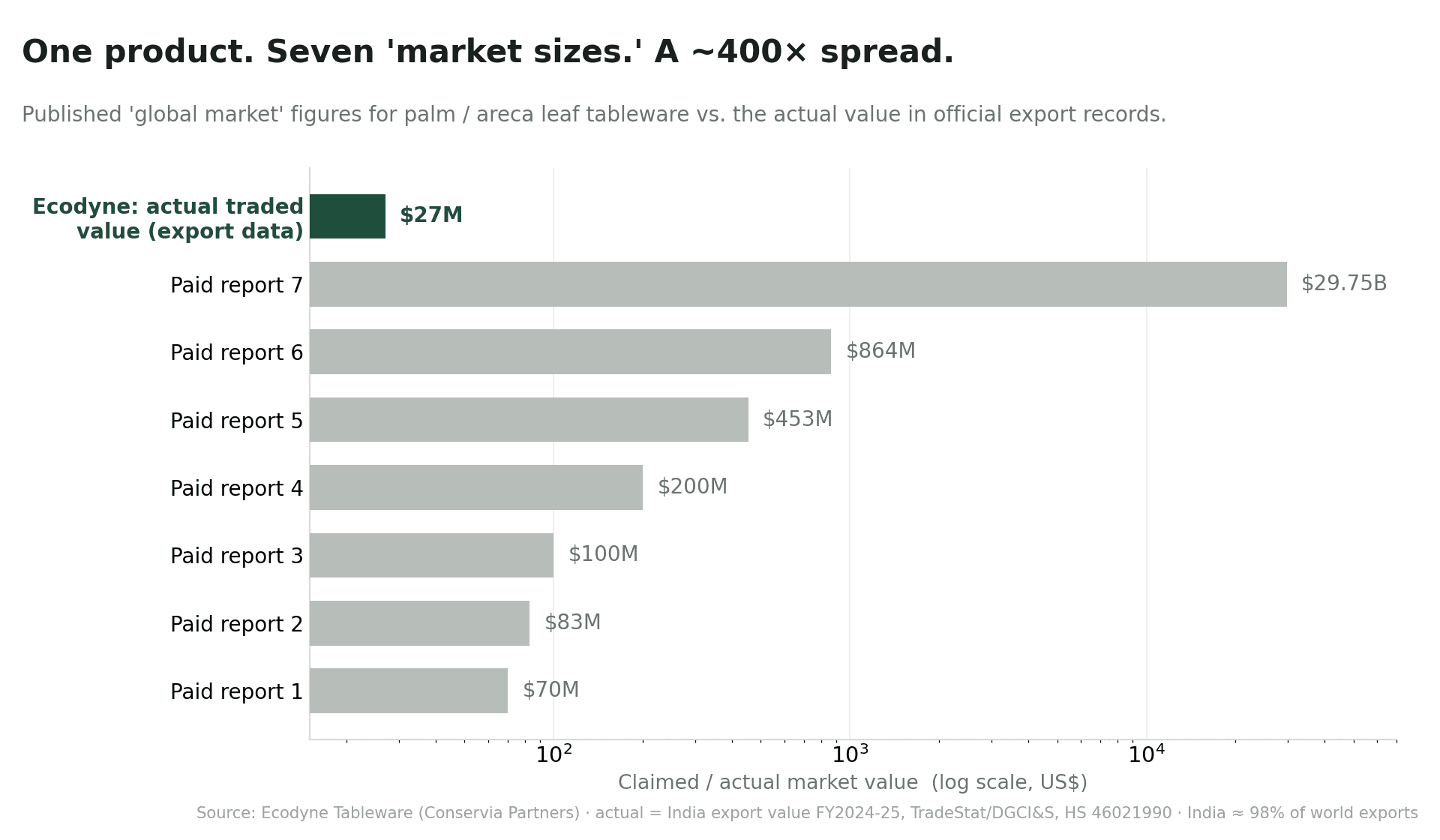
Search for the size of the palm and areca leaf tableware market and you will find a confident answer. Several, in fact. One report puts the global market at about $70 million. Another at $864 million. Another projects it past $29 billion. Same product, same era, figures that disagree by roughly 400 times.
We make and export this product, so the gap mattered to us. We went looking for the actual number – not a modeled estimate behind a paywall, but the official record. This is what we found.
Seven reports, seven “market sizes”
At least nine market-research firms publish a dedicated areca or palm leaf plate report. The category shelf is crowded. The problem is that the numbers do not converge – and real measurements converge. When seven “global market sizes” for one product span from $70 million to nearly $30 billion, what you are looking at is modeling, not measurement. Several even reuse the same growth rate to the second decimal place, on top of visibly machine-generated text, all locked behind a paywall.
What the export record actually shows
India is roughly 98% of the world’s palm-leaf-plate exports, so India’s export ledger is effectively the global traded market – and unlike a modeled estimate, it is a public, checkable number (TradeStat / DGCI&S, HS code 46021990). Three things stand out, and none of them appears in the paid reports.
1. It is small
The traded category runs around $27 million a year – not hundreds of millions, and certainly not tens of billions. Add India’s registered domestic market context and the total traceable activity is on the order of $80 million. A “$864 million” or “$29.75 billion” global market is not measuring this category; it is modeling one that does not exist.
2. It is contracting, not booming
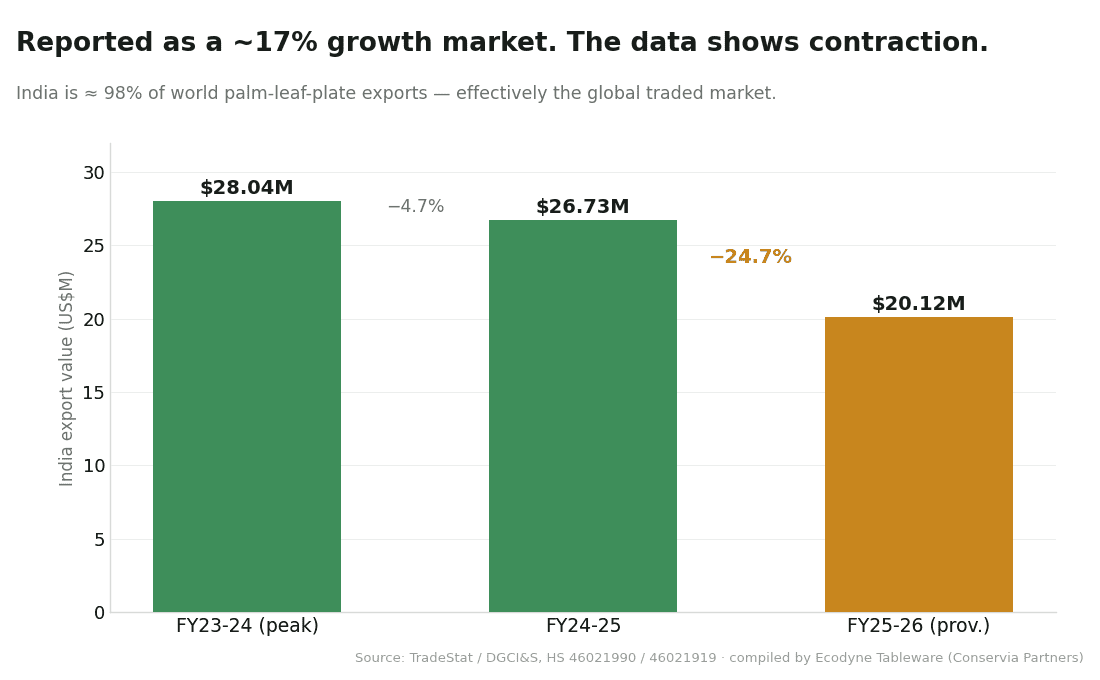
Every syndicated report sells the same headline: roughly 17% annual growth. The export record shows the opposite. From the FY2023-24 peak, value fell 4.7%, then fell a further 24.7% the following year. This is a shrinking traded market, not a growth rocket.
3. It is a US shock, not a global slump
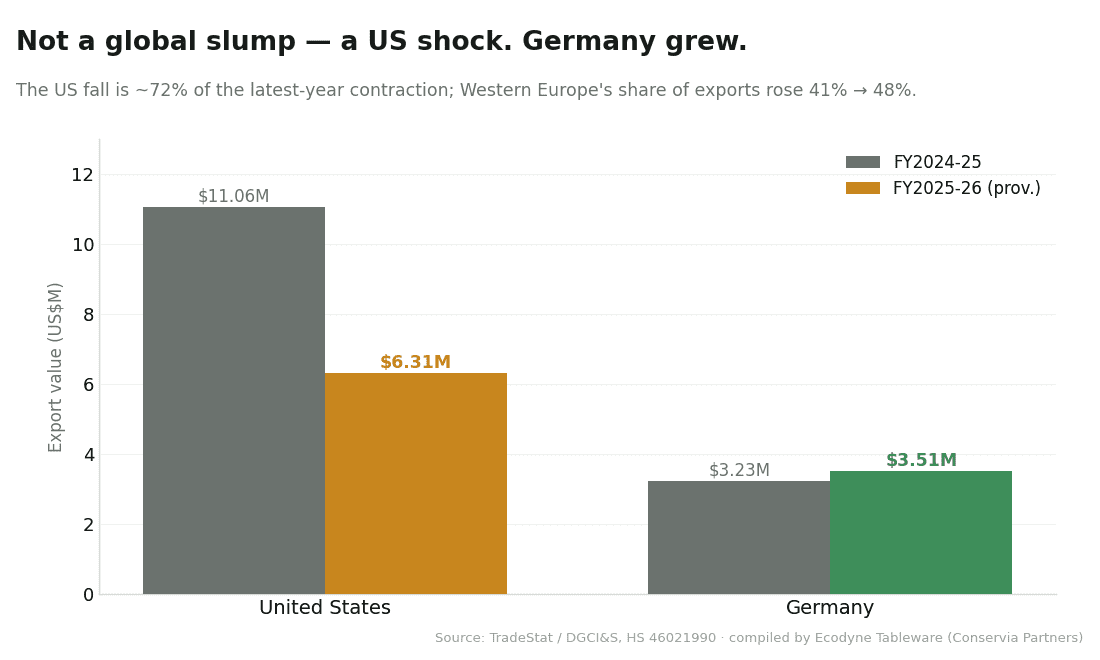
The contraction is not broad – it is concentrated. The United States alone accounts for roughly 72% of the latest year’s decline, with its share of exports falling from about 41% to 31% (a 2025 US regulatory action on areca tableware appears to be the main driver). Meanwhile Germany actually grew, and Western Europe’s share of exports rose from about 41% to 48%. The real story is a single-market shock against a resilient European base – a nuance no single “global CAGR” figure can carry.
Centuries on a leaf
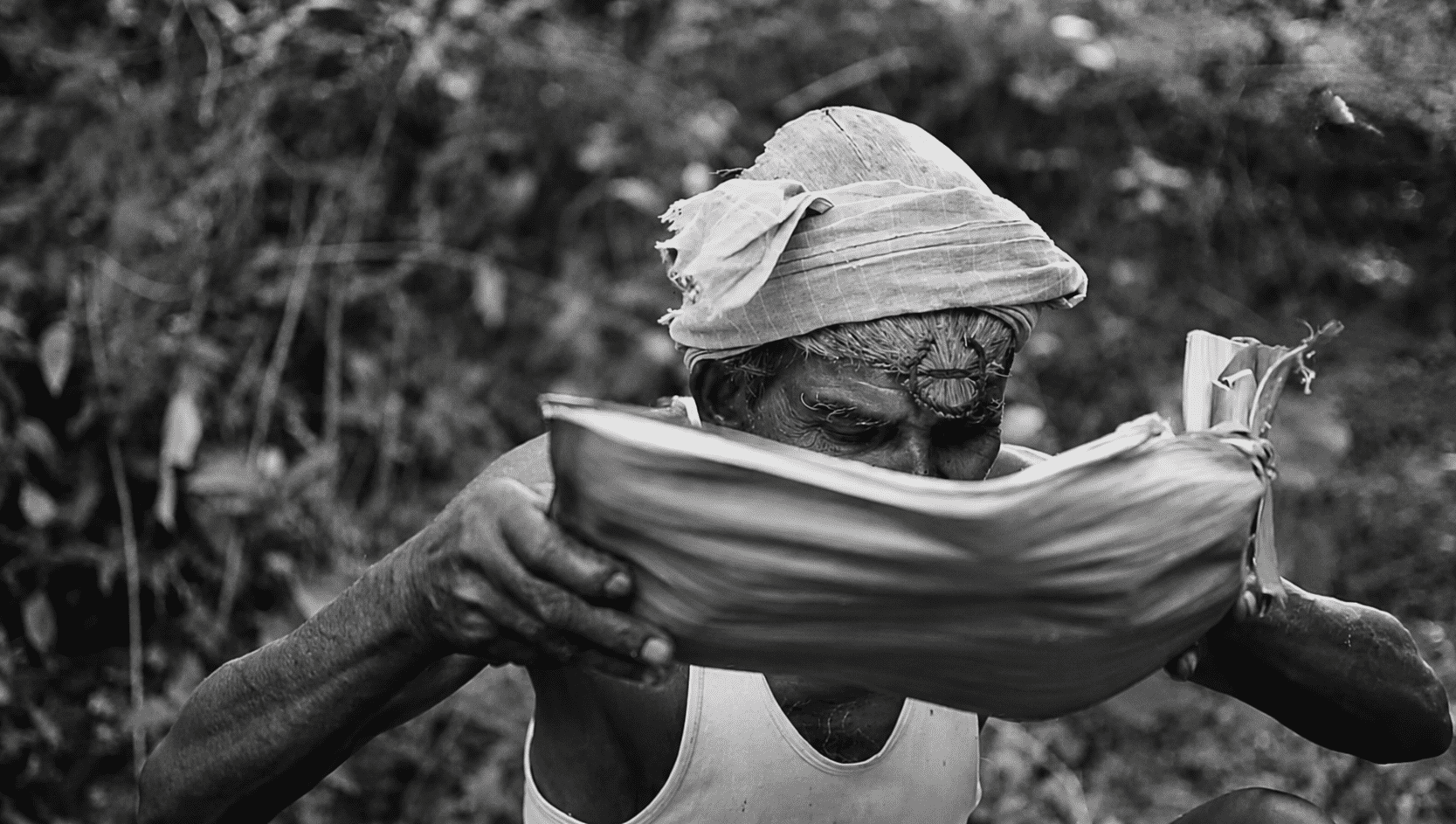
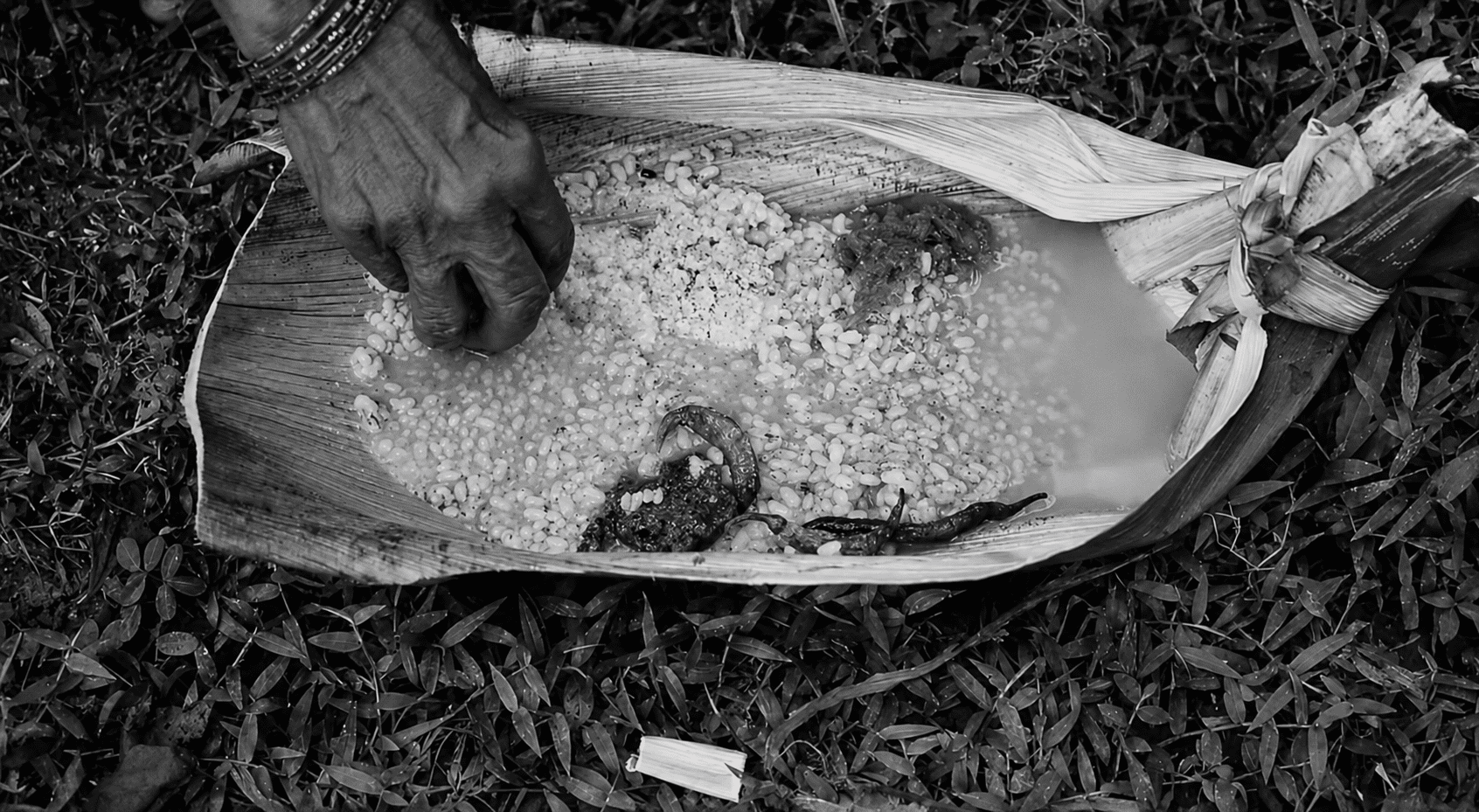
There is one more thing the market reports miss, and it is the oldest fact in the category: India has been eating off leaves for a very long time. Serving food on leaves and stitched leaf-plates is one of the country’s oldest dining traditions – documented across Hindu, Jain and Buddhist texts, classified in Ayurvedic Samhita literature, with roots often traced to the Charaka Samhita. The plates carry regional names – patravali, pattal, vistaraku, vistar, khali; the bowls, dona or done – and have been made from sal, banyan, palash, siali and banana leaves for generations.
This was never a niche craft. Temples still serve offerings to deities and distribute prasadam to devotees on leaf plates; they remain part of weddings, festivals and community feasts across the country, and in the South a full meal off a banana leaf is everyday practice. A 2019 peer-reviewed study in the Bulletin of the National Research Centre described it simply as a long-standing tradition with cultural, religious, medicinal and socioeconomic significance.
What changed is the manufacturing, not the idea. The modern areca plate takes the naturally shed leaf-sheath of the areca palm and presses it under heat – no stitching, no chemicals, no tree felled – into a clean, uniform, food-safe plate built for export. That pressing method only scaled in recent decades. So the product is modern; the practice behind it runs back centuries.
It is worth saying plainly, because the story often gets told backwards. Leaf tableware is periodically “discovered” and marketed in the West as an eco-innovation. It is not an invention. It is a centuries-old Indian practice, now made to international food-safety and supply standards – by manufacturers inside the tradition it came from.
Why we published this
We have an obvious interest here: we manufacture and export this product. That is exactly why we built the report on primary export data rather than estimates – provenance you can check beats a number you have to buy. To be clear about scope, this measures export trade flows, the part of the category with hard, public provenance – not a top-down global valuation. We would rather state what is sourced and verifiable than guess at a total.
The full picture – market, supply chain, export trade, regulation and forecast – is available as a free, open report, built on primary export data by people inside the industry rather than a firm reselling modeled estimates.
Read the full Palm & Areca Leaf Tableware Industry Report 2026