Palm Leaf Plate Manufacturing — Karnataka, India
Palm leaf plate manufacturing at Ecodyne Tableware combines 90 distributed CNC units, 6,500 hydraulic moulds and 200,000 sq ft of solar-powered production floor to produce 4.5 million units every month — from naturally fallen Areca catechu leaves, with zero chemicals, zero dyes and zero additives. India’s largest palm leaf plate manufacturer, 45 minutes from New Mangalore Port, exporting to 18 countries on a 10-working-day container loading guarantee backed by a 1% per day delay penalty.

Inside India’s Largest Palm Leaf Plate Manufacturing Operation
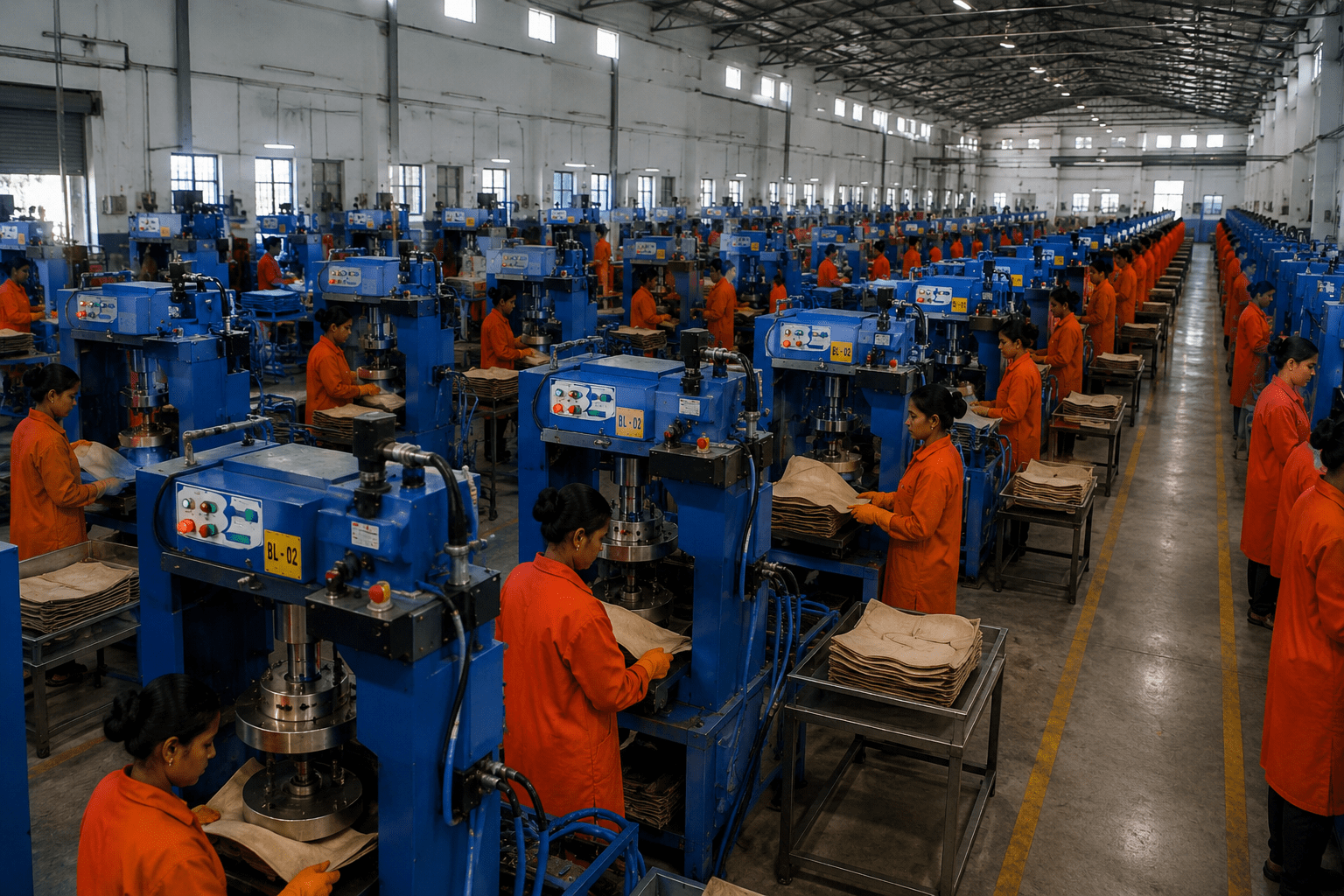
Ecodyne Tableware operates the largest palm leaf plate manufacturing footprint in India — a distributed CNC network of 90 production units running 24/7 across North Karnataka, all powered exclusively by solar. The current monthly output of 4.5 million units scales to 6 million within 45 days and 9 million within 75 days. A standing inventory of more than 3 million units means bulk orders ship from stock, not from a production queue.
4.5M Units Every Month
50 million units a year today, scaling to 9 million per month within 75 days on confirmed demand. No competitor in the sector publishes comparable monthly volume.
90 CNC Manufacturing Units
Distributed across North Karnataka — 200,000 sq ft of total floor area — every unit running on solar power. Production absorbs demand shocks without single-site dependency.
6,500 CNC Hydraulic Moulds
Steel dies machined to every SKU shape — round, square, compartment, oval — running 24/7. Custom moulds for private-label orders cut on-site, typically 20 working days.
3M+ Units in Standing Stock
Bulk orders fulfil from inventory rather than the production queue. A 40ft High Cube container loads in 10 working days — backed by a 1% per day delay penalty.
The 8-Stage Palm Leaf Plate Manufacturing Process
Every Ecodyne palm leaf plate moves through an eight-stage manufacturing pipeline: collection, pressure cleaning, sun-drying, CNC heat-pressing, edge trimming, 24-hour industrial drying at 60°C, final quality inspection with UV sterilisation, and automated packing for container-load despatch.
Leaf Collection from Naturally Fallen Areca Palms
Only naturally fallen leaves of Areca catechu are collected — never harvested from living trees. 810 farming families across 2,000 hectares of CPCRI-guided organic farmland deliver leaves to 30 collection centres within 10–15 km of every supplier village.
Hydro-Pressure Cleaning with Potable Water
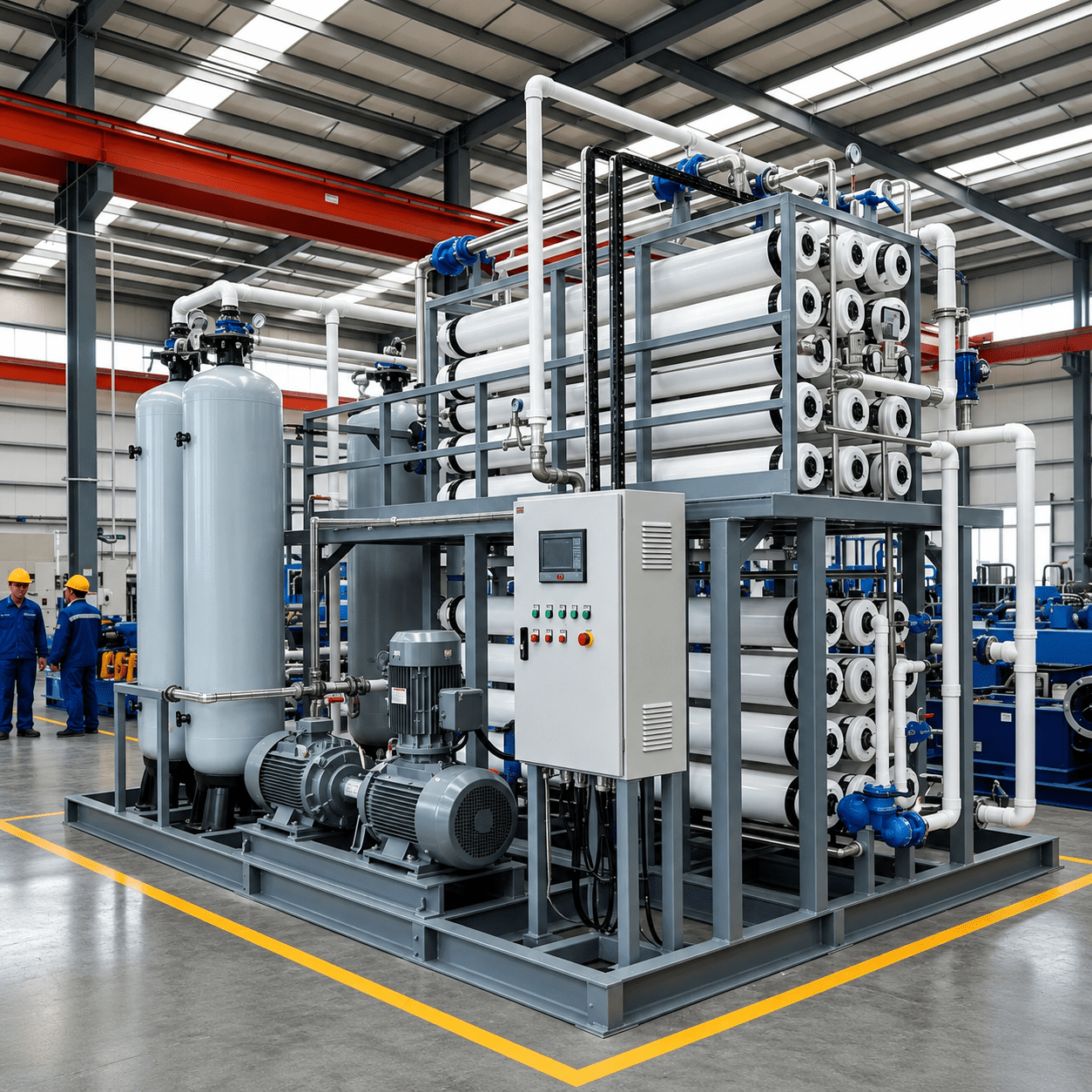
High-velocity water jets remove soil, dust and biological debris. No chemical detergents, no bleaches, no surfactants — the leaf’s natural waxy surface gives inherent moisture and bacteria resistance. 90% of all production water is recycled through RO and UV treatment.
Sun-Drying and Controlled Drying
Cleaned leaves are dried to 8–10% moisture content over 6–8 hours. November to May, natural sunlight does the work; during the June–October monsoon, controlled drying chambers keep moisture inside the specification window.
CNC Hydraulic Pressing at 200°C
Dried leaves are placed in steel dies machined to the SKU geometry — round, square, compartment, oval. Heat-pressing at 200°C simultaneously shapes the plate, sterilises the surface and creates the natural grain pattern. The leaf’s natural lignin holds the form.
Edge Trimming and Nosing
Pressed plates are trimmed flush to the die edge by automated cutters, then run through a nosing machine for the smooth retail finish. Trimmed offcuts are returned to farming partner villages as biomass.
24-Hour Industrial Drying at 60°C
Trimmed plates leave the press with 10–14% bound moisture from the leaf’s natural lignin and the heat-press cycle. Without removal, that moisture becomes the substrate for Aspergillus and Penicillium bloom inside sealed export containers. Plates rack vertically into a forced-air chamber at 60°C for 24 hours — roughly 250 kWh per batch — until pin-tested residual moisture sits under 6%. Run on every batch, absorbed entirely by 100% solar power. Why most manufacturers skip this step →
7-Stage Quality Inspection and UV Sterilisation
Each plate is hand-graded across seven QC stages — leaf selection, wash, pre-press inspection, post-press sterilisation, edge inspection, dimensional tolerance and final visual pass. Plates pass through a UV conveyor belt as a second sterilisation layer after the 200°C heat-press.
Automated Packing for Container-Load Despatch
Accepted plates are counted by automated lines into 25-piece shrink-wrapped packs using 19-micron food-safe poly-olefin film. Four packs fill a 5-ply food-grade corrugated carton — 100 units. Cartons receive EAN barcodes and customer-specified shipping marks, then load straight onto pallets for the 45-minute drive to New Mangalore Port. A 40ft High Cube container loads in 10 working days from PO confirmation.
100% Solar-Powered, 90% Water Recycled


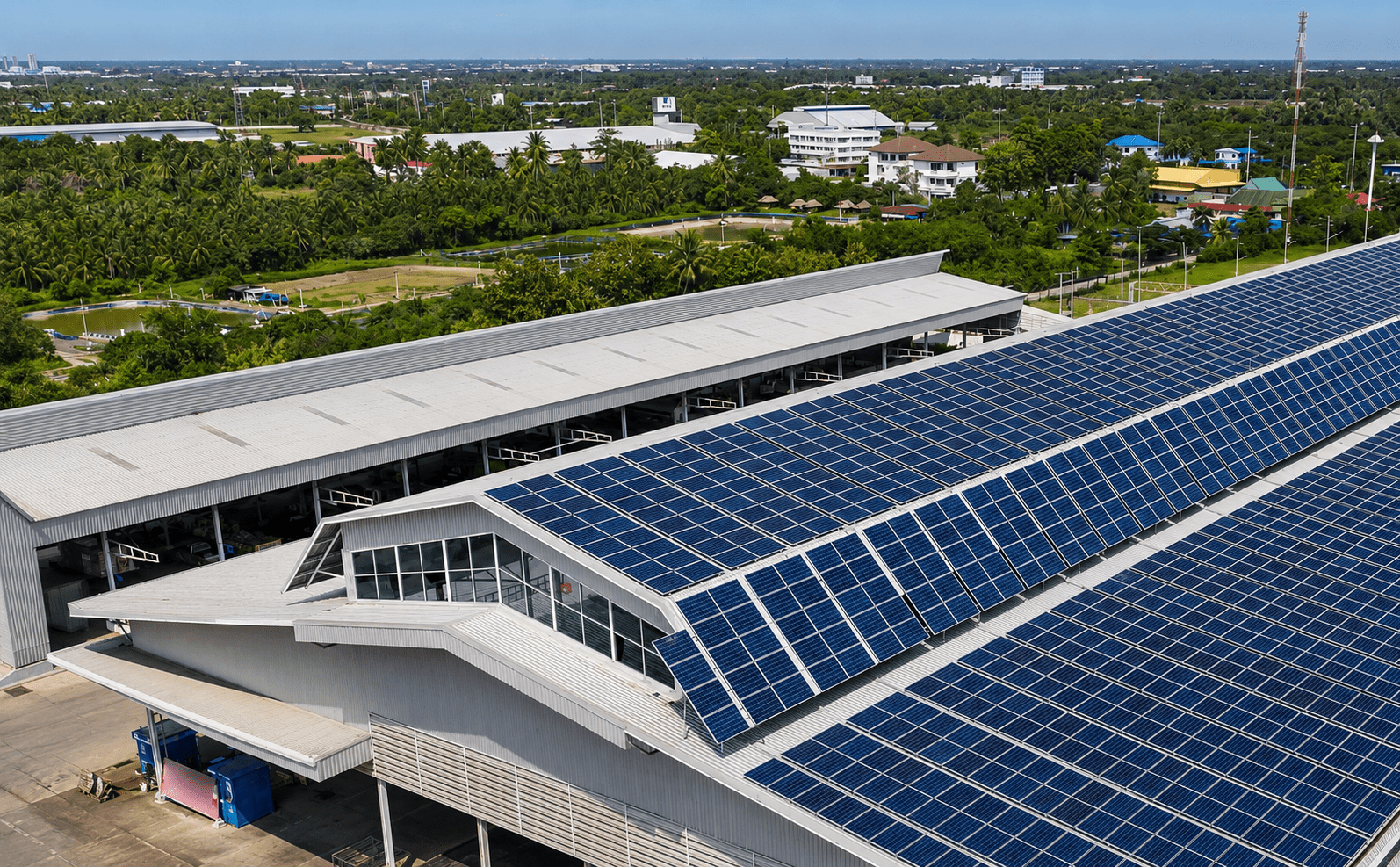
Every one of the 90 palm leaf plate manufacturing units runs on dedicated solar capacity — there is no grid offset, no carbon credit accounting, no “transition plan”. The factory roof was the energy plan from day one. 90% of all production water is recycled through reverse-osmosis and UV treatment loops before being reused on the next wash cycle.
Naturally fallen leaves mean no tree is harmed for production. The botanical raw material — Areca catechu — sheds its sheaths annually on a November–May cycle that Karnataka’s 216,000 hectares of areca cultivation already runs as a side product. Full sustainability detail and CPCRI partnership specifics on the sustainability page.
Three Published Quality Tiers — Premium, Economy, Domestic
Ecodyne publishes three discrete quality tiers, each with a written specification. Buyers specify the tier on the PO; product code reflects it. No tier mixing in container loads.
Premium
For retail and premium HoReCa — visually flawless leaf grain, full dimensional tolerance. The benchmark spec for buyers shipping under their own brand.
Economy
For catering, event service and high-volume foodservice — minor leaf variation acceptable, full functional integrity and food-safety compliance.
Domestic
For the Indian market only — broader visual tolerance, full food-safety compliance. Not exported.
Quality assurance runs across seven inspection stages, with dual sterilisation — 200°C heat-press contact followed by a UV conveyor — and a 15–17% rejection rate. Of every 100 plates entering the QC pipeline, only 83–85 leave the facility. No other palm leaf plate manufacturer in the sector publishes a rejection rate. Ecodyne is also the first palm leaf plate manufacturer in India to certify ISO 9001:2015 — the QMS that governs every step from leaf intake to despatch.
Watch the Palm Leaf Plate Manufacturing Process
Four minutes inside a working Ecodyne palm leaf plate manufacturing unit in Karnataka — from naturally fallen leaf through pressure-wash, drying, CNC heat-press, edge trim, QC inspection and packing into a 40ft High Cube container.
In-person and video factory tours can be scheduled with the procurement team. Email sales@ecodynetableware.com or message on WhatsApp.
Certifications Backing the Manufacturing Process
Every wholesale quote ships with the full certification documentation pack. Scanned originals on request: ISO 9001:2015, ISO 14001:2015, BSCI audit certificate, LFGB §30/§31 migration test reports, USDA BioPreferred certificate.
Full certification stack, scope and audit cadence on the certifications page.
Questions About Palm Leaf Plate Manufacturing
The questions wholesale buyers and importers most often ask before placing a first palm leaf plate manufacturing order.
Where are Ecodyne’s palm leaf plates manufactured?
+
All Ecodyne palm leaf plate manufacturing happens in North Karnataka, India — 90 distributed CNC units totalling 200,000 sq ft, headquartered at Hosabettu Village, Bangra Manjeshwara. The facility cluster is 45 minutes from New Mangalore Port (INMAA), which handles containerised exports to Germany, France, Spain, the United Kingdom, Israel, Australia and 12 other countries.
What is the palm leaf plate manufacturing process?
+
The palm leaf plate manufacturing process is an eight-stage pipeline: collection of naturally fallen Areca catechu leaves, hydro-pressure cleaning with potable water, drying to 8–10% moisture, CNC hydraulic pressing at 200°C in steel dies, edge trimming and nosing, 24-hour industrial drying at 60°C to prevent post-press mould, seven-stage quality inspection including UV sterilisation, and automated packing into 25-piece shrink wraps and 100-piece corrugated cartons. No chemicals, dyes, additives, adhesives or coatings are used.
Are any chemicals or coatings used in palm leaf plate manufacturing?
+
No. Ecodyne’s palm leaf plate manufacturing uses water and heat only — no chemical detergents, no bleaches, no dyes, no surface coatings, no resin liners, no PFAS, no adhesives. The leaf is held in shape by its own lignin, which softens at 200°C and re-sets on cooling. LFGB §30/§31 migration testing on every production lot confirms food-contact safety; the BSCI audit confirms supply-chain ethics.
How is consistent quality maintained across 90 manufacturing units?
+
Every unit runs to the same ISO 9001:2015 Quality Management System — the first such certification in the palm leaf sector. Seven inspection stages, identical CNC dies, identical 200°C press parameters, identical post-press UV sterilisation, and a published 15–17% rejection rate keep specification uniform. Three written quality tiers — Premium, Economy, Domestic — let buyers specify exactly which standard ships, with no tier mixing inside a container load.
What is Ecodyne’s monthly palm leaf plate manufacturing capacity?
+
Current monthly output is 4.5 million units — approximately 50 million units a year — scaling to 6 million per month within 45 days and 9 million per month within 75 days on confirmed PO. A standing inventory of over 3 million units means bulk orders ship from stock; a 40ft High Cube container loads in 10 working days, backed by a 1% per day delay penalty written into every supply contract.
Can buyers visit the palm leaf plate manufacturing facility in person?
+
Yes. Wholesale buyers, importers and white-label partners can schedule a video factory tour or an in-person visit to the Karnataka facility — typically arranged within two weeks. Tours cover the full eight-stage process, the CPCRI farming partnership and the QC pipeline. Contact sales@ecodynetableware.com or WhatsApp +91 82773 02580 to schedule; response is sub-four hours.
About Ecodyne Tableware — Palm Leaf Plate Manufacturer in Karnataka
Ecodyne Tableware, a brand of Conservia Partners, is India’s largest manufacturer and exporter of palm leaf plates, bowls and tableware. Based in Karnataka, India, Ecodyne produces 4.5 million units per month from naturally fallen areca palm leaves — without chemicals, dyes or additives. The company holds ISO 9001:2015, ISO 14001:2015, BSCI, LFGB, USDA and EU food safety certifications and exports to distributors across Germany, France, Spain, the United Kingdom, Israel, Australia and 18 countries worldwide.
Ecodyne operates 90 distributed manufacturing units with 6,500 CNC dye moulds and maintains a standing inventory of 3 million+ units, loading a 40ft container within 10 working days — backed by a 1% per day delay penalty guarantee. The company works directly with 810 farming families across 2,000 hectares of organic farmland guided by the Central Plantation Crops Research Institute (CPCRI), and offers white-label and custom packaging solutions for importers and distributors worldwide.
See Palm Leaf Plate Manufacturing in Person
Wholesale quote with full certification documentation pack. Video factory tour with the procurement team. Or an in-person visit to the Karnataka facility. Sub-four-hour response on sales@ecodynetableware.com.
Common Questions About Our Manufacturing
Where are Ecodyne’s palm leaf plates manufactured?
All Ecodyne palm leaf plate manufacturing happens in North Karnataka, India — 90 distributed CNC units totalling 200,000 sq ft, headquartered at Hosabettu Village, Bangra Manjeshwara. The facility cluster is 45 minutes from New Mangalore Port (INMAA), which handles containerised exports to Germany, France, Spain, the United Kingdom, Israel, Australia and 12 other countries.
What is the palm leaf plate manufacturing process?
The palm leaf plate manufacturing process is an eight-stage pipeline: collection of naturally fallen Areca catechu leaves, hydro-pressure cleaning with potable water, drying to 8–10% moisture, CNC hydraulic pressing at 200°C in steel dies, edge trimming and nosing, 24-hour industrial drying at 60°C to prevent post-press mould, seven-stage quality inspection including UV sterilisation, and automated packing into 25-piece shrink wraps and 100-piece corrugated cartons. No chemicals, dyes, additives, adhesives or coatings are used.
Are any chemicals or coatings used in palm leaf plate manufacturing?
No. Ecodyne’s palm leaf plate manufacturing uses water and heat only — no chemical detergents, no bleaches, no dyes, no surface coatings, no resin liners, no PFAS, no adhesives. The leaf is held in shape by its own lignin, which softens at 200°C and re-sets on cooling. LFGB §30/§31 migration testing on every production lot confirms food-contact safety; the BSCI audit confirms supply-chain ethics.
How is consistent quality maintained across 90 manufacturing units?
Every unit runs to the same ISO 9001:2015 Quality Management System — the first such certification in the palm leaf sector. Seven inspection stages, identical CNC dies, identical 200°C press parameters, identical post-press UV sterilisation, and a published 15–17% rejection rate keep specification uniform. Three written quality tiers — Premium, Economy, Domestic — let buyers specify exactly which standard ships, with no tier mixing inside a container load.
What is Ecodyne’s monthly palm leaf plate manufacturing capacity?
Current monthly output is 4.5 million units — approximately 50 million units a year — scaling to 6 million per month within 45 days and 9 million per month within 75 days on confirmed PO. A standing inventory of over 3 million units means bulk orders ship from stock; a 40ft High Cube container loads in 10 working days, backed by a 1% per day delay penalty written into every supply contract.
Can buyers visit the palm leaf plate manufacturing facility in person?
Yes. Wholesale buyers, importers and white-label partners can schedule a video factory tour or an in-person visit to the Karnataka facility — typically arranged within two weeks. Tours cover the full eight-stage process, the CPCRI farming partnership and the QC pipeline. Contact sales@ecodynetableware.com or WhatsApp +91 82773 02580 to schedule; response is sub-four hours.
What are the 8 stages of Ecodyne’s palm leaf plate manufacturing process?
(1) Farmer collection, (2) Sorting and grading, (3) Cleaning, (4) Soaking, (5) Heat pressing at 200°C, (6) 24-hour industrial drying at 60°C, (7) Edge trimming, (8) Quality inspection and packing.
Why does Ecodyne use a 24-hour drying step at 60°C?
The dedicated 24-hour drying stage drives leaf moisture below 8%, which eliminates mould risk during ocean shipping and storage. This is the single most important quality differentiator vs cottage-industry suppliers who skip or shorten this stage.
How is the manufacturing facility powered?
The Bengaluru facility runs on 100% on-site solar, eliminating fossil-fuel electricity from production.
What certifications does Ecodyne’s manufacturing operation hold?
ISO 9001:2015 (quality), ISO 14001:2015 (environmental), BSCI (social compliance), LFGB (German food safety §30 §31), USDA BioPreferred, and EU 1935/2004 food-contact compliance. EN 13432 certification is in progress.
What temperature is used during the heat-pressing stage?
200°C, in precision-controlled steel moulds. Higher than the industry-standard 100–120°C — Ecodyne’s specification eliminates microorganisms in a single press cycle and produces a denser, more consistent leaf without bleaching.
How many SKUs and mould shapes does Ecodyne offer?
The proprietary mould library covers 6,500+ shapes spanning plates, bowls, platters, compartment plates, and custom OEM designs across 18 export markets.
Can Ecodyne develop custom moulds for private-label customers?
Yes. Private-label and OEM mould development typically takes 4–6 weeks from approved drawings, with typical MOQ of 2 containers (~60,000 units) per SKU.