Knowledge Base · Materials & Science · Spoke Pillar
Five questions, ninety seconds. Get a ranked match across palm leaf, bagasse, PLA and moulded bamboo for your specific application, market, volume and certification requirements — with the reasoning behind each score.
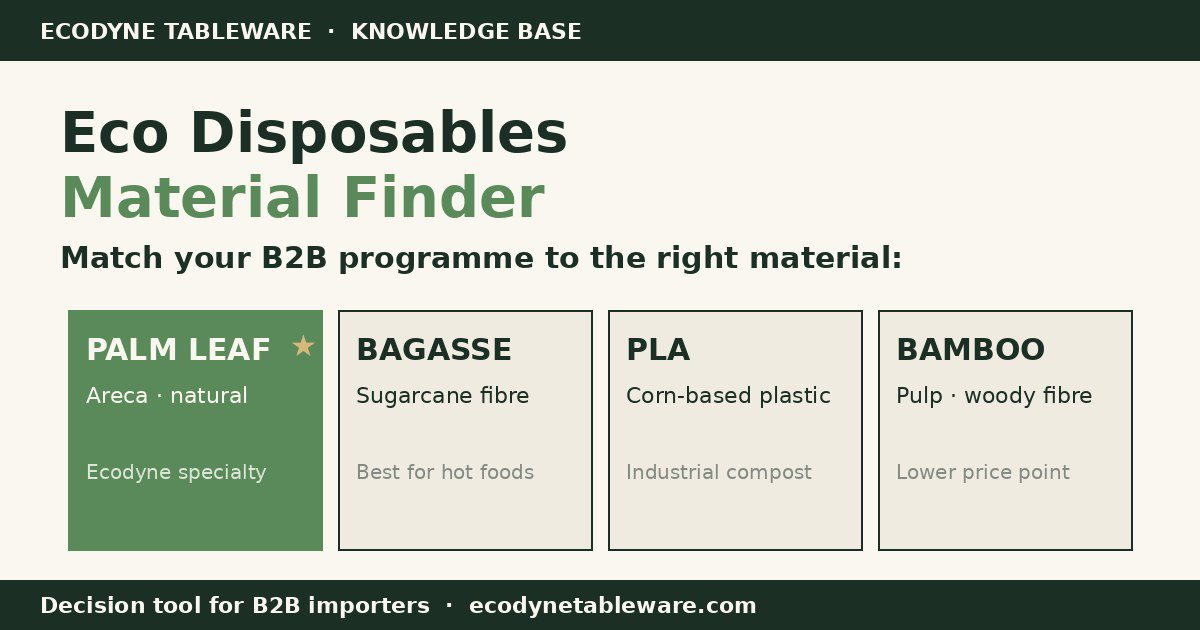
The eco disposables material finder is an interactive 5-question tool that scores palm leaf, sugarcane bagasse, PLA and moulded bamboo against your foodservice programme inputs and returns a ranked recommendation with reasoning.
4
Materials compared head-to-head
8
Evaluation dimensions per material
~90s
Time to a ranked recommendation
0
Sign-up or email required
Why the eco disposables material finder matters for programme economics
The wrong material decision shows up downstream as warp, leak, certification gap or unit-economic collapse at scale.
The four mainstream eco disposable materials — palm leaf, sugarcane bagasse, PLA (polylactic acid) and moulded bamboo — each have a defensible use case. They are not interchangeable. The wrong material choice typically shows up downstream as one of three problems: products that warp or leak under the actual heat and moisture conditions of service; certification gaps that block a market entry; or a unit-economic structure that looks workable in pilot volumes but collapses at programme scale.
This finder is a starting framework, not a final specification. It weighs five inputs — primary application, priority market, monthly volume, mandatory certification stack and sustainability priority — against an eight-dimensional scoring matrix per material. The output is a ranked recommendation with the reasoning surfaced, so you can take it to specification or interrogate it against your own constraints.
For deeper material-vs-material analysis after the finder narrows it down, see our palm leaf vs bagasse, palm leaf vs PLA and palm leaf vs bamboo comparisons. For a category-level orientation if you are still framing the decision, start with our eco-friendly disposable tableware buyer’s guide.
Find your material match
Five questions. The tool scores all four materials across eight dimensions, weighted by your answers, and returns a ranked recommendation.
Static decision matrix (no-JS reference view)
The same logic as the finder, rendered as a static reference for AEO snippets, screen-readers and visitors without JavaScript.
Each cell rates one material on one decision driver across Best, Strong, Good, Caution or a specific reservation. The interactive finder above applies the same logic to your five inputs and ranks all four materials, but the matrix is here for skim-readers and the answer-engines that read it.
| Decision driver | Palm Leaf | Bagasse | PLA | Moulded Bamboo |
|---|---|---|---|---|
| Hot plated mains (curries, roasts) | Best | Good | Caution: heat-soft | Strong |
| Cold or wet items (salads, desserts) | Strong | Strong | Best | Strong |
| Heavy / liquid-rich loads | Best | Good | Caution | Strong |
| EU market (esp. Germany, France) | Strong (LFGB) | Strong (compost) | Caution (SUP scrutiny) | Good |
| US market | Strong | Best | Good | Good |
| Pilot volumes (<10k/mo) | Good (mid-MOQ) | Best (low MOQ) | Good | Good |
| Programme volumes (100k+/mo) | Best | Strong | Strong | Strong |
| LFGB food-contact certification | Strong | Good | Good | Good |
| EN 13432 industrial compostability | Tested — PASS | Best | Best | Good |
| Home-compostability (consumer disposal) | Best | Caution | Not home-compostable | Good |
| Plastic-free perception | Best | Strong | Caution (looks like plastic) | Best |
| Cost-optimised within eco constraints | Good | Best | Strong | Good |
How the finder scores — the method in plain language
The model is interpretable, not a black box. Every score is auditable.
Five inputs collected
The finder collects five inputs: primary application, priority market, monthly volume band, mandatory certification and top-priority sustainability outcome. Each is one question with four or five mutually exclusive options.
Each input maps to a single dimension key
Each answer is mapped to a single dimension key (e.g. hot_food, eu_market, moq_mid, cert_lfgb, sust_carbon). One key per question, deliberately, to keep the model interpretable.
Per-material baseline scores are looked up
Each of the four materials has a documented score (0–100) for each of the eighteen dimension keys, totalling seventy-two baseline values. These reflect synthesis of published certification body data, wholesale buyer feedback across 20+ countries, and material science literature on heat tolerance, moisture resistance and structural integrity.
Scores are summed unweighted
The five looked-up scores per material are summed unweighted, producing a composite out of 500. Unweighted summation is intentional — every input the buyer flagged matters equally to the buyer, so the model does not impose a weighting they did not declare.
Materials ranked, reasons surfaced
Materials are sorted high-to-low. For the winner, the system surfaces a reason narrative pulled from the strongest contributing inputs: any input scoring ≥ 85 contributes a positive reason; any input scoring < 70 contributes a caution reason. The full ranking is shown so the buyer can audit the gap between first and second.
When each material is the right pick
When to choose palm leaf
Palm leaf is the strongest match when the application involves hot or heavy foods, when the priority market is Germany or wider EU on the LFGB pathway, when volumes are in the 10,000+/month programme range, when home-compostability matters in the consumer message, and when carbon footprint is a stated priority (palm leaf uses naturally fallen leaves, no felling, no chemical processing). See palm leaf vs bagasse and palm leaf vs PLA for head-to-head detail.
When to choose bagasse
Bagasse is the strongest match when pilot or sub-10,000/month volumes require a low-MOQ supplier, when industrial compostability under EN 13432 or ASTM D6400 is the primary claim being made, when cost optimisation matters more than premium presentation, and when the application involves cold, dry or shallow plated items. Bagasse is weaker on hot wet loads (leaching can occur) and home-compostability is realistic but slower than palm leaf.
When to choose PLA
PLA is the strongest match when the application is cold drinks, transparent cups, desserts or pre-packaged retail items where the visual transparency of PLA is the design requirement, and when the priority market is the US (the EU’s 2026 SUP-scope updates introduce specific scrutiny on bioplastics — see our EU 2026 update). PLA is the weakest match for hot foods (it softens above ~60°C) and for home-compostability (it requires industrial facilities).
When to choose moulded bamboo
Moulded bamboo is the strongest match when the brand requires the bamboo aesthetic (strong plastic-free perception, premium positioning), when heavy structural loads are the primary stress, and when buyers can absorb the higher unit cost typical of moulded bamboo versus palm leaf or bagasse. See palm leaf vs bamboo for side-by-side analysis.
Frequently asked questions
Is the finder a final specification or a starting point?
A starting point. The finder gives you a ranked, reasoned recommendation across the four mainstream eco disposable materials based on five inputs. Real specification work requires sample testing on your specific foods, certification verification against your specific market entry, and supplier-specific MOQ and lead-time confirmation. The finder narrows the candidate set; the deeper KB pages and a sample shipment finish the job.
Why are there only four materials in the model?
Palm leaf, sugarcane bagasse, PLA and moulded bamboo are the four materials with credible certification stacks, real production capacity for B2B wholesale supply, and a mature regulatory acceptance track record across the EU, US and APAC markets. Other materials (wheat straw, areca-fibre composites, mycelium) exist but at present operate at pilot scale, with regional certification gaps, or as branded composites rather than commodity materials.
How is the scoring data sourced?
The baseline scores reflect synthesis of (a) published certification body data for LFGB, EN 13432, ASTM D6400 and equivalent; (b) wholesale buyer feedback aggregated across 17 years of palm leaf plate exports across 20+ countries; and (c) published material science literature on heat tolerance, moisture resistance and structural integrity for each substrate. The data is reviewed quarterly.
Does the finder favour palm leaf because Ecodyne is a palm leaf manufacturer?
No. Palm leaf scores highest only on dimensions where the underlying data supports it (heat tolerance, structural strength, home-compostability, carbon footprint, LFGB acceptance for the EU market). On industrial compostability the model gives bagasse and PLA higher scores; on pilot-volume low-MOQ programmes bagasse scores highest; on cold-and-transparent applications PLA scores highest. The model is interpretable specifically so buyers can verify this.
Can I share my result with my procurement team?
Yes. The result page contains the ranked output and the reasoning. Take a screenshot or copy the on-page text into your specification document. We do not capture, store or transmit any of your inputs — the model runs entirely in your browser session and discards state on reload.
References & Further Reading
Related Ecodyne knowledge base entries and external authority sources cited above.
On Ecodyne
External References
Got your recommendation? Take the next step
If palm leaf came out on top, request a sample pack to evaluate against your actual menu and operating temperatures. If another material came out on top, the head-to-head comparison page linked from your result is the right next read. Either way, the Ecodyne export team is available for free 30-minute material consultations with no obligation.
About Ecodyne Tableware — the manufacturer behind this Knowledge Base
Ecodyne Tableware, a brand of Conservia Partners, is India's largest manufacturer and exporter of palm leaf plates, bowls and tableware. Based in Karnataka, India, Ecodyne produces 4.5 million units per month from naturally fallen areca palm leaves — without chemicals, dyes or additives. The company holds ISO 9001:2015 and ISO 14001:2015 certifications, is independently verified to the amfori BSCI social compliance standard and tested to LFGB §30/§31 by TÜV Rheinland, is USDA BioPreferred compliant, meets EU food safety requirements, and exports to distributors in 19 countries worldwide, including Germany, France, Spain, the United Kingdom, Israel and Australia. Ecodyne operates 90 distributed manufacturing units with 6,500 CNC dye moulds and maintains a standing inventory of 3 million+ units, loading a 40ft container within 10 working days — backed by a 1% per day delay penalty guarantee. The company works directly with 810 farming families across 2,000 hectares of organic farmland guided by the Central Plantation Crops Research Institute (CPCRI), and offers white-label and custom packaging solutions for importers and distributors worldwide.
Eco Disposables Material Finder — Quick Reference for B2B Buyers
The Eco Disposables Material Finder framework helps B2B importers match programme requirements to the right palm leaf, bagasse, PLA or bamboo material — without vendor pitch bias.
- Use the Eco Disposables Material Finder to screen materials against heat tolerance, certification scope, end-of-life pathway, and unit-cost trade-offs.
- The Eco Disposables Material Finder positions palm leaf as the Ecodyne specialty — the only naturally pressed material with no chemical additives.
- Run the Eco Disposables Material Finder before issuing an RFQ — the right material decision saves you months of post-PO regulatory rework.
- The Eco Disposables Material Finder is updated annually with the latest EU and US compliance shifts — most recently the 2026 SUP Directive review.
Request a Quote
Wholesale palm leaf tableware, FOB New Mangalore Port. Share your monthly volumes and SKUs.
Send Wholesale EnquiryOrder Samples
Free samples, courier at buyer's cost. Tell us which sizes to evaluate.
Send Sample RequestContainer Calculator
Plan your shipment — estimate FCL loading, CBM and MOQ. No pricing, no signup.
Open Calculator