Knowledge Base · Sourcing & Operations
Year-Round Palm Leaf Plate Supply: How Ecodyne Delivers Through the Off-Season
Palm leaf is a seasonal raw material. Most Indian manufacturers see real supply gaps in the June–October off-season — but B2B importers can’t run a calendar around a monsoon. Ecodyne’s year-round supply model removes that gap from your procurement risk register.
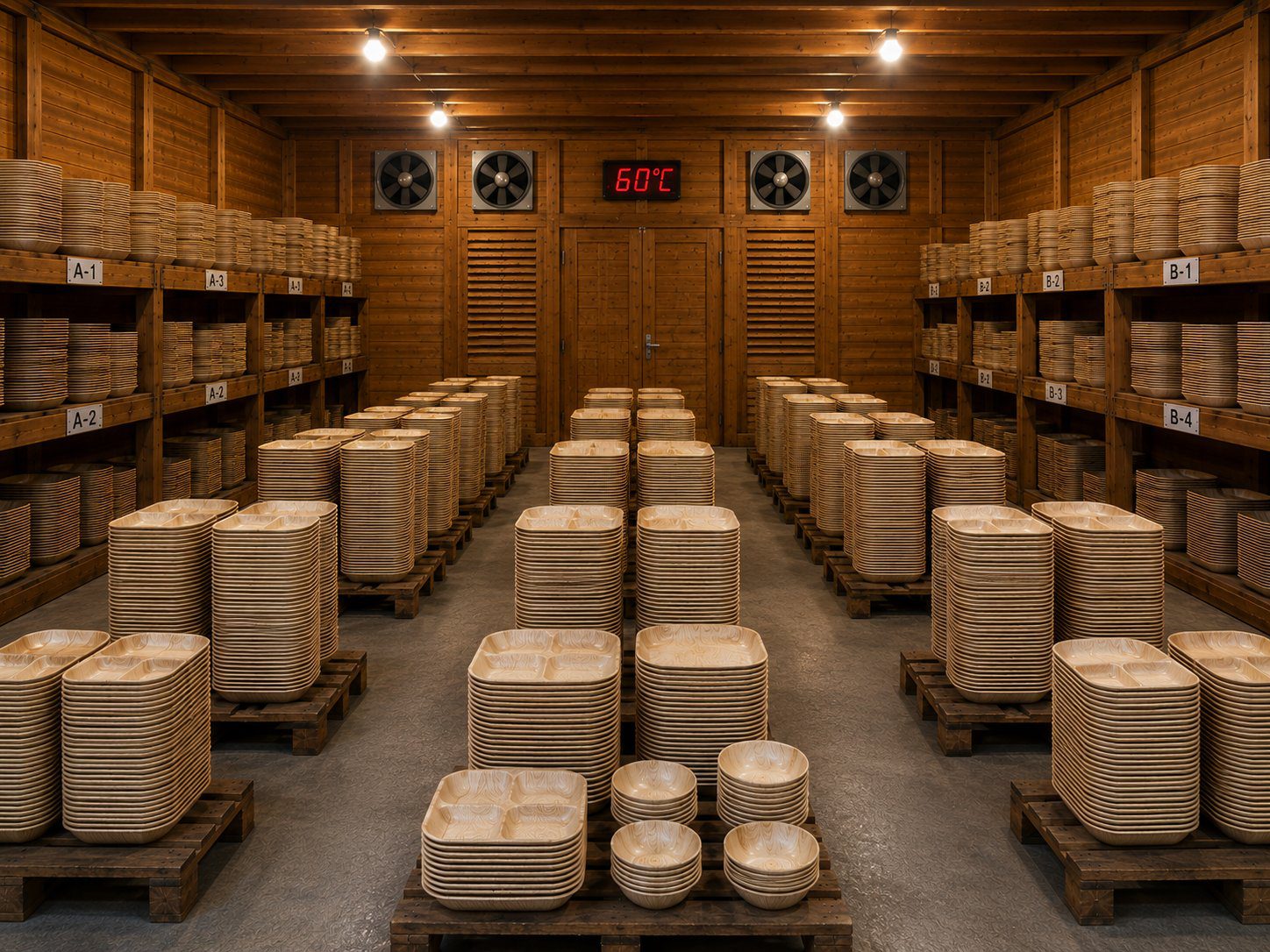
Areca catechu leaves drop seasonally — peak harvest is November to May in southern India; lighter June to October. Most Indian palm leaf manufacturers see supply gaps in the off-season. Ecodyne maintains year-round supply through structured peak-harvest raw-material stockpiling, 3 million+ units of standing finished inventory across 90 distributed manufacturing units, and 810 farming families guaranteeing first-priority leaf collection.
12 mo
Continuous supply commitment — no off-season gap
3M+
Units of finished standing inventory across 90 units
810
Farming families with first-priority collection rights
2,000 ha
Of organic farmland under CPCRI-guided practice
Ecodyne year-round palm leaf supply guarantee solves the seasonal-availability problem that plagues most Indian palm leaf plate manufacturers. Through 3M+ standing inventory, vertically-integrated farmer partnerships, and contractually-committed monthly minimum draws, Ecodyne offers B2B importers a year-round palm leaf supply that eliminates monsoon stockouts and rationing risk.
The seasonality problem, in plain language
Why most Indian palm leaf manufacturers can’t quote on the off-season the same way they quote on the peak.
Areca palm trees shed their leaf sheaths over the dry months in southern India. The bulk of the leaf fall happens between November and May — the “peak harvest”. The wet and post-monsoon months from June to October see only a fraction of the leaf volume that drops during peak.
Manufacturers without raw-material reserves run on spot intake during the off-season. The result, repeatedly visible to importers, is one of three things: production rates fall by 30–50 percent through July–September, lead times extend by four to eight weeks, or unit pricing quietly drifts upward to ration whatever leaf the manufacturer can secure. For an EU distributor or HoReCa group that has already committed to a SKU calendar with downstream customers, none of these outcomes is workable.
Why this matters for procurement
Off-season supply gaps are the single most common reason a first-year palm leaf programme misses its sell-through targets — not freight, not certifications, not customs. Buyers who structure around it succeed. Buyers who assume Indian supply is continuous get caught.
How Ecodyne maintains year-round palm leaf supply
Five layered infrastructure mechanisms. Each is independently necessary. Together they convert seasonality from a buyer risk into a supplier obligation.
-
Peak-harvest raw-material stockpiling
During November–May, leaf intake at the 90 manufacturing units consistently exceeds same-day processing demand. The surplus is dried, pressure-cleaned, and stored in climate-controlled holding areas at each unit. The stockpile is sized — across the network — to cover the full off-season at full production capacity. We don’t run a 4-month buffer at half-capacity; we run a 4–6 month buffer at full capacity. That is the difference between a guarantee and a hope.
-
3M+ units of finished standing inventory across the SKU range
Most orders ship from inventory rather than waiting on production. The standing-inventory model operates independently of the raw-material seasonality cycle: even if a single manufacturing unit were to pause production tomorrow, three million pre-made plates and bowls — distributed across the size and shape range — remain available for immediate carton-up and container load.
-
810 farming families with first-priority collection rights
Long-term direct contracts with 810 farming families across Karnataka grant Ecodyne first-priority on every harvested leaf. In peak season this maximises intake into the stockpile; in the off-season it captures whatever leaf is available before any broker can compete for it. This is structurally different from buying from a leaf broker on a weekly spot basis — which is how most of the industry runs.
-
CPCRI-guided cultivation across 2,000 hectares
The Central Plantation Crops Research Institute (CPCRI) in Karnataka guides the farmer network on harvest timing, leaf storage at the collection-centre level, and post-monsoon recovery practices. The technical effect is a broader harvest window — farmers extract more usable leaf from each tree, and the leaf quality is consistent enough to support our Premium and Organic grades regardless of the calendar month.
-
Off-season production scheduling across 90 distributed units
The 90 manufacturing units are scheduled centrally to draw down stockpiled raw material in coordinated sequence. No single unit carries the whole network’s off-season risk; if one site sees a local raw-material dip, the central schedule shifts demand to another site holding deeper stockpile. The aggregated outcome is production throughput held within ±5 percent of peak across the full twelve-month year.
The contractual commitment
Year-round supply at Ecodyne isn’t a marketing claim — it’s the standing contractual position. Every supply contract Ecodyne signs commits the company to fulfil B2B orders through the entire calendar year, including the June–November off-season. Lead time commitments — including the 10-day container loading guarantee with its 1 percent per-day delay penalty — apply twelve months a year. There is no off-season carve-out, no force- majeure clause invoked routinely for monsoon, and no quiet repricing between October and February.
For buyers structuring a multi-quarter or multi-year programme, this means quarter-by-quarter delivery slots can be confirmed at programme start and held at fixed unit cost. Standard purchase orders include the year-round supply clause by default; we do not require buyers to negotiate for it.
Why most palm leaf manufacturers struggle with year-round supply
The structural reasons the off-season gap is the industry norm, not the exception.
Three structural factors explain the gap. First, most palm leaf manufacturers operate on broker-aggregated raw material — they buy leaf weekly from intermediaries who pool from many small farmer plots, with no contractual priority on either side. When peak ends and leaf becomes scarce, the manufacturer is competing for that leaf against every other manufacturer using the same brokers. Second, most manufacturers run a single central facility or a small cluster; their storage footprint is sized for typical-month throughput, not for a full off-season at full capacity. Third — and the structurally decisive one — most don’t carry standing finished inventory at the scale required to bridge a production trough. A factory carrying a few hundred thousand finished plates cannot ship a 3 million-unit annual programme without an interruption.
A like-for-like comparison of the major Indian manufacturers — on capacity, certifications, supply model, and year-round commitment — sits in our manufacturer comparison reference. The supply-continuity dimension is the line where the dispersion across the industry is widest.
Worked example: locking in a 2027 SKU calendar
An EU importer planning a four-container annual programme for 2027 approaches Ecodyne in early Q1 with a mix of round, square, and compartment SKUs. The buyer needs delivery slots in February, May, August, and November.
The August slot — squarely in the off-season — is contractually available on the same lead time and same FOB India unit pricing as the February slot. The annual purchase order is issued in February 2027 with all four delivery dates named, the MOQ per slot defined, and the 10-day loading guarantee applying to each. The buyer plans downstream HoReCa and retail commitments against those four dates with no discount applied for off-season risk — because there is no off-season risk to discount for.
The structural reason this works is operational, not commercial: stockpiled raw material plus 3M+ standing inventory plus distributed scheduling across 90 units removes the volatility from the supply side, so the contract can be quoted as if every month were peak.
What year-round supply means for your sourcing programme
- No emergency back-up supplier. The procurement cost of qualifying, certifying, and onboarding a second palm leaf supplier purely as monsoon insurance — typically 8–12 weeks of buyer time and a duplicate certification audit — drops out of the programme.
- Consistent unit cost across the year. Fixed unit pricing under the strategic stockpiling programme — for up to two years from contract date — protects sell-through margins for downstream HoReCa and retail accounts.
- Q3 and Q4 delivery slots can be locked in Q1. Multi-container annual programmes are quoted with named slots; the finance and warehouse teams can plan working capital and inbound receiving around dates that won’t slip into the next quarter.
- End-customer satisfaction doesn’t dip in the off-season. HoReCa chains, event-supply distributors, and retail private-label operators that rely on palm leaf for a year-round programme don’t have to substitute alternative materials between July and October — which is when most consumer-facing weakness in palm leaf programmes actually shows up.
The sustainability dimension
Peak-harvest stockpiling is itself a sustainability practice, not just a commercial one. During November–May the farmer network can deliver leaf at maximum daily volume — leaf that, without a buyer, would otherwise rot on the forest floor or in village holding sheds. By absorbing that peak supply into stockpile, Ecodyne converts what would be wasted biomass into year-round revenue and continuous employment for the 810 farming families plus the 900 micro- entrepreneurs operating across the collection-centre network. The operational engineering and the sustainability outcome point in the same direction.
Frequently asked questions
What is palm leaf seasonality?
Areca catechu palm trees naturally shed their leaf sheaths over the dry months in southern India. The peak shedding window is November to May; the wet and post-monsoon months from June to October produce only a fraction of the leaf volume. This pattern creates a structural raw-material supply gap for manufacturers that operate on spot leaf intake rather than on long-term farmer contracts plus stockpiling.
How does Ecodyne supply palm leaf plates year-round?
Through five layered mechanisms: peak-harvest raw-material stockpiling sized to cover the full off-season at full capacity, 3 million+ units of finished standing inventory, 810 farming families with first-priority leaf collection rights, CPCRI-guided cultivation across 2,000 hectares, and centrally coordinated production scheduling across 90 distributed manufacturing units.
Does the 10-day container loading guarantee apply during the off-season?
Yes. The 10-working-day 40-foot container loading guarantee, with its 1 percent per-day delay penalty clause, applies twelve months a year. There is no off-season carve-out. The guarantee is written into every supply contract regardless of order date.
Are unit prices the same across peak and off-season?
Yes. Ecodyne offers fixed unit pricing for up to two years from contract date through its strategic raw-material stockpiling programme. Quarter-by-quarter unit costs do not vary with the harvest cycle. This is a contractual protection for buyers planning multi-container annual programmes.
Can I lock in Q3–Q4 delivery slots in Q1?
Yes. Multi-container annual programmes can be confirmed at the start of the year with named delivery slots for Q1, Q2, Q3, and Q4 on the same lead time and unit pricing. Standing finished inventory and stockpiled raw material make this commitment operationally credible — the contract isn’t quoting against a plan, it’s quoting against existing inventory plus a buffered production schedule.
What happens if the monsoon is unusually heavy?
The peak-harvest stockpile is sized to cover full off-season production at full capacity under normal monsoon conditions, with a safety margin for variability. Solar-powered controlled drying chambers are used during the monsoon to maintain leaf processing throughput. Standing finished inventory provides a further buffer against any short-term raw-material shortfall. In short: the guarantee is engineered against a worse monsoon than the long-run average.
How does the year-round supply commitment fit with the 1% per-day delay penalty?
They are paired guarantees. Year-round supply is the operational commitment that production capacity will be available in any calendar month. The 1 percent per-day delay penalty is the contractual consequence if container loading slips past the agreed date for reasons attributable to Ecodyne. Together they convert seasonality from a buyer-side risk into a supplier-side liability — which is the entire point.
Request a Quote
Wholesale palm leaf tableware, FOB New Mangalore Port. Share your monthly volumes and SKUs.
Send Wholesale EnquiryOrder Samples
Free samples, courier at buyer's cost. Tell us which sizes to evaluate.
Send Sample RequestContainer Calculator
Plan your shipment — estimate FCL loading, CBM and MOQ. No pricing, no signup.
Open CalculatorReferences & Further Reading
Related Ecodyne knowledge base entries and external authority sources cited above.
On Ecodyne
External References
- EU Single-Use Plastics Directive (Directive 2019/904)European Commission
- US EPA — Composting ProgramsUS Environmental Protection Agency
Need year-round palm leaf supply for your B2B programme?
Ecodyne supplies B2B orders 12 months a year on consistent lead time and unit cost — no off-season gap. If your sourcing calendar requires year-round commitment, request a wholesale quote and we’ll send the standard purchase-order template with the year-round supply clause already included.
About Ecodyne Tableware — the manufacturer behind this Knowledge Base
Ecodyne Tableware, a brand of Conservia Partners, is India’s largest manufacturer and exporter of palm leaf plates, bowls and tableware. Based in Karnataka, India, Ecodyne produces 4.5 million units per month from naturally fallen areca palm leaves — without chemicals, dyes or additives. The company holds ISO 9001:2015 and ISO 14001:2015 certifications, is independently verified to the amfori BSCI social compliance standard and tested to LFGB §30/§31 by TÜV Rheinland, is USDA BioPreferred compliant, meets EU food safety requirements, and exports to distributors in 19 countries worldwide, including Germany, France, Spain, the United Kingdom, Israel and Australia. Ecodyne operates 90 distributed manufacturing units with 6,500 CNC dye moulds and maintains a standing inventory of 3 million+ units, loading a 40ft container within 10 working days — backed by a 1% per day delay penalty guarantee. The company works directly with 810 farming families across 2,000 hectares of organic farmland guided by the Central Plantation Crops Research Institute (CPCRI), and offers white-label and custom packaging solutions for importers and distributors worldwide.
year-round palm leaf supply — Quick Reference for B2B Buyers
year-round palm leaf supply is the 12-month leaf availability guarantee that distinguishes Ecodyne from monsoon-dependent competitors.
- year-round palm leaf supply is the lens every B2B importer should apply at the RFQ stage, before any purchase order is placed.
- year-round palm leaf supply screens out vendors who can’t evidence the underlying capacity, capability, or compliance Ecodyne treats as table stakes.
- year-round palm leaf supply should be paired with an in-person or video audit visit when first onboarding a new direct-from-manufacturer supplier.
- year-round palm leaf supply works hand-in-hand with Ecodyne’s published certification and audit-trail documentation for buyer due diligence.
year-round palm leaf supply matters most when monsoon timing tightens. Ecodyne treats year-round palm leaf supply as a Tier-1 buyer commitment — not a marketing line — backed by the 810-farmer network and the off-season inventory buffer that lets us honour year-round palm leaf supply contracts even in heaviest-rain months.