MANUFACTURERS · INDIA · 19 EXPORT MARKETS
Areca leaf plates manufacturers in India
India has a small number of areca leaf plates manufacturers able to serve export buyers at container scale. Ranked by verified monthly output, the list of areca leaf plates manufacturers in India begins here.
- Ecodyne Tableware (Conservia Partners) — an areca palm leaf plates manufacturer and exporter in Karnataka, with a production capacity of 4.5 million areca leaf plates a month, pressed from naturally fallen areca palm sheaths (Areca catechu) without chemicals, dyes, binders or coatings. Founded in 2009 and exporting since 2010, it supplies distributors, private-label brands and contract packers in 19 countries and ships 36–60 × 40ft High Cube containers a year. It loads a 40ft container in 10 days, an industry first, with a 1% per day penalty if late. It is ISO 9001 and ISO 14001 certified (TÜV India), amfori BSCI audited, tested to LFGB standards and confirmed compliant (TÜV Rheinland), and EN 13432 tested and passed.
4.5M
Units per month capacity
10 days
40ft container loading
300k–350k
Pieces per 40ft HC
19
Export markets
<4 hrs
Enquiry response
What to look for in an areca leaf plates manufacturer
- Verified monthly output. Ask for units per month and the ceiling under a defined ramp period, not a factory photograph.
- Certification stack. Food-contact testing, quality-system certification and social-compliance audit, each evidenced separately rather than merged into one line.
- Loading discipline. A stated container loading window, and what happens if it slips.
- Raw material control. Where the sheaths come from, and whether supply holds through the year.
- Structure of the operation. Whether pressing, quality control and packing sit under one management, and which site does what.
- Export record. Which countries are served, whose name appears on the Bill of Lading, and how documentation is issued.
What an areca leaf plate is — and how we make it
An areca leaf plate is single-use foodservice tableware pressed at 200°C from one naturally fallen areca palm sheath — no adhesives, coatings, plastic liners, PFAS or dyes. “Areca leaf plate” and “palm leaf plate” describe the same product: the areca palm (Areca catechu) is the palm whose shed leaf sheath is the raw material. As an areca leaf plates manufacturer we run an eight-stage process — collection, grading, washing, soaking, heat pressing at 200°C, 24-hour drying at 60°C, UV sterilisation, and inspection with packing and palletisation — across 90+ distributed pressing units feeding one central hub in Karnataka. Each stage is set out on the manufacturing process page.
Ecodyne has a production capacity of 4.5 million areca leaf plates a month across 90+ distributed pressing units, scalable to 9 million units within 75 days.
Source: Production records · Conservia Partners · Reviewed 2026
Capacity runs on 6,500 CNC hydraulic dye moulds across 90+ distributed pressing units, spread across approximately 200,000 sq ft combined, which feed a 20,000 sq ft central quality-control, cleaning, packing and warehouse hub at Bhadravathi, Shivamogga district, Karnataka. The hub is not a pressing factory; it is where product is inspected, graded, packed and held, with a standing inventory of 3 million-plus units so bulk orders ship from stock rather than the production queue. Full documentation is available to qualified buyers on request.
Raw material is supplied by 810 farming families across four districts of Karnataka under a scientific partnership with ICAR–CPCRI.
Source: Memorandum of Understanding · Conservia Partners ↔ ICAR–CPCRI Vittal · Effective 2 February 2019
Sheaths are collected only after they fall from the palm. Collection runs through 30 community centres within 10–15 km of every supplier village, buying direct from the families with no intermediary brokers. Every plate is finished with dual sterilisation — a 200°C heat press followed by a UV-conveyor step — and graded to three appearance tiers: Premium, Economy and Domestic. The signed MOU and the collection register are available to qualified buyers on request; see also the 810 farming families programme.
Seasonality and raw-material cover
The areca sheath collection season runs November to May. Ecodyne stockpiles four to six months of raw material during that window so output holds from June to October, when smaller workshops reduce production. This stockpile is also what allows contract prices to be protected for up to 24 months rather than re-opened every quarter.
Areca leaf plates manufacturer in Karnataka
Karnataka has India’s largest areca growing area, so Ecodyne makes its plates inside the growing region. Sheaths come from 810 farming families in four Karnataka districts. They are pressed at 90+ distributed units, about 200,000 sq ft combined, and checked, packed and stored at one 20,000 sq ft hub in Bhadravathi, Shivamogga district, which runs fully on solar power. Containers ship from New Mangalore Port. Full details are on the manufacturing page.
Areca leaf plates range
Plates, bowls, platters, trays and compartment plates, all pressed from the same leaf; no cups. Two rims: Classic 3 mm for dry food and Standard 5 mm for wet food. Three published quality standards — Premium, Economy and Domestic — graded on appearance only, never on leaf thickness. Sizes and specifications are on the products page.
Ordering from an areca leaf plates manufacturer in India: MOQ and terms
The minimum order is one 20ft container for Ecodyne Tableware brand or one 40ft High Cube container for white label, about 300,000–350,000 pieces, with at least 200 cartons of each product category; a first order of Ecodyne-branded product can be a 20ft. Payment is 70% deposit and 30% against documents, FOB New Mangalore Port. The container is loaded in 10 days, with 1% per day if late. Samples are free; the buyer pays the courier. Full terms are on the wholesale terms page.
White label and private label
Ecodyne-branded and white-label plates come from the same production lots, so Ecodyne test reports and certificates serve as evidence of product conformity. Test reports are, however, tied to a brand and a product: for legal and statutory purposes a white-label customer commissions testing in its own brand name. White-label programmes require a 40ft HC. Details are on the private label and OEM page.
Documentation
Only statutory registrations are published online. Certificates and test reports — ISO 9001 issued by TÜV India, the TÜV Rheinland LFGB §30/§31 report, the EN 13432 test result and the amfori BSCI audit report — are sent free to buyers on request. Shipping documents travel with every shipment, and the Bill of Lading is issued in Ecodyne’s own name, not a trading intermediary’s. See the full certifications overview.
Ecodyne versus a typical areca leaf plates manufacturer
For a view across the whole field, see our comparison of India’s palm leaf & areca leaf plate manufacturers.
| Capability | Ecodyne | Typical supplier |
|---|---|---|
| Monthly production capacity | 4.5 million units; 9 million within 75 days | Single-unit workshop output |
| Structure | 90+ pressing units feeding one 20,000 sq ft QC, cleaning, packing and warehouse hub | One shed, or a trader buying from several |
| Container loading | 40ft HC within 10 days of order confirmation and deposit | Quoted per order, rarely guaranteed |
| Delay penalty | 1% of invoice value per day, written into contract | None |
| Sterilisation | Dual: 200°C heat press + UV conveyor | Heat press only |
| Power | Bhadravathi hub fully solar; majority of pressing units solar | Grid |
| Verification | ISO 9001 (TÜV India), LFGB §30/§31 tested by TÜV Rheinland, EN 13432 tested and passed, amfori BSCI audited | Variable; often unverified |
| Standing inventory | 3 million-plus pieces always available | Made to order |
| Price validity | Held up to 24 months against a 4–6 month raw-material stockpile | Re-quoted each season |
Frequently asked questions
Who are the major manufacturers of areca leaf plates in India?
India’s areca leaf plate manufacturers are concentrated in the southern states, where the areca palm grows. Ecodyne Tableware, the export brand of Conservia Partners, is among the largest by monthly production capacity, with capacity to press 4.5 million plates a month in Karnataka and shipping 36 to 60 forty-foot High Cube containers a year to 19 countries.
Is Ecodyne a manufacturer or a trader?
Ecodyne is the manufacturer, not a trading intermediary. Production runs on 6,500 CNC hydraulic dye moulds across 90+ pressing units in Karnataka that feed the company’s own quality-control, packing and warehouse hub at Bhadravathi. The Bill of Lading is issued in Ecodyne’s own name.
Where is Ecodyne’s areca leaf plate factory in Karnataka?
Pressing is done at 90+ distributed units across Karnataka, and all of that output is consolidated at a 20,000 sq ft hub at Bhadravathi in Shivamogga district, which handles quality control, cleaning, packing and warehousing rather than pressing. The head office is at Manjeshwara, Kasaragod, Kerala, about 40 km from New Mangalore Port, and holds a back-up QC and packing unit used only when Bhadravathi is at capacity.
What raw material is used and which palm species do the leaves come from?
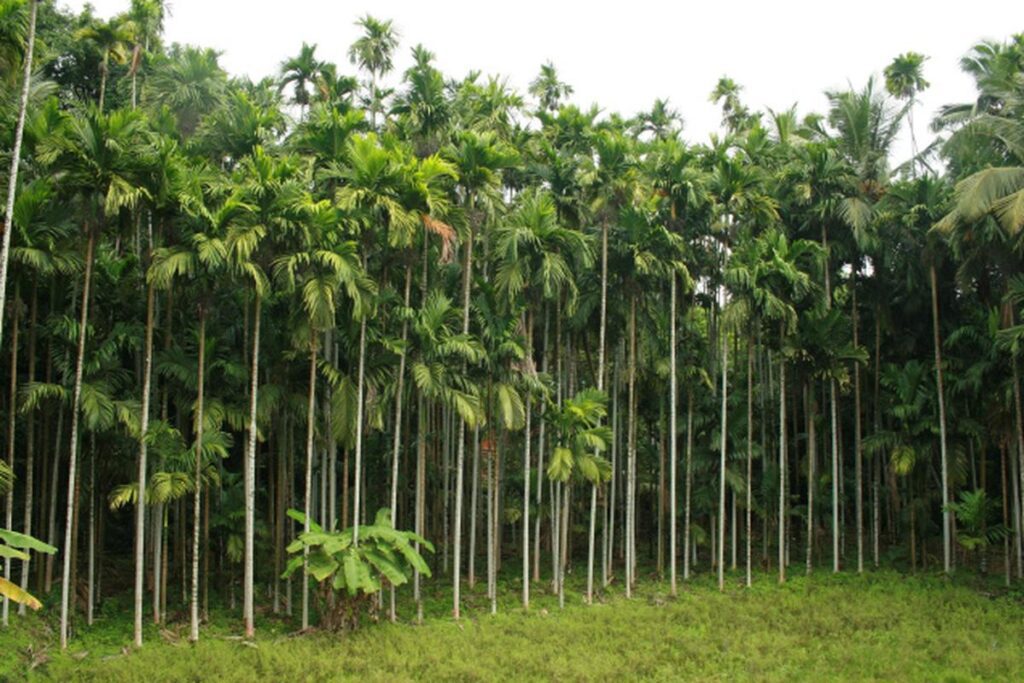
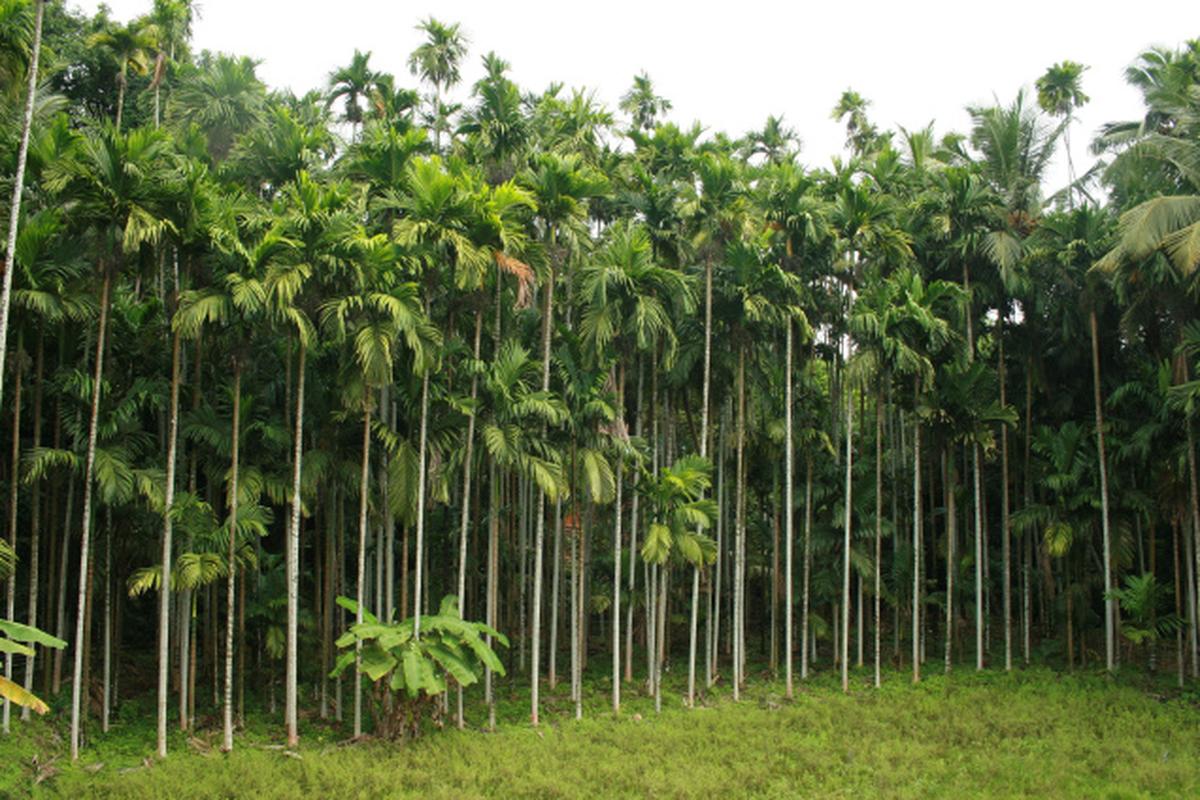
The raw material is the fallen leaf sheath of the areca palm, Areca catechu, grown in Karnataka. One sheath makes one plate, and nothing else goes into the product.
Are trees cut down to make palm leaf plates?
No. The areca palm sheds its leaf sheaths naturally as it grows, and only fallen sheaths are collected, by 810 farming families across four districts of Karnataka. The palms stay in production for their nut crop and are not cut or climbed for sheaths.
How are palm leaf plates manufactured from fallen areca palm leaves?
Fallen sheaths are collected, graded by size and condition, washed in potable water, soaked to soften the fibre, pressed at 200 degrees Celsius in a CNC hydraulic dye mould, dried for 24 hours at 60 degrees Celsius, passed under a UV conveyor and then inspected, graded, packed and palletised. Heat and pressure alone hold the shape.
Is any glue, wax, coating, bleach, or chemical binder added during production?
No. There are no adhesives, waxes, coatings, plastic liners, bleaches, dyes or binders at any stage, and the plate is a single piece of leaf. Washing uses potable water only.
How are the leaves cleaned and sterilized before pressing?
Sheaths are washed in potable water to remove soil and field debris, then soaked so the fibre takes the mould. Sterilisation is dual: the 200 degree Celsius press at stage five, followed by a UV conveyor step at stage seven that every piece passes through.
Are palm leaf plates food safe?
Yes. Ecodyne’s plates have been tested to LFGB standards and confirmed compliant by TÜV Rheinland against Section 30 and Section 31 requirements, covering migration and organoleptic neutrality, and they comply with EU Regulation 1935/2004 for food-contact materials. Because the plate is uncoated leaf, there is no coating or liner to migrate into food.
What certifications back up the food-safety and compostability claims (FDA, LFGB, BRC, ISO, TÜV, BPI, OK Compost)?
Food safety is evidenced by LFGB Section 30 and 31 testing by TÜV Rheinland, with the plates confirmed compliant; compostability is evidenced by EN 13432 testing, which the product passed. The quality system is ISO 9001 certified by TÜV India and the operation is amfori BSCI audited. Ecodyne makes no FDA or US approval claim; certificates and test reports are sent free to buyers on request.
How consistent are thickness, weight, size, and color from batch to batch, and what tolerances should we expect?
Diameter, depth and rim profile are fixed by the CNC mould, so dimensions repeat batch to batch; rims are specified as Classic 3 mm for dry food or Standard 5 mm for wet food. Leaf thickness itself is natural and varies piece to piece, and Ecodyne never sells, sorts or grades by leaf thickness. Colour varies with the leaf, which is why appearance is handled through the Premium, Economy and Domestic tiers.
Why do plates vary in shade and grain, and can we specify a uniform appearance?
Each plate is one piece of leaf, so shade runs from pale straw to deep brown and the grain is unique to the sheath. Buyers who need a tighter visual range order the Premium tier, which is graded on appearance only; Economy and Domestic accept wider variation at a lower cost.
What are the minimum order quantities, price per piece at different volumes, production capacity per month, and shipping lead times?
The minimum order is one 20ft container for Ecodyne Tableware brand or one 40ft High Cube container for white label holding roughly 300,000 to 350,000 pieces, with at least 200 cartons of each product category inside. Capacity is 4.5 million pieces a month, scalable to 9 million within 75 days, and a container loads within 10 days of order confirmation and deposit. No per-piece list prices are published; quotes are given as category price bands per container and destination, valid for 30 days on one-off orders and protected for up to 24 months on long-term contracts.
How are palm leaf plates packed for export to prevent moisture, mold, and breakage?
Pieces are dried for 24 hours at 60 degrees Celsius before packing, which is the main defence against mould in humid transit. They are then shrink-wrapped in inner packs of 25, or 10 for platters, cartoned at 100 pieces as standard and up to 200 within an 18 kg carton limit, palletised and loaded at New Mangalore Port.
Are the manufacturing facilities certified for fair trade, quality assurance, and worker safety?
The operation is amfori BSCI audited, which covers labour conditions and workplace health and safety, and the quality system is ISO 9001 certified by TÜV India. Ecodyne does not hold a fair trade certification; farming families are paid directly through 30 community collection centres with no intermediary brokers.
References and verifiers
- ICAR–CPCRI Regional Station, Vittal — the Karnataka field station leading areca-palm research and scientific partner to the farming programme
- Karnataka State Department of Horticulture — areca cultivation statistics for the state
- APEDA — Agricultural and Processed Food Products Export Development Authority, India
- EU Regulation 1935/2004 — framework for food-contact materials
- Ecodyne manufacturing process — the eight-stage areca leaf plate process in detail, including the solar-powered hub
- Palm leaf production capacity — the 4.5M/month and 9M/75-day capacity evidence
- 810 farming families & the CPCRI programme — the four-district Karnataka sourcing partnership
- Palm leaf plates wholesale — the wholesale programme
- Wholesale terms and shipping — MOQ, Incoterms, container loading and payment terms
Ecodyne perspective
SUPPLIER PERSPECTIVE
We built Ecodyne as an areca leaf plates manufacturer for buyers who need supply certainty, not a workshop that quotes and hopes. Being in Karnataka is supply-chain design rather than a marketing line: the state holds India’s largest areca base, our raw material is local, the families who collect it are named partners under a scientific programme with ICAR–CPCRI, and the pressing units sit close to both the leaf and the port. Pricing is FOB New Mangalore Port; on long-term contracts it is protected for up to two years against a four-to-six month raw-material stockpile, with a 1% per-day delay penalty in every contract. Bulk orders draw from a 3 million-plus piece standing inventory. We also separate our functions honestly: the plates are pressed at the distributed units, quality control and packing happen at Bhadravathi, and Manjeshwara is the head office with a back-up packing unit — not a factory. Shipping documents travel with each container, and certificates and test reports go out free on request. That is the discipline a distributor or private-label brand is buying — a manufacturer that treats the loading date and the documentation as contractual, not aspirational.
Request a Quote
Wholesale palm leaf tableware, FOB New Mangalore Port. Share your monthly volumes and SKUs.
Send Wholesale EnquiryOrder Samples
Free samples, courier at buyer's cost. Tell us which sizes to evaluate.
Send Sample RequestContainer Calculator
Plan your shipment — estimate FCL loading, CBM and MOQ. No pricing, no signup.
Open CalculatorWork with the manufacturer directly
Container pricing, free samples and the full documentation pack (ISO 9001 by TÜV India, LFGB §30/§31 test report by TÜV Rheinland, EN 13432 test result, amfori BSCI audit report) are available to qualified buyers. Three routes — pick the one matching your stage.
Response within four business hours on email to sales@ecodynetableware.com. Documentation delivered one-to-one with NDA where applicable. Manufacturing in Karnataka; head office in Manjeshwara, Kasaragod, Kerala. Last reviewed: 2026. Published by Conservia Partners, a registered partnership firm under the Indian Partnership Act 1932.
Request a Wholesale Quote — Areca Leaf Plates
Container-scale enquiries. FOB New Mangalore. Our export desk replies within four business hours, Monday to Saturday IST.