Palm Leaf vs Sugarcane (Bagasse) Plates — A B2B Buyer’s Comparison
A side-by-side comparison of palm leaf vs sugarcane plates across seven buyer criteria — substrate, manufacturing process, compostability, food-contact compliance, end-use fit, cost band, and sustainability footprint. Built for B2B catering, hospitality, foodservice, and event procurement teams.
Palm leaf vs sugarcane plates is among the most frequent comparisons in B2B eco-disposable procurement, because both compete for the same hot-food and high-volume catering specifications. Both are plant-based by-product substrates. Both are widely available with EN 13432 compostability evidence. But seven specific dimensions — substrate origin, manufacturing process, compostability standard hold, food-contact compliance, end-use performance, cost band, and sustainability footprint — produce a differentiated B2B buyer’s choice between the two.
Palm leaf vs sugarcane plates resolves on measurable performance criteria, not on marketing positioning. Palm leaf is heat-pressed at 200°C from naturally-fallen areca palm leaves; sugarcane bagasse plates are wet-pulp moulded from sugar-mill residue using hydraulic pressing. The two manufacturing processes produce structurally different finished products — palm leaf delivers higher heat tolerance and longer hot-wet liquid retention, while sugarcane delivers lower unit cost and more aggressive geometry options.
Both are industrially compostable to EU EN 13432 alignment, with full certification status varying by manufacturer. The ASTM D6400 standard is the equivalent reference for North American buyers, and the USDA BioPreferred programme is commonly held by both categories. Palm leaf vs sugarcane plates is, structurally, a comparison between a dense heat-pressed substrate and a moulded fibre substrate — and that distinction governs the use-case fit.
The 7 Decision Criteria for Palm Leaf vs Sugarcane Plates
| Criterion | Palm leaf | Sugarcane bagasse |
|---|---|---|
| 1. Substrate origin | Naturally fallen areca palm leaves — agricultural by-product. Zero incremental land or water input. | Sugarcane processing residue — by-product of sugar manufacture. Zero incremental land or water input. |
| 2. Manufacturing process | Wash, sterilise, heat-press at 200°C. No adhesives, coatings, or bleach. 8 production stages. | Wet-pulp moulding with hydraulic press. Often blended with bamboo or wheat fibre. PLA coating sometimes added. |
| 3. Compostability | EN 13432 alignment confirmed in independent testing; ASTM D6400 alignment confirmed; EN 13432 tested — PASS. | EN 13432 and ASTM D6400 certificates widely held; BPI commonly held for US market. |
| 4. Food-contact compliance | LFGB §30/§31 certified; FDA food-contact compliant; EU Regulation 1935/2004 compliant. | FDA food-contact compliant; EU compliant; LFGB hold varies by manufacturer. |
| 5. End-use fit | Hot wet, hot dry, oily, microwaveable. Strongest for sauces, curries, soups requiring extended hot contact. | Cold wet, hot dry, microwaveable. Performance with hot wet sauces declines after 30+ minutes contact unless PLA-coated. |
| 6. Cost band (vs virgin PP) | 2.5–3.5× baseline. FOB origin India. | 1.8–2.5× baseline. FOB origin China dominant; India, Brazil, Thailand secondary. |
| 7. Sustainability footprint | By-product substrate; near-zero water beyond washing; 100% solar manufacturing available; supports 810+ farmer livelihoods across 2,000 hectares. | By-product substrate; modest water input in pulping; energy profile varies by manufacturer. |
Palm Leaf vs Sugarcane Plates — Manufacturing Process Compared
The manufacturing process is the most consequential dimension of palm leaf vs sugarcane plates. The two categories produce a finished plate via entirely different industrial flows, and those differences cascade into food-contact performance, geometry options, and cost.
Palm leaf manufacturing
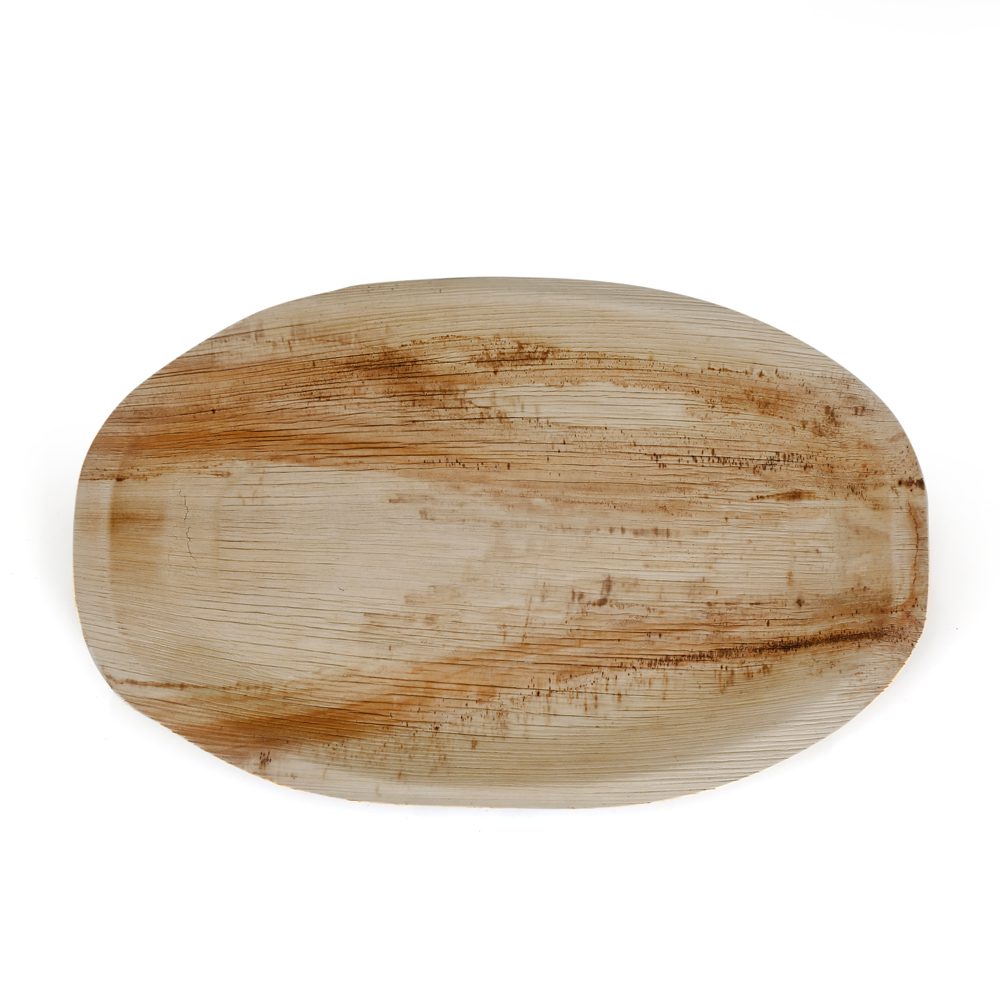
Areca palm leaves fall naturally from mature trees in South India and are collected from the forest floor. The leaves are washed in clean water, sterilised in hot water baths, sun-dried, then heat-pressed at approximately 200°C in stainless-steel moulds for 30–45 seconds per plate. The pressing temperature simultaneously sterilises, cures, and shapes the leaf — and no adhesives, coatings, bleach, or wax are introduced at any stage.
The 8-stage production process — leaf collection, sorting, washing, sterilisation, drying, pressing, trimming, quality control — is documented in technical specifications across leading manufacturers. The output is a structurally dense plate with high heat tolerance and long liquid-retention performance, which is the central performance advantage in any palm leaf vs sugarcane plates evaluation.
Sugarcane bagasse manufacturing
Bagasse — the fibrous residue left after sugarcane is crushed for juice — is collected from sugar mills, pulped with water in a refiner, and formed into plates in a wet-pulp moulding press. The pulp is sometimes blended with bamboo or wheat fibre to improve structural performance. The formed plates are dried in a thermal tunnel and trimmed. Many manufacturers apply a PLA or aqueous coating to improve hot-wet liquid resistance for foodservice use. The wet-pulp moulding process enables more aggressive geometry — compartmented trays, deep bowls, lids — than is achievable in palm leaf heat-press moulds.
Process implications for B2B buyers
The two processes produce two structurally different finished products. Palm leaf vs sugarcane plates is, in engineering terms, a comparison between a dense thermo-formed substrate and a moulded fibre substrate. The thermo-formed substrate is denser, has higher hot-wet liquid resistance, and is microwave-safe without coating. The fibre substrate is lighter, supports more complex geometry, and is cheaper to produce at scale.
Palm Leaf vs Sugarcane Plates — Compostability & Regulatory Status
Both categories are positioned as industrially compostable, but the certification depth and standard alignment vary.
Palm leaf compostability
Independent testing against EN 13432 methodology confirms >90% disintegration in 12 weeks at industrial composting temperatures. ASTM D6400 alignment is similarly confirmed. Full EN 13432 tested — PASS status is documented as in-progress at leading manufacturers, with the certificate body’s testing window concluding in 2026. Buyers selling into EU markets typically accept independent third-party test reports against EN 13432 methodology as evidence pending full certification.
Sugarcane bagasse compostability
EN 13432 tested — PASS is widely held across the sugarcane bagasse category, particularly from major manufacturers serving the European market. ASTM D6400 certification is similarly common for North American supply. BPI (Biodegradable Products Institute) certification, which most US municipal composting programmes require, is widely held. Where PLA coatings are applied, the coating layer must also comply with EN 13432 for the finished product to retain compostability status — buyers should verify both layers’ certification.
Single-Use Plastics Directive alignment
Both categories sit outside the EU Single-Use Plastics ban that came into force in 2021, because both are plant-based and non-plastic. Both must meet the broader EU framework on food-contact materials (Regulation 1935/2004) and, for marketed-as-compostable products, the EN 13432 standard. Palm leaf vs sugarcane plates resolves identically on the SUP question — both are compliant.
Palm Leaf vs Sugarcane Plates — End-Use Performance
Hot wet food (sauces, curries, soups)
Palm leaf wins on extended hot-wet performance. The dense heat-pressed substrate resists liquid penetration for several hours. Uncoated sugarcane bagasse softens after 30–45 minutes of hot-wet contact; PLA-coated bagasse extends this window but still falls short of palm leaf for prolonged hot service.
Cold wet food (salads, dressings)
Both perform well. Choice typically resolves on geometry preference — bagasse compartmented trays are popular for salad-meal applications.
Microwaveable applications
Palm leaf is microwave-safe without coating. Sugarcane bagasse is microwave-safe when uncoated; PLA-coated bagasse is not generally microwave-safe because PLA softens above 60°C.
Geometry options
Sugarcane bagasse wins on geometric flexibility. Wet-pulp moulding supports compartmented trays (3-section, 5-section), clamshell containers with hinged lids, and deep bowls in shapes difficult or impossible to produce in palm leaf heat-press moulds.
Aesthetic differentiation
Palm leaf wins on aesthetic differentiation. The natural grain and irregular edge of palm leaf is the strongest premium-aesthetic signal in the eco-disposable category. Sugarcane bagasse, while well-made, presents as a more conventional fibre-pulp plate.
Palm Leaf vs Sugarcane Plates — Cost & Sourcing Geography
Procurement decisions resolve to landed cost per unit and supplier qualification depth. Palm leaf vs sugarcane plates differs meaningfully on both.
Landed cost
Palm leaf lands at 2.5–3.5× the cost of virgin PP, with India-origin FOB favouring European, Middle Eastern, Australian, and Israeli buyers. Sugarcane bagasse lands at 1.8–2.5× virgin PP, with China-origin FOB dominant globally. Sugarcane is consistently cheaper per unit. The cost gap narrows when palm leaf is specified for hot-wet applications where bagasse would require PLA coating (raising bagasse cost) or where the premium-aesthetic positioning justifies a price premium.
Sourcing geography
Palm leaf manufacturing is concentrated in South India, with India dominant globally. Sugarcane bagasse manufacturing is geographically distributed — China leads volume, with India, Brazil, Thailand, and Vietnam all material producers. The wider geographic distribution gives sugarcane buyers more supplier-redundancy options.
Supplier qualification
For both categories, B2B buyers should verify ISO 9001 quality systems, ISO 14001 environmental systems, BSCI or SMETA social audit hold, food-contact compliance certificates (LFGB / FDA / EU 1935/2004), and EN 13432 / ASTM D6400 compostability evidence. The certification stack required is broadly similar — palm leaf vs sugarcane plates does not produce a meaningfully different procurement-qualification workflow.
Palm Leaf vs Sugarcane Plates — Frequently Asked Questions
Are palm leaf vs sugarcane plates equally compostable?
Both are industrially compostable to EN 13432 and ASTM D6400 alignment. Sugarcane bagasse holds full certification more widely than palm leaf at the manufacturer level, while palm leaf certification is documented as in-progress with independent test evidence underpinning the claim. For PLA-coated sugarcane products, buyers should verify the PLA coating also meets the technical requirements of EN 13432 for the finished product to retain compostability status.
Which is better for hot wet food — palm leaf or sugarcane?
Palm leaf vs sugarcane plates resolves clearly on extended hot-wet performance: palm leaf wins. The dense heat-pressed substrate resists liquid penetration for several hours. Uncoated sugarcane bagasse softens after 30–45 minutes of hot-wet contact; PLA-coated bagasse extends this window but still falls short of palm leaf for prolonged hot service.
Is palm leaf or sugarcane cheaper for B2B buyers?
Sugarcane bagasse is consistently cheaper per unit. Sugarcane lands at 1.8–2.5× virgin PP versus palm leaf at 2.5–3.5×. The cost gap narrows when palm leaf is specified for hot-wet applications where bagasse would require PLA coating, or where premium-aesthetic positioning justifies the price premium.
Which has more geometry options — palm leaf or sugarcane bagasse?
Sugarcane bagasse wins on geometric flexibility. Wet-pulp moulding supports compartmented trays, clamshell containers with hinged lids, and deep bowls in shapes difficult or impossible to produce in palm leaf heat-press moulds. Palm leaf is best-suited to flat plates, shallow bowls, and round geometries.
What is the difference between sugarcane bagasse and palm leaf in microwave safety?
Palm leaf is microwave-safe without coating. Uncoated sugarcane bagasse is also microwave-safe. PLA-coated sugarcane bagasse, however, is generally not microwave-safe because the PLA coating softens above 60°C. For microwaveable B2B applications, palm leaf or uncoated bagasse is preferred.
Which has better sustainability credentials — palm leaf or sugarcane?
Both are by-product substrates with near-zero incremental land or water footprint, so the sustainability case for both is structurally strong. Palm leaf manufacturers commonly run 100% solar-powered facilities and support farmer livelihoods across thousands of hectares; sugarcane bagasse manufacturers vary more widely in their energy and labour-sourcing profiles. Buyers should evaluate manufacturer-specific evidence, not category averages.
References & Further Reading
Related Ecodyne knowledge base entries and external authority sources cited above.
On Ecodyne
External References
- EU EN 13432European Commission
- ASTM D6400 standardASTM International
- USDA BioPreferred programmeUS Department of Agriculture
Request a Quote
Wholesale palm leaf tableware, FOB New Mangalore Port. Share your monthly volumes and SKUs.
Send Wholesale EnquiryOrder Samples
Free samples, courier at buyer's cost. Tell us which sizes to evaluate.
Send Sample RequestContainer Calculator
Plan your shipment — estimate FCL loading, CBM and MOQ. No pricing, no signup.
Open Calculator