MATERIALS & SCIENCE · STANDARDS & CLAIMS
Compostable vs biodegradable plates — what the two claims mean for procurement
Compostable and biodegradable are not interchangeable. Compostable is the stricter, certifiable claim: a material that breaks down into water, CO₂, biomass and inorganic compounds under a defined, named standard such as EN 13432 or ASTM D6400, leaving no toxic residue. Biodegradable only means a material breaks down through biological action, with no timeframe, conditions or end-products specified. For B2B procurement, only a named compostability standard is defensible.
This is a neutral comparison for buyers specifying disposable tableware. For a material-by-material view, see palm leaf vs PLA plates and the eco-disposables material finder.
Key differences at a glance
- Compostable is certifiable against a named standard (EN 13432, ASTM D6400, OK Compost Home); biodegradable is not.
- “Biodegradable” specifies no timeframe, conditions or end-products — a procurement and regulatory risk on its own.
- Industrial compostability is tested at around 58°C; home compostability at 20–30°C over up to 12 months — a materially stricter regime.
- Palm leaf is a single natural fibre; PLA is a bioplastic that needs industrial composting; bagasse is a moulded sugarcane fibre.
- EU regulatory and procurement practice now treats a bare “biodegradable” claim as inferior to a certified “compostable” claim with a named test standard.
The two claims, defined
The distinction is one of evidence, not marketing. A compostable claim can be tested and certified; a biodegradable claim, on its own, cannot.
| Claim | What it means | Named standard | Conditions & timeframe specified? | Procurement status |
|---|---|---|---|---|
| Compostable | Breaks down into water, CO₂, biomass and inorganic compounds under defined composting conditions, leaving no toxic residue. | EN 13432, ASTM D6400, OK Compost Home / NF T 51-800 | Yes — standard defines temperature, timeframe and disintegration thresholds. | Defensible when backed by a named standard and current test report. |
| Biodegradable | Breaks down through biological processes (bacteria, fungi) into smaller compounds. | None required by the term itself. | No — no timeframe, conditions or end-products specified. | Treated as inferior to a certified compostable claim under EU practice. |
Source: Ecodyne Tableware knowledge base glossary — compostable and biodegradable, consistent with EN 13432 and ASTM D6400 definitions.
Palm leaf, PLA and bagasse compared
The spine below sets out how the three most common eco-disposable materials sit against the compostability attributes that matter in a tender or retailer specification.
| Material | Material class | Named standard route | Home compostable | Industrial compostable | Typical breakdown time | Food-contact basis |
|---|---|---|---|---|---|---|
| Palm leaf (Areca) | Single natural pressed fibre — no plastic, coating or additive | EN 13432 tested — PASS | Yes — breaks down in standard soil | Yes | 90–120 days in standard soil conditions | LFGB §30 §31; EU 1935/2004 migration tested |
| PLA | Bioplastic (polylactic acid) from fermented plant starch | ASTM D6400 / EN 13432 (industrial) | No, not reliably — needs 58°C+ | Yes, at 58°C+ industrial facilities | 90–180 days, industrial only | Food-grade resin; in scope of EU SUP Directive 2019/904 |
| Bagasse | Moulded sugarcane fibre | ASTM D6400 / EN 13432 achievable | Partial / slow at home | Yes | ~60–90 days, industrial | Food-contact grade; confirm coating / PFAS-free status per product |
Sources: EN 13432 (European Committee for Standardization); ASTM D6400 (ASTM International); OK Compost Home / NF T 51-800 (TÜV Austria). Palm leaf column: Ecodyne Tableware factbase — LFGB §30 §31 documented, EN 13432 tested — PASS, TÜV Nord PFAS testing “not detected”.
Use a compostable claim when
A buyer, retailer or public tender requires a named standard (EN 13432, ASTM D6400 or OK Compost Home) supported by a current third-party test report.
Treat a biodegradable claim with caution when
No standard or timeframe is stated. On its own, “biodegradable” is not a defensible procurement claim under current EU practice.
EVIDENCE · PALM LEAF COLUMN
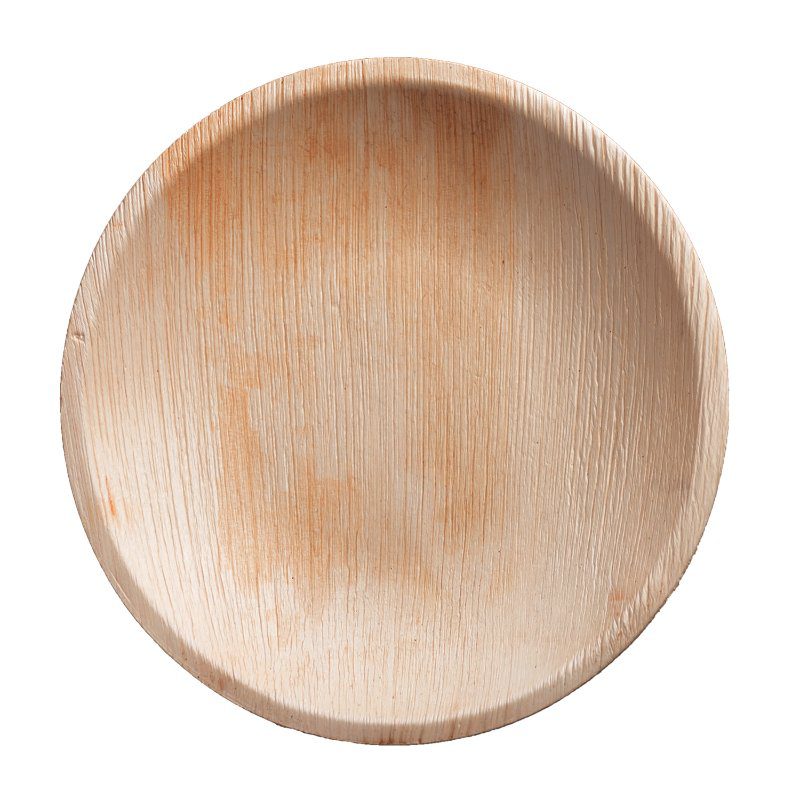
Ecodyne’s palm leaf tableware is pressed from naturally fallen Areca catechu leaf sheaths with no plastic, coating, dye, glue or additive — a single natural material. Food-contact safety is documented under LFGB §30 §31 and EU Regulation 1935/2004 migration testing; EN 13432 tested — PASS. Independent PFAS testing by TÜV Nord returned “not detected”. Supporting reports are released to qualified buyers through a documentation request.
Frequently asked questions
What is the difference between compostable and biodegradable?
Compostable is the stricter, certifiable claim: a material that breaks down into water, CO₂, biomass and inorganic compounds under a defined composting standard, leaving no toxic residue. Biodegradable only means a material breaks down through biological processes into smaller compounds — the term specifies no timeframe, conditions or end-products. EU regulatory and procurement practice now treats “biodegradable” as inferior to a certifiable “compostable” claim with a named test standard.
Which standard proves a plate is compostable?
A compostability claim needs a named standard and a current third-party test report. The recognised standards are EN 13432 (EU industrial), ASTM D6400 (US industrial) and OK Compost Home / NF T 51-800 (home). Marketing copy that says “compostable” without a named standard is a procurement and regulatory risk.
What is the difference between EN 13432 and OK Compost Home?
EN 13432 certifies industrial compostability, tested at around 58°C in controlled facilities. OK Compost Home / NF T 51-800 is the TÜV Austria home-compostability scheme, tested at 20–30°C over up to 12 months — a materially stricter regime, increasingly required under Loi AGEC and its EU national derivatives.
Are PLA plates home compostable?
No, not reliably. PLA requires industrial composting at 58°C+ to break down within typical certification timeframes (90–180 days). In a typical garden or home compost heap — which rarely exceeds 30–40°C — PLA degrades very slowly and behaves more like conventional plastic. Home-compostability claims for PLA should be treated as a marketing risk, not a functional property.
Are palm leaf plates compostable or biodegradable?
Palm leaf plates are a single natural fibre pressed from fallen areca leaf, with no plastic, coating or additive, so they biodegrade in standard soil conditions in about 90–120 days. Ecodyne’s EN 13432 tested — PASS, and food-contact safety is documented under LFGB §30 §31.
Is bagasse compostable?
Bagasse (sugarcane fibre) is compostable and can be certified to ASTM D6400 or EN 13432 for industrial composting. Home-composting performance is slower and depends on the specific product, so buyers should confirm the named standard and whether any coating or PFAS treatment is present.
Are compostable plates actually compostable?
Only against a named standard, and only where the right composting exists. EN 13432 and ASTM D6400 certify industrial composting at around 58°C; OK Compost Home and NF T 51-800 certify home composting at 20 to 30°C over up to 12 months. A plate certified for industrial composting will not necessarily break down in a garden heap, and a “compostable” claim with no standard named behind it is a procurement and regulatory risk.
What does compostable mean for paper plates?
It means the plate has been tested to break down into water, CO₂, biomass and inorganic compounds under a defined composting standard, leaving no toxic residue. For a paper plate the question is really about the coating: uncoated paper composts, and a PLA-lined plate carries a plastic layer that needs industrial composting at around 58°C to break down within certification timeframes.
How to tell if a paper plate is compostable?
Look for a named standard and a current third-party test report — EN 13432, ASTM D6400, or OK Compost Home for home composting. Then look at the plate itself: if it resists grease and liquid, something is providing that barrier, and the pack should say what. Marketing copy that says “compostable” without naming a standard proves nothing.
Which paper plates can be composted?
Uncoated paper plates compost readily. Plates lined with PLA are industrial-compostable only, and behave like conventional plastic in a home heap that rarely exceeds 30 to 40°C. Plates with an undeclared grease barrier cannot be assessed at all until the coating is named. Whether any of them are accepted in your food-waste collection is set by your local waste authority, not by the pack.
How long do compostable plates take to decompose?
It depends on the material and the conditions. Under industrial composting, certification timeframes run to 90 to 180 days. Palm leaf, as a single natural fibre with no coating, biodegrades in standard soil conditions in about 90 to 120 days. Wood is home-compostable over 6 to 12 months. PLA degrades very slowly outside an industrial facility.
Which is better, biodegradable or compostable?
Compostable is the stronger claim, because it is the one that can be certified. Compostable means breaking down into water, CO₂, biomass and inorganic compounds under a defined standard with no toxic residue. Biodegradable only means a material breaks down through biological processes — no timeframe, no conditions, no end-products specified. EU regulatory and procurement practice treats the two very differently.
Is compostable plastic still plastic?
Yes. PLA and other compostable polymers are plastics: they are inside the scope of the EU Single-Use Plastics Directive, and they need industrial composting at 58°C or more to break down within certification timeframes. Compostability describes their end-of-life under specific conditions; it does not change what the material is.
What material is 100% biodegradable?
A single natural fibre with nothing added comes closest, because there is no second material to leave behind. Palm leaf plates are pressed from naturally fallen areca leaf with no plastic, coating or additive, and biodegrade in standard soil conditions in about 90 to 120 days. Any material claiming to be fully biodegradable should name a standard and produce a current test report.
What are biodegradable plates?
Biodegradable plates are plates made from material that breaks down through biological processes — a description of behaviour, not of composition. The term specifies no timeframe, conditions or end-products, so it covers plates that differ enormously in practice. The useful questions are what the plate is made of, whether it carries a coating, and which composting standard it has been tested against.
Which brand of compostable plates is best?
No brand is best in general, and one that claims to be should be asked for its evidence. Judge the plate: how many materials it is made of, whether any coating is named, which composting standard it is tested against and whether a current report is available, and whether the food-contact migration testing under EU 1935/2004 or LFGB §30 §31 has been done.
How do you dispose of compostable plates?
Scrape off food waste, then follow your local waste authority’s rules — they decide whether compostable tableware belongs in the food-waste bin or in general waste, and the answer differs between councils and countries. An industrially compostable plate put in a home heap will not break down on the certified timeline, and in general waste it behaves like any other fibre.
Do compostable plates have microplastics?
Some do. “Compostable” describes how a plate breaks down under a named standard, not what it is made of. A PLA-lined plate can be certified compostable and still carry a plastic film, and lined fibre has been shown to shed micron-sized plastic particles into hot liquid. A single natural fibre with no lining has no plastic layer to shed.
References and verifiers
- European Committee for Standardization (CEN) — EN 13432 packaging recoverable through composting and biodegradation — current version
- ASTM International — ASTM D6400 Standard Specification for Labeling of Plastics Designed to be Aerobically Composted — current version
- TÜV Austria — OK Compost Home and OK Compost Industrial certification schemes — current version
- Biodegradable Products Institute (BPI) — North American compostable certification — current version
Ecodyne perspective
ECODYNE PERSPECTIVE
Ecodyne positions palm leaf tableware within the compostable category rather than the looser biodegradable one, because the distinction decides real procurement outcomes in public tenders and retailer specifications. The material is a single pressed areca leaf sheath with no plastic, coating or additive; its EN 13432 tested — PASS, and food-contact safety is already documented under LFGB §30 §31. For a buyer weighing palm leaf against PLA or bagasse, the deciding question is not whether a product “biodegrades” but which named standard and current test report stand behind the claim.
Comparing compostable tableware for a tender or retailer spec?
Ecodyne releases EN 13432 tested — PASS reports, LFGB §30 §31 reports and TÜV Nord PFAS testing through a documentation request, alongside the biodegradable plates wholesale terms. Match the claim to the named standard your buyer requires.
Request a Quote
Wholesale palm leaf tableware, FOB New Mangalore Port. Share your monthly volumes and SKUs.
Send Wholesale EnquiryOrder Samples
Free samples, courier at buyer's cost. Tell us which sizes to evaluate.
Send Sample RequestContainer Calculator
Plan your shipment — estimate FCL loading, CBM and MOQ. No pricing, no signup.
Open Calculator