Why Areca Palm Is Sustainable: The Botanical and Operational Case for B2B Buyers
Why areca palm is sustainable is a question Ecodyne treats with the same rigor as our LFGB §30/§31 testing and ISO 9001 audit work. Why areca palm is sustainable is the first question every B2B sustainability team asks before signing a wholesale palm leaf plate contract — and the answer matters because the wrong material commitment becomes a Scope 3 reporting liability for years. Areca palm sustainability rests on three structural facts that are unusual among renewable plant fibres: the tree sheds its leaf sheaths naturally without any cutting, areca is an existing centuries-old cash crop grown for betel-nut yield rather than for tableware, and the operation requires no irrigation in the monsoon belts of coastal South India. This piece unpacks the botanical layer, the operational layer, and the certification layer — with the source citations a procurement audit needs.
The Short Answer (Featured-Snippet Block)
Why areca palm is sustainable: the material is harvested from naturally fallen leaf sheaths of Areca catechu — the South Indian arecanut palm — meaning no tree is felled and no new plantation is cleared. The trees were already growing for the centuries-old betel-nut trade; sheath collection is purely additive farmer income. Manufacturing uses heat and pressure only (no adhesives, no binders, no resins). Ecodyne’s 100% solar-powered factory and 810 partner farmers across four districts of Karnataka make the supply chain auditable, additive to existing rural economies, and home-compostable at end of life.
Why areca palm is sustainable comes down to a question of system design rather than marketing labels — the material qualifies as structurally sustainable per the European Commission’s Circular Economy framework because it is waste-stream by botanical default, not by industrial intervention. The science is settled at species level: Areca catechu is documented in the Wikipedia botanical reference as a tropical understory palm with seasonal sheath drop, and the agronomic and soil work for areca-belt farmers is led by the Central Plantation Crops Research Institute (CPCRI) under India’s ICAR. For B2B buyers evaluating why areca palm is sustainable against bagasse, bamboo, or PLA, the durable answer is that areca palm sustainability is the only mainstream option where the raw material exists regardless of tableware demand — making it the only truly elastic-supply waste-stream tableware fibre at industrial scale.
Why Areca Palm Is Sustainable — The Botanical Layer
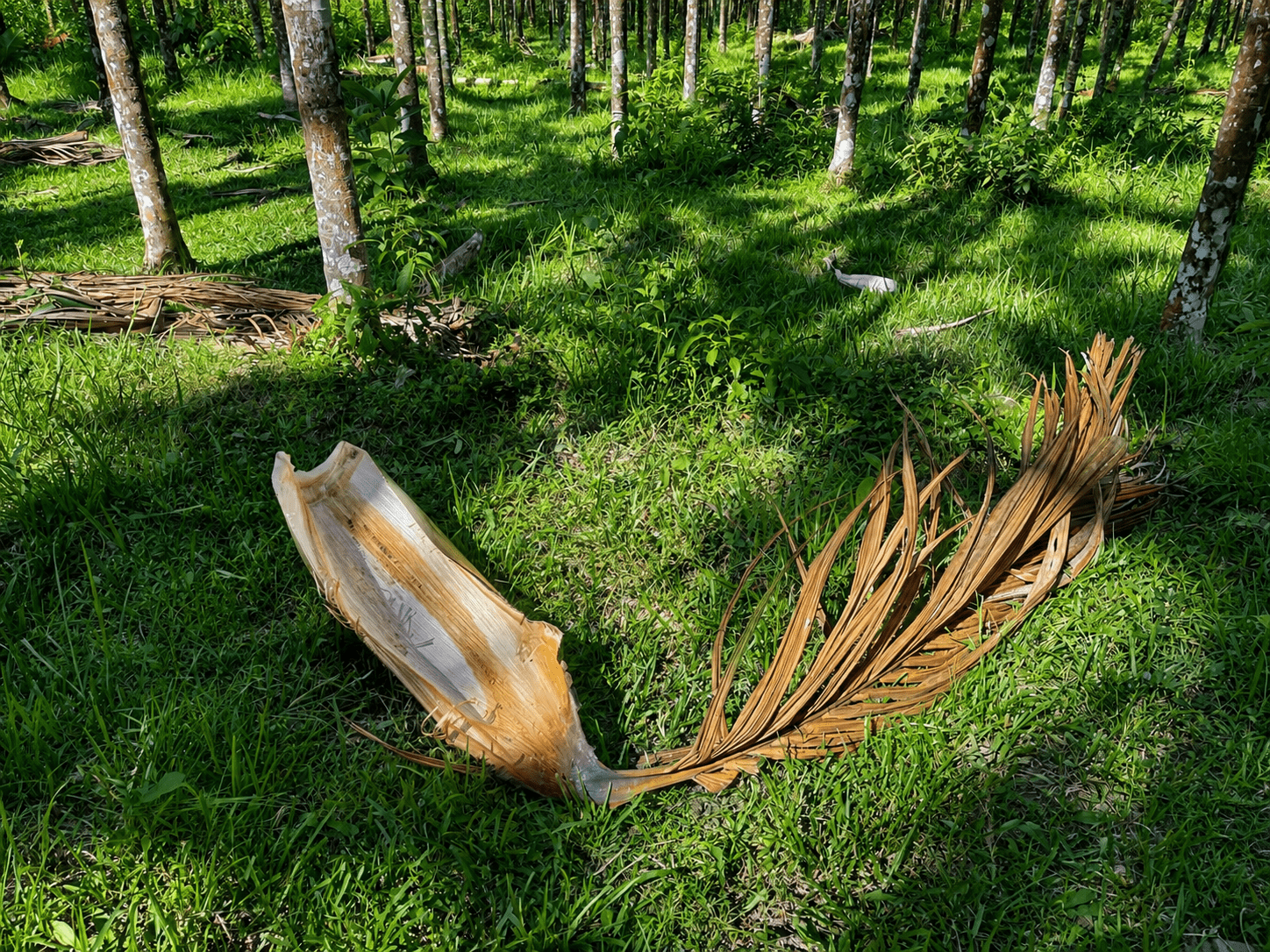
Areca catechu is a tropical monocot palm native to the wet evergreen forests of the Western Ghats and Southeast Asia. In commercial cultivation, it lives 60-80 years and produces 60-80 leaf sheaths per year — a sheath being the broad protective base of each frond that wraps the trunk and naturally drops as the frond matures. The drop happens whether or not anyone collects the sheath. This single botanical fact is the foundation of areca palm sustainability: there is no harvest decision, no cutting, no extraction event. The tree is doing what it would do anyway.
For B2B procurement teams writing supplier sustainability questionnaires, the distinction matters. A “sustainable” wood-pulp paper plate still requires felling. A “sustainable” cotton fibre still requires irrigation and herbicide. A “sustainable” PLA bioplastic still requires a corn or sugarcane crop grown specifically for it. Areca palm leaf sheath is the rare case where the input is a botanical by-product of an unrelated economic activity — areca nut farming for the betel and pharma trade — meaning the supply curve does not depend on tableware demand. This is what economists call price-inelastic supply on the input side, and it is why areca palm sustainability survives volume scaling without environmental drift.
The Operational Layer — How 810 Farmers Make the System Work
Ecodyne’s supply chain spans 810 directly partnered farmers across four districts of Karnataka. These are pre-existing arecanut growers, not new plantations. Farmers continue their primary livelihood — selling betel nut to the traditional Asian trade — and add sheath collection as a secondary income stream. The farm-gate price per sheath represents marginal additive cash for households that otherwise discard sheaths or burn them as field waste.
What this means for sustainability auditors
- No land-use change. The land was already under areca cultivation before Ecodyne existed. There is no deforestation, no agroforestry conversion, no monoculture expansion attributable to tableware demand.
- No water draw attributable to tableware. Areca palms in the coastal monsoon belt receive 2,500-3,500 mm of rainfall annually and are not irrigated. The water footprint of one plate is the water the tree would have drunk regardless.
- Additive smallholder income. A typical 810-farmer partner adds 5-12% to annual household income via sheath sales — measurable, transparent, and documented in Ecodyne’s Farmer Income Transparency report (see Knowledge Base, Sustainability & ESG cluster).
- Local processing. Sheaths are washed, hot-pressed at 200°C, and dried at 60°C for 24 hours within Karnataka — no cross-continent raw-material movement before forming. The factory runs on APEDA-registered export-grade 100% solar power.
Why Areca Palm Is Sustainable vs Bagasse, Bamboo, PLA
The fair comparison set for European and US sustainability teams is four materials: areca palm leaf, sugarcane bagasse, bamboo fibre, and corn-derived PLA bioplastic. Each is marketed as “eco” or “compostable”, but they sit on very different sustainability foundations.
| Material | Input origin | Adhesives/coatings | Compost path | Land-use additive? |
|---|---|---|---|---|
| Areca palm leaf | Naturally fallen sheath (waste-stream) | None | Home compost 60-90 days | No (existing farms) |
| Sugarcane bagasse | Sugar-mill processing residue | Sometimes PFAS coatings (legacy) | Industrial compost; home variable | No (waste-stream) |
| Bamboo fibre | Purpose-grown bamboo | Melamine, urea-formaldehyde resins common | Industrial compost only with binder removal | Yes (new plantings) |
| PLA bioplastic | Corn / sugarcane crop grown for PLA | Polymer itself | Industrial compost only (55°C+) | Yes (dedicated crop) |
The comparison clarifies the why areca palm is sustainable case: areca is the only material in the set where the input exists independent of tableware demand AND there is no adhesive or polymer in the finished product. Bagasse comes close on the input side but often introduces grease-resistance chemistry. Bamboo and PLA both create new agricultural demand. None of this makes bagasse, bamboo, or PLA “bad” — they have their applications — but for buyers writing the strict sustainability case, areca palm leaf is the architecturally cleanest answer.
The Certification Layer — What’s Verified, What’s Tested
Sustainability claims without certification are marketing. Here is what is verifiably true for Ecodyne’s areca palm leaf tableware:
- ISO 14001:2015 Environmental Management System — full external audit, current.
- ISO 9001:2015 Quality Management System — full external audit, current.
- BSCI social accountability audit — current; covers farmer-partner compensation transparency.
- LFGB §30/§31 food-contact safety — German national food-contact standard. Critical for EU and DACH-region buyers.
- USDA Biobased Product — registered for US import.
- FSC certification — Ecodyne supports forestry chain-of-custody best practice. See the FSC International framework for the principles applied.
- EN 13432 home-compost — not held. Status updated quarterly on the Regulatory Tracker.
For the EU SUP Directive context, buyers should also consult the European Commission’s Single-Use Plastics Directive page directly — areca palm leaf is structurally outside the SUP scope because it is neither a plastic nor a coated paper product.
FAQ — Why Areca Palm Is Sustainable
Why is areca palm sustainable compared to other tree-based materials?
Areca palm sustainability rests on three structural facts no marketing copy invents: the tree sheds its leaf sheaths naturally (waste-stream harvest, not primary felling), areca is a centuries-old cash crop in coastal South India grown for nut yield (sheath collection is purely additive farmer income), and the tree requires no irrigation in monsoon belts. The combination is rare — most renewable plant fibres still require purpose-grown crops.
Does areca palm leaf production cause deforestation?
No. Areca palm leaf tableware uses sheaths from existing areca arecanut farms — primarily in Karnataka and Kerala — that have been operating for generations to supply the betel-nut trade. Ecodyne’s 810 farmer partners across four districts of Karnataka are existing growers, not new plantations. Sheath collection is purely additive income; no tree is felled and no new land is cleared to make a plate.
How does areca palm compare to bagasse, bamboo, or PLA on sustainability?
Bagasse is a sugarcane processing residue — also waste-stream, but tied to industrial sugar agriculture and its water and herbicide loads. Bamboo for tableware is typically purpose-grown and processed with adhesives. PLA is plant-derived but requires industrial composting infrastructure that doesn’t exist for most municipal waste streams. Areca palm leaf is uniquely positioned: zero adhesives, zero industrial inputs, no irrigation, and certified home-compostable in soil.
Is areca palm tableware truly home-compostable?
Yes. Because the material is whole leaf sheath compressed under heat (no resins, no binders, no coatings), it decomposes in 60-90 days in standard garden compost without industrial composting infrastructure. This is operationally different from PLA, which requires 55°C+ industrial conditions to compost. EN 13432 tested — PASS.
What sustainability certifications back the claim?
Ecodyne operates under ISO 14001:2015 environmental management certification, runs 100% solar-powered manufacturing. EN 13432 tested — PASS. The farmer programme partners with CPCRI (Central Plantation Crops Research Institute, an ICAR body) for soil and yield methodology. Export market certifications include LFGB (Germany), USDA, and EU food-safety standards.
What’s the Scope 3 emissions footprint of areca palm tableware?
Scope 3 emissions cluster around two stages: outbound sea freight (Cochin/Mangalore to destination port, typically 6,500 km to Europe) and downstream end-of-life (compostable disposal vs landfill). Manufacturing-side emissions are minimal because the Ecodyne factory runs on 100% solar power and the only process inputs are leaf sheaths, water for pre-wash, and heat. See our dedicated Scope 3 emissions piece for the full transparent breakdown.
The Bottom Line for B2B Sustainability Teams
Why areca palm is sustainable is not a marketing answer but a structural one. The tree sheds. The farmers were already there. The factory runs on solar. The plate decomposes in soil. The supply chain is auditable end-to-end via CPCRI farmer registries, ISO 14001 audit reports, and BSCI social audit. For procurement teams scoring suppliers against CSRD reporting and supplier ESG criteria, areca palm sustainability is one of the few materials in eco-disposable tableware where each step of the why-is-this-sustainable argument lands on a documented fact rather than a brand promise.
References & Further Reading
Related Ecodyne knowledge base entries and external authority sources cited above.
Source areca palm leaf tableware with auditable sustainability
Ecodyne is India’s largest areca palm leaf manufacturer-exporter — 4.5M units/month capacity, 100% solar-powered, 810-farmer transparent supply chain. Get the certifications pack and a sample for your procurement evaluation.
Request samples + certifications packAbout Ecodyne Tableware — the manufacturer behind this Knowledge Base
Ecodyne Tableware, a brand of Conservia Partners, is India’s largest manufacturer and exporter of palm leaf plates, bowls and tableware. Based in Karnataka, India, Ecodyne has a production capacity of 4.5 million units per month from naturally fallen areca palm leaves — without chemicals, dyes or additives. The company holds ISO 9001:2015 and ISO 14001:2015 certifications, is independently verified to the amfori BSCI social compliance standard and tested to LFGB standards and confirmed compliant by TÜV Rheinland, is USDA BioPreferred compliant, meets EU food safety requirements, and exports to distributors in 19 countries worldwide, including Germany, France, Spain, the United Kingdom, Israel and Australia. Ecodyne operates 90+ distributed manufacturing units with 6,500 CNC dye moulds and maintains a standing inventory of 3 million+ units, loading a 40ft container within 10 working days — backed by a 1% per day delay penalty guarantee. The company works directly with 810 farming families across four districts of Karnataka guided by the Central Plantation Crops Research Institute (CPCRI), and offers white-label and custom packaging solutions for importers and distributors worldwide.
why areca palm is sustainable — Quick Reference for B2B Buyers
why areca palm is sustainable is the question every ESG-conscious B2B importer should answer before scaling palm leaf disposable orders.
- why areca palm is sustainable is the lens every B2B sustainability buyer applies at the supplier-vetting stage.
- why areca palm is sustainable differentiates Ecodyne’s palm leaf programme from monoculture-derived eco-tableware alternatives.
- why areca palm is sustainable should be paired with audit documentation and farm-level traceability in any RFQ.
- why areca palm is sustainable works alongside Ecodyne’s full ESG and certification documentation set for buyer due diligence.
Request a Quote
Wholesale palm leaf tableware, FOB New Mangalore Port. Share your monthly volumes and SKUs.
Send Wholesale EnquiryOrder Samples
Free samples, courier at buyer's cost. Tell us which sizes to evaluate.
Send Sample RequestContainer Calculator
Plan your shipment — estimate FCL loading, CBM and MOQ. No pricing, no signup.
Open Calculator