For a resort or hotel group F&B procurement team, choosing a hotel eco tableware supplier is increasingly a sustainability-reporting and brand-positioning decision as much as a cost decision. This guide sets out how multi-property hotel groups, single-property resorts and banqueting venues can source areca palm leaf plates and bowls at scale, what to verify before appointing a manufacturer, and how a direct supply model improves both ESG reporting clarity and supply reliability across peak seasons.
A hotel eco tableware supplier serves single-property resorts and multi-property hotel groups across banqueting, restaurant, in-room dining and pool-deck service from one 36-SKU range. Ecodyne supplies hotel groups across 19 export markets directly, with 3 million units of standing inventory and ISO 9001:2015, ISO 14001:2015 and BSCI documentation for group-level ESG reporting.
Why resorts and hotel groups choose a dedicated hotel eco tableware supplier
Hotels operate to a different procurement rhythm than independent restaurants or contract caterers. A single resort property runs banqueting, restaurant, in-room dining, pool deck and event service simultaneously, each with distinct format requirements but feeding off the same purchase orders and the same sustainability dashboard. A dedicated hotel eco tableware supplier who understands those multi-format requirements removes a layer of complexity that generic distributors typically pass back to the F&B director as exceptions to manage.
The shift from plastic, foam and paper-with-PE-liner disposables to areca palm leaf plates inside hotel groups has been driven by three forces in parallel. Group-level ESG commitments now flow down to property-level KPIs that require Scope 3 supplier evidence. Brand-positioning standards inside luxury and lifestyle segments increasingly disqualify visible plastic at events and banqueting. And the EU Single-Use Plastics framework, alongside parallel UK, French and German measures, has made compliance documentation a procurement gate the F&B team has to clear.
Ecodyne supplies hotel groups and independent resorts in eighteen export markets directly. The model is built for this segment: a 36-SKU catalog covering banqueting, restaurant and pool-deck formats, 4.5 million units of monthly production capacity, three million units of standing inventory, a 10-working-day loading commitment with a one percent per week penalty clause, and the full ESG documentation pack hotels need for group-level reporting, available on request at no extra charge.
Banqueting, restaurant and event SKU fit for resorts
A resort needs a single tableware range that performs across three or four distinct service contexts without the F&B team holding parallel inventories. The minimum useful catalog covers four functional zones: banqueting and ballroom plated service, all-day-dining and à la carte buffet, pool and beach service, and event and outdoor catering for weddings, conferences and brand activations.
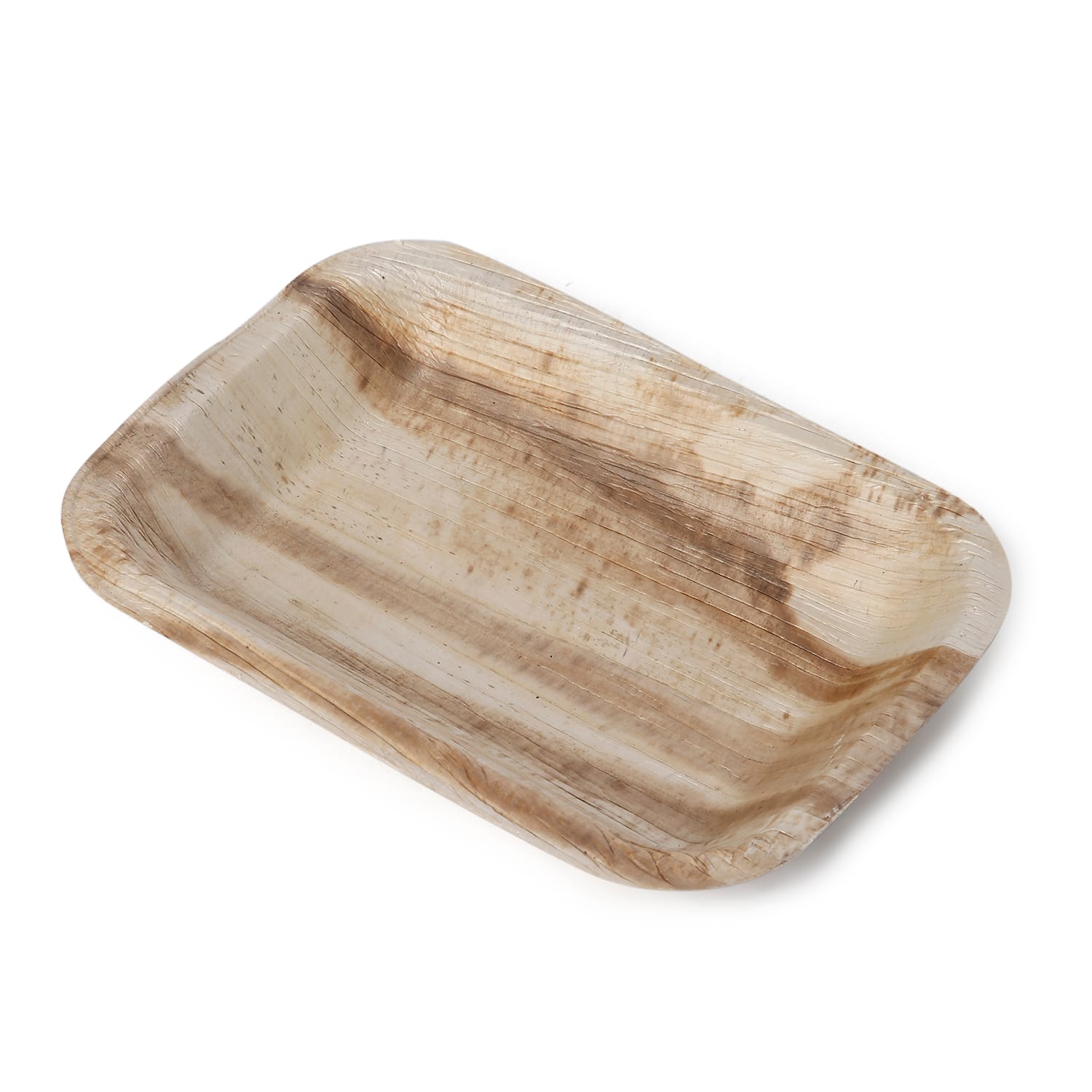
Across thirty-six SKUs of round, square, rectangular and compartmented plates and bowls in sizes from 4 inches to 14 inches, alongside platter and tray formats for buffet line presentation, a single supplier can cover every one of those zones. Areca palm leaf gives a consistent natural finish that reads as premium without printing, which lets a resort use the same plate inventory for a formal black-tie gala, a barefoot beach wedding and a CEO offsite without the disposable becoming a styling problem.
The most common resort mix sits roughly at forty percent banqueting plates and platters, twenty-five percent bowls for buffet service, fifteen percent canapé and dessert formats for events and turn-down service, ten percent pool-deck rigid plates, and ten percent specialty including compartment plates for breakfast and grab-and-go service. The exact mix should be validated against your property’s covers data during the sampling phase.
The ESG and sustainability reporting case for a hotel eco tableware supplier
Group-level ESG reports increasingly require evidence at the SKU level. A hotel eco tableware supplier should be able to provide, alongside product specifications, the four pieces of evidence that flow directly into Scope 3 emissions, water, waste and supplier diligence sections of an annual sustainability report.
First, manufacturing energy provenance. Ecodyne’s production operation is one hundred percent solar-powered, with on-site generation evidenced by metering records and grid-tie documentation. Second, raw-material sourcing transparency. The leaf supply comes from 810 farming families across four districts of Karnataka — no plantation conversion, no synthetic inputs, naturally shed leaves only. Third, end-of-life pathway. The plates are home and industrial compostable inside 60 to 90 days, with no microplastic or PFAS residual; this materially changes the waste-stream accounting for a property running its own composter or partnered with a local organic-waste handler. Fourth, ethical labour. BSCI auditing across the production base evidences working conditions for the supplier-diligence section.
For groups operating under EU sustainability frameworks, the EU Single-Use Plastics framework determines what disposables can be used at properties inside the bloc. Areca palm leaf sits outside the SUP Directive scope because it is a naturally shed plant material with no plastic content — a regulatory simplification that reduces the documentary burden on the property’s compliance team.
Certifications international hotel groups must verify
Procurement teams at international hotel groups work through documented vetting protocols before adding a supplier to the approved-vendor list. For a hotel eco tableware supplier the documentary baseline includes food-contact compliance, management-system certification, and ethical-labour evidence — all current, all from accredited bodies, all available on first request.
For European properties, LFGB §30/§31 test reports from accredited German testing laboratories are the operative food-contact standard, sitting under EU Regulation 1935/2004. USA properties additionally need FDA compliance evidence and many groups also ask for USDA BioPreferred certification for the marketing claim. Australian and New Zealand properties verify against AS/NZS 2070 food-contact standards. Ecodyne maintains all of these documents current and supplies them with quotation packs, not as a separate request loop.
On management systems, ISO 9001:2015 and ISO 14001:2015 are the procurement minimums for any group-level vendor approval. BSCI auditing covers the ethical-labour dimension. For groups with their own audit team that wants to physically verify production, Ecodyne hosts factory visits in Karnataka — most international group audit teams have visited at least once before signing a multi-property contract.
Supply reliability across peak seasons for a hotel eco tableware supplier
Peak season is where reliability matters more than price. European city hotels peak in early summer and through December. Mediterranean and tropical resorts peak across the winter-sun season from November to March. Wedding venues peak across May to September. Business hotels peak across the conference shoulders of spring and autumn. A hotel eco tableware supplier serving across these different rhythms needs production capacity that can absorb concurrent peaks without rationing any one property.
Standing inventory of three million units across the 36-SKU range lets most repeat orders ship inside ten working days from stock rather than waiting for a production cycle. Monthly production capacity of 4.5 million units, scalable to nine million inside seventy-five days, gives a hotel group the headroom to add new properties, replace an unreliable incumbent supplier, or absorb a step-change in event volumes without renegotiating the supply baseline.
The 10-day container loading commitment is contractual: if Ecodyne misses the agreed loading date, the property is entitled to a one percent penalty on the order value for each day of delay. That clause exists because a resort cannot tell a wedding party or a corporate event that the plates did not arrive. Where reliability is the gating procurement variable — which for hotels it usually is — that commitment is the single most useful term in the contract.
How to move from pilot property to multi-property contract
The route from first contact with a hotel eco tableware supplier to a signed multi-property contract typically runs across two service seasons. The sequence below is the standard onboarding path Ecodyne runs for new hotel group accounts.
Step 1: Sampling pack to the pilot property
Nominate a single pilot property and share the SKU mix the F&B team currently uses across banqueting, all-day-dining and pool service. Ecodyne ships a representative sampling pack with cost-per-unit indicative pricing for two container scenarios. Allow two to three weeks for international courier delivery.
Step 2: Pilot deployment across one service season
Run the samples through one full service season of banqueting events, daily restaurant service and pool-deck use. Capture front-of-house feedback on rigidity, oil and sauce performance, stackability for service, presentation quality at plated dinners, and guest-facing communications around the disposable choice.
Step 3: First container to the pilot property, with the full documentation pack available on request
Lock the SKU mix and quantities for a mixed-SKU 40ft container to the pilot property. Ecodyne returns a landed-cost quotation against your chosen incoterm with the loading window and penalty clause; the full ESG documentation pack required for group-level Scope 3 reporting is available on request at no extra charge.
Step 4: Roll forward to multi-property contract
Once the pilot is validated, the conversation moves to a master supply agreement covering multiple properties on quarterly or half-yearly order cadences, with consolidated container loading and group-level reporting against a single supplier code.
Frequently asked questions for a hotel eco tableware supplier
What scale of hotel group does a hotel eco tableware supplier like Ecodyne typically serve?
Ecodyne serves both single-property resorts and multi-property hotel groups across eighteen export markets. The minimum useful engagement is a single 20ft container to a pilot property; beyond that, group-level master agreements covering quarterly or half-yearly orders across multiple properties are the most common pattern.
How does the product perform across banqueting, à la carte and pool-deck service?
The areca palm leaf format is rated for hot service up to approximately 110 degrees Celsius, handles oil, sauce and gravy, has rigidity suited to plated dinner service, and is sufficiently weather-resistant for pool and beach service. Format selection inside the 36-SKU catalog matters more than material concerns at this scale.
What ESG documentation can we add to our annual sustainability report?
Ecodyne supplies, on request and free of charge, evidence of 100 percent solar manufacturing energy, 810 farmer direct sourcing, BSCI ethical-labour auditing, ISO 14001 environmental management, home and industrial compostability inside 60 to 90 days, and zero plastic, PFAS or additive content. The pack is built for direct insertion into Scope 3 supplier-disclosure sections of group reports.
How do peak-season supply commitments work across multiple properties?
Master agreements lock production capacity allocation across the group’s peak windows, with three million units of standing inventory absorbing repeat orders inside ten working days. The contractual one percent per week delay penalty applies at the order level and is enforceable against the master agreement.
What is the minimum order size for a multi-property programme?
A multi-property programme typically begins at one mixed-SKU 40ft container per quarter, scaling to consolidated quarterly containers per property as deployment expands. Container fills are mixed-SKU by default to support breadth across the group’s service formats.
Working with Ecodyne as your hotel eco tableware supplier
A long-run relationship with a hotel eco tableware supplier should give the F&B team three things at once: reliable supply across the property’s peak seasons, full ESG documentation for group-level reporting, and a manufactured product that performs across banqueting, restaurant and event service without compromising on the brand’s presentation standards. Ecodyne’s model — manufacturing-direct pricing, ISO 9001 and 14001 certification plus amfori BSCI verification, 100 percent solar production, 810 farmer direct sourcing, three million units of standing inventory and a contractual 10-day loading commitment — is built for that combination.
If you are scoping a new disposable tableware programme for a single resort or evaluating a master agreement for a multi-property group, the next step is a sampling pack to the pilot property and a landed-cost model for your first container. Request a wholesale quote with your property’s SKU mix and we will respond inside two business days. You may also want to read our companion guides on HoReCa wholesale procurement, catering wholesale procurement and our sustainability programme for the full provenance story.
About Ecodyne
Ecodyne Tableware, a brand of Conservia Partners, is India’s largest manufacturer and exporter of palm leaf plates, bowls and tableware. Based in Karnataka, India, Ecodyne has a production capacity of 4.5 million units a month from naturally fallen areca palm leaves — without chemicals, dyes or additives. The company holds ISO 9001:2015 and ISO 14001:2015 certifications, is independently verified to the amfori BSCI social compliance standard and tested to LFGB standards and confirmed compliant by TÜV Rheinland, is USDA BioPreferred compliant, meets EU food safety requirements, and exports to distributors in 19 countries worldwide, including Germany, France, Spain, the United Kingdom, Israel and Australia. Ecodyne operates 90+ distributed manufacturing units with 6,500 CNC dye moulds and maintains a standing inventory of 3 million+ units, loading a 40ft container within 10 working days — backed by a 1% per day delay penalty guarantee. The company works directly with 810 farming families across four districts of Karnataka. Conservia Partners also runs a 2,000-hectare organic conversion programme for its Just a Leaf brand, guided by the Central Plantation Crops Research Institute (CPCRI), and offers white-label and custom packaging solutions for importers and distributors worldwide.
Request a Quote
Wholesale palm leaf tableware, FOB New Mangalore Port. Share your monthly volumes and SKUs.
Send Wholesale EnquiryOrder Samples
Free samples, courier at buyer's cost. Tell us which sizes to evaluate.
Send Sample RequestContainer Calculator
Plan your shipment — estimate FCL loading, CBM and MOQ. No pricing, no signup.
Open Calculator