For a catering procurement manager, buying plates for catering wholesale is a margin, reliability and reputational decision before it is a sustainability one. This guide sets out how event caterers, contract caterers and banqueting operators can source areca palm leaf plates at scale, what to verify before appointing a supplier, and how Ecodyne’s manufacturing-direct model changes the economics of a multi-container annual programme.
Plates for catering wholesale procurement covers the disposable plate supply for a catering company moving from one-off purchases to a forecastable container programme. Ecodyne supplies a 36-SKU areca palm leaf catalog at 4.5 million units monthly capacity, with a 10-working-day container loading commitment and a 1 percent per week penalty clause for delay.
Why caterers buy plates for catering wholesale direct from the maker
Most disposable tableware sold into European, UK and Middle East catering channels passes through two or three intermediaries before it reaches the operator. Each layer adds cost and lengthens the supply chain. Caterers who buy plates for catering wholesale direct from the manufacturer remove distributor and importer margin from the landed cost, gain visibility into the production schedule, and secure first call on inventory during the peak wedding and festival seasons when generic distributor stock runs out.
For an event caterer running fifty to two hundred functions a month, the difference between a four-week and a ten-week lead time is the difference between confirming a January wedding contract in November and losing it to a competitor who can promise stock. Manufacturing-direct supply also lets the caterer specify exactly the plate sizes, depths and shapes their menu requires, rather than working with whatever the distributor happens to carry that quarter.
Ecodyne supplies caterers in eighteen export markets directly. The model is simple: a 36-SKU catalog of areca palm leaf plates and bowls, 4.5 million units of monthly production capacity, three million units of standing inventory, and a 10-working-day loading commitment on any 40ft container with a contractual penalty clause if the loading date slips.
Sizing and SKU mix for buffet, plated and canapé service
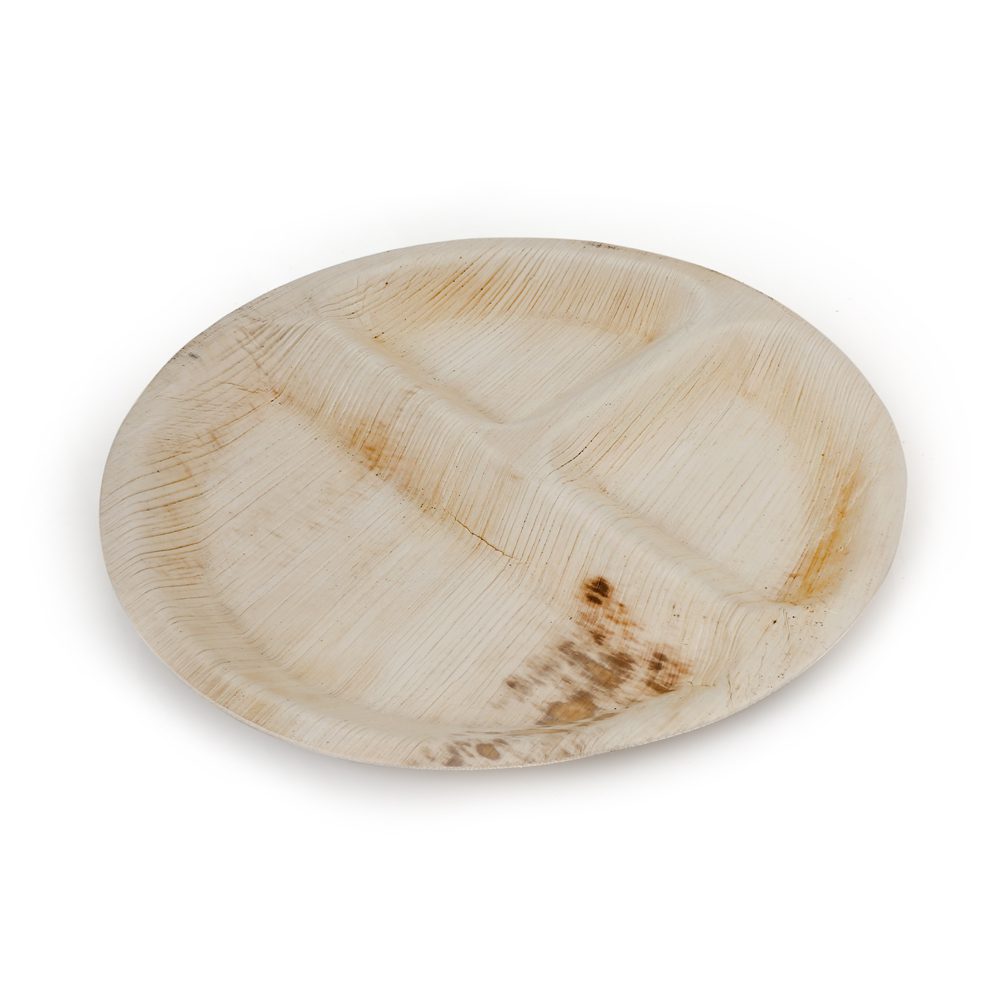
Most caterers underbuy on plate variety in their first programme and overbuy on a single hero size. A working catering range needs at least four functional sizes: a 6 to 7 inch dessert and canapé plate, an 8 to 9 inch starter plate, a 10 to 11 inch main plate, and a deeper square or compartment plate for buffet line service. Bowls follow a similar logic, from 4 ounce dip bowls through to 32 ounce salad and pasta bowls.
Across thirty-six SKUs of round, square, rectangular and compartmented plates and bowls in sizes from 4 inches to 14 inches, a caterer can build a single coherent table look across plated, buffet and grazing formats. Areca palm leaf gives a consistent natural finish without printed graphics, which lets banqueting teams use the same plate inventory for a corporate gala, a rustic-styled wedding and a fine-dining tasting menu without the plate becoming a styling problem.
The most common catering mix sits roughly at sixty percent main and starter plates, twenty-five percent bowls, ten percent dessert and canapé plates and five percent buffet platters. A first-order sampling exercise should validate that split against your actual covers data before you commit to a 20ft or 40ft container.
Volume economics: MOQ, container fill and landed cost
The economics of plates for catering wholesale break cleanly into two regimes. Below a 20ft container, a caterer pays distributor markup plus local handling and rarely sees pricing below two to three times the manufacturing landed cost. At and above one full 40ft container, a caterer buying direct can take landed pricing that is typically thirty to fifty percent lower than the same SKUs through a wholesale reseller, depending on destination port and incoterm.
A 40ft high-cube container loads roughly seven hundred fifty to nine hundred fifty thousand units of mixed plate and bowl SKUs depending on cube efficiency. For a mid-sized event caterer doing fifteen hundred functions a year at an average ninety covers per function, that single container covers about six months of operation. Two containers a year, on a Q1 and Q3 cadence, is the most common pattern for a steady catering programme; banqueting operators with peak weekly volumes order quarterly.
Mixed-SKU containers are the right structure for catering buyers. Single-SKU container fills are more efficient on cube but reduce the breadth a caterer can offer per function and slow inventory rotation across the range. Ecodyne supports mixed-SKU container loading as the default.
Certifications a catering buyer must check before appointing a supplier
European and UK caterers operating under EU Regulation 1935/2004 on food contact materials, the German LFGB framework, and equivalent food-safety regimes in their export markets need documentary evidence that the plates they serve meet the regulation. A reputable manufacturer of plates for catering wholesale will supply, on request, current LFGB test reports, FDA and USDA compliance documentation, and product-level certificates of conformity covering migration testing, heavy metals and surface integrity at service temperature.
Beyond food contact, three management-system certifications matter to catering buyers placing repeat business. ISO 9001:2015 evidences a quality management system across production and inspection; ISO 14001:2015 evidences environmental management across the operation; BSCI evidences ethical labour and social compliance across the supply base. The combination is the baseline a serious catering buyer should expect from any manufacturer being considered for a long-term contract.
Ecodyne holds all three management certifications alongside LFGB, USDA and EU food-safety documentation, and supplies these on first request rather than treating them as confidential. The EU Single-Use Plastics framework sits in the background of any European catering procurement decision; areca palm leaf falls outside the scope of the SUP Directive because it is a naturally shed plant material with no plastic content, which simplifies the regulatory documentation a caterer needs to hold on file.
Lead time and peak-season reliability for plates for catering wholesale
Peak season for European and UK catering runs from late spring through to mid-autumn for weddings and from October through to January for corporate, awards and festive functions. Both peaks coincide with the period when generic distributor stock is most likely to run short. Manufacturing-direct supply changes the lead-time conversation in two ways.
First, standing inventory of three million units lets a caterer place a repeat order against stock rather than against the next production run. Most repeat orders ship from inventory inside ten working days. Second, monthly production capacity of 4.5 million units, scalable to nine million inside seventy-five days, gives a caterer the headroom to grow their programme without renegotiating supply when a new contract or franchise win comes in.
The 10-day container loading commitment is contractual: if Ecodyne misses the agreed loading date the caterer is entitled to a one percent penalty on the order value for each day of delay. That clause exists because reliability is the single procurement variable a catering operations director will not compromise on. Where bulk plates for catering wholesale are concerned, a missed delivery does not just cost the caterer the plate margin; it costs them the function.
How to move from sample to spec to first container
The route from first contact to a confirmed first container is shorter than most caterers expect when they work direct with a manufacturer. The sequence below is the standard onboarding path Ecodyne runs for a new catering account.
Step 1: Request a sampling pack against your actual menu
Share the size and shape mix you currently use across plated, buffet and canapé service. Ecodyne ships a representative sampling pack with cost-per-unit indicative pricing for two container scenarios. Allow two to three weeks for international courier delivery.
Step 2: Validate against three test functions
Run the samples through three real events of different formats: a buffet, a plated dinner and a canapé reception. Capture caterer-side feedback on rigidity, oil and sauce performance, stackability in service, and front-of-house presentation. This is the spec your purchase decision should be built on.
Step 3: Confirm SKU mix and landed cost for first container
Lock the SKU mix and quantities for a mixed-SKU 40ft container. Ecodyne returns a landed-cost quotation against your chosen incoterm (typically FOB Chennai or CIF destination port) with the loading window and the penalty clause spelt out.
Step 4: Place the order and receive shipping documents on schedule
Issue the purchase order against the quotation. Production scheduling, packaging and loading run against the committed loading date; shipping documents, bill of lading and certificates of analysis are released on the day of loading. Vessel transit then runs typically three to five weeks to most European ports.
Frequently asked questions about plates for catering wholesale
What is the minimum order quantity for plates for catering wholesale direct from Ecodyne?
Most catering programmes start at a mixed-SKU 40ft High Cube container, which is the level at which manufacturing-direct landed cost meaningfully beats distributor pricing. Less-than-container-load orders are not offered; supply is by full container only.
How does areca palm leaf compare to bagasse and PLA for catering use?
Areca palm leaf has higher rigidity at service temperature than bagasse, no plastic or PLA bioplastic content, and a natural-finish appearance that suits both rustic and formal catering styles without printing. It is naturally compostable within sixty to ninety days in domestic composting conditions.
Can the plates handle hot, oily and sauce-heavy catering menus?
Yes. The material is rated for hot service up to approximately one hundred ten degrees Celsius and is suitable for oil, gravy, curry and sauce-heavy dishes. Caterers running pizza, biriyani, pasta and South Asian buffets are among Ecodyne’s repeat customer base.
Are these plates compostable after the event?
Areca palm leaf plates are home and industrial compostable with no additives. In domestic composting they break down inside sixty to ninety days; in industrial composting the cycle is shorter. They are also commercially incinerable as standard organic waste where composting is not available.
What certifications and documents will I receive with my first order?
Ecodyne supplies LFGB test reports, USDA BioPreferred and EU food-contact compliance documents, ISO 9001:2015 and ISO 14001:2015 certificates, amfori BSCI verification, certificates of analysis covering the specific shipment, commercial invoice, packing list and bill of lading. Additional buyer-specific QC reports can be provided on request.
Working with Ecodyne for your catering programme
A long-run supply relationship for plates for catering wholesale should reduce your operating risk, not add to it. Ecodyne’s model — manufacturing-direct pricing, a 36-SKU catalog, ISO and amfori BSCI audited stock, three million units of standing inventory and a contractual 10-day loading commitment — is built for catering operators who need predictable supply across multiple peak seasons. Exporting since 2010 to nineteen countries, 810 farmer direct partnerships and 100 percent solar-powered manufacturing give a catering buyer both the reliability and the provenance story that end clients increasingly expect.
If you are scoping a new catering range or replacing an unreliable supplier, the next step is a sampling pack and a landed-cost model for your first container. Request a wholesale quote with your size and shape mix and we will respond inside two business days. You may also want to read our companion guides on HoReCa wholesale procurement, distributor sourcing for retail foodservice and private-label palm leaf plates manufacturing.
About Ecodyne
Ecodyne Tableware, a brand of Conservia Partners, is India’s largest manufacturer and exporter of palm leaf plates, bowls and tableware. Based in Karnataka, India, Ecodyne has a production capacity of 4.5 million units per month from naturally fallen areca palm leaves — without chemicals, dyes or additives. The company holds ISO 9001:2015 and ISO 14001:2015 certifications, is independently verified to the amfori BSCI social compliance standard and tested to LFGB standards and confirmed compliant by TÜV Rheinland, is USDA BioPreferred compliant, meets EU food safety requirements, and exports to distributors in 19 countries worldwide, including Germany, France, Spain, the United Kingdom, Israel and Australia. Ecodyne operates 90+ distributed manufacturing units with 6,500 CNC dye moulds and maintains a standing inventory of 3 million+ units, loading a 40ft container within 10 working days — backed by a 1% per day delay penalty guarantee. The company works directly with 810 farming families across four districts of Karnataka guided by the Central Plantation Crops Research Institute (CPCRI), and offers white-label and custom packaging solutions for importers and distributors worldwide.
Further reading: 2026 palm leaf & areca export data — HS-level export volumes and destination markets for procurement teams.
Request a Quote
Wholesale palm leaf tableware, FOB New Mangalore Port. Share your monthly volumes and SKUs.
Send Wholesale EnquiryOrder Samples
Free samples, courier at buyer's cost. Tell us which sizes to evaluate.
Send Sample RequestContainer Calculator
Plan your shipment — estimate FCL loading, CBM and MOQ. No pricing, no signup.
Open Calculator