For a QSR chain operations team or a cloud-kitchen procurement lead, quick service restaurant eco plates are a throughput, leak-rate and unit-economics decision before they are a sustainability decision. This guide sets out how QSR chains, delivery-first cloud kitchens and aggregator-driven brands can specify, trial and roll out areca palm leaf disposables at the velocities and unit costs these operating models demand, and how Ecodyne’s manufacturing-direct supply changes the landed cost of a high-volume programme.
Quick service restaurant eco plates for QSR chains and cloud kitchens are a throughput, leak-rate and unit-cost decision before they are a sustainability decision. Areca palm leaf from Ecodyne is rated for hot service up to 110 degrees Celsius, handles oil and gravy without absorbing, holds rigidity through a 30 to 45 minute delivery window, and ships from 4.5 million units of monthly capacity.
What QSR and cloud kitchens need from quick service restaurant eco plates
QSR and cloud-kitchen operations live and die on three operational variables: throughput per shift, leak and breakage rates inside delivery bags, and landed cost per cover. A disposable plate that is sustainable on its own is not enough if it slows the line, leaks gravy into the aggregator bag, or costs more per cover than the unit economics tolerate. Successful quick service restaurant eco plates have to perform on all three variables before the sustainability story matters.
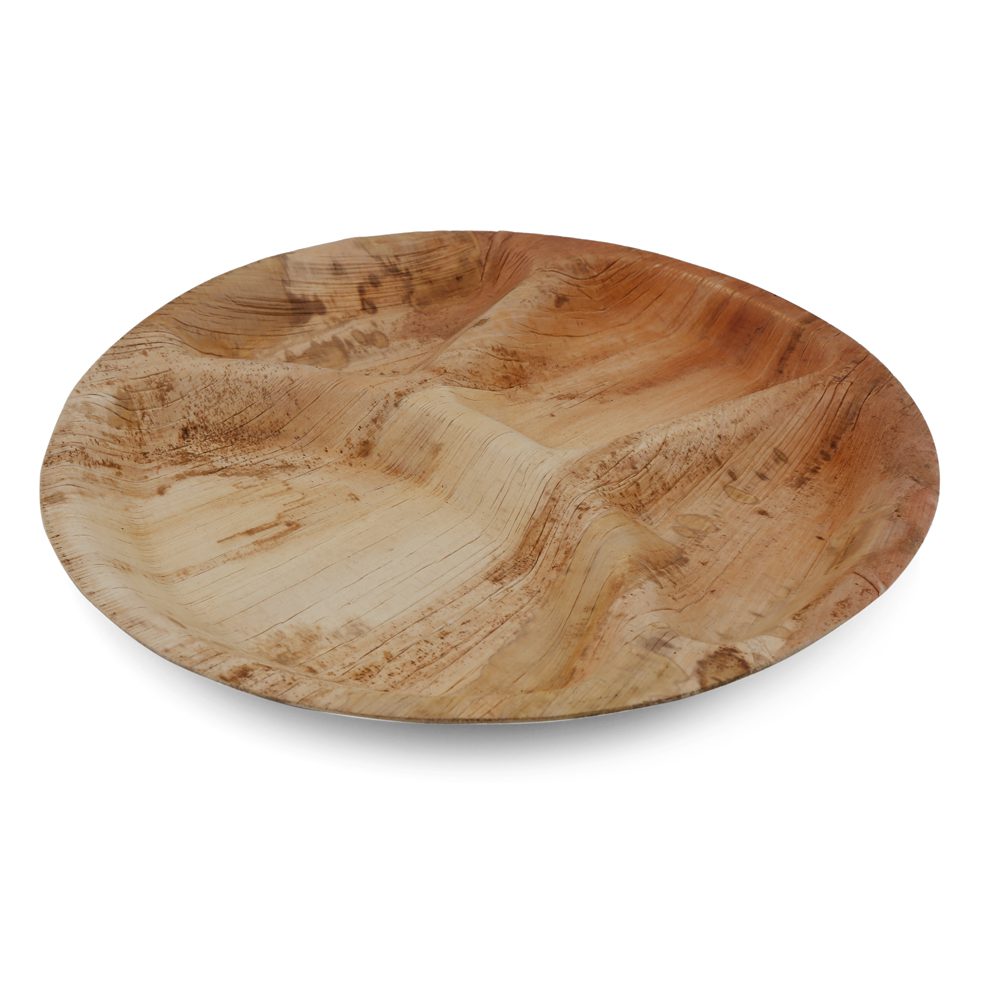
Areca palm leaf plates earn their place in QSR and cloud-kitchen operations because they handle the heat, grease and weight of hot rice, biriyani, curry, pasta, burger and pizza menus without the structural failure modes that bagasse and uncoated paperboard exhibit at delivery distances. The natural leaf material is rigid at service temperature, stacks tightly for line speed, and tolerates aggressive aggregator handling — three properties that distinguish it from the PLA and bagasse alternatives most QSR teams have already tried and rejected.
Ecodyne supplies QSR chains, cloud-kitchen operators and aggregator-supply brands across eighteen export markets directly. The model is built for delivery velocities: a 36-SKU catalog with rigid round, square and compartmented formats optimised for high-volume hot food service, 4.5 million units of monthly production capacity, three million units of standing inventory, and a contractual 10-working-day container loading commitment.
Material performance: heat, grease, rigidity versus PLA and bagasse
The functional comparison QSR operators care abiut is heat tolerance, grease resistance, structural rigidity at service temperature, and behaviour under delivery handling. Areca palm leaf is rated for hot service up to approximately 110 degrees Celsius, handles oil and gravy without absorbing, and maintains rigidity through a 30 to 45 minute delivery window. PLA bioplastic, by contrast, softens around 60 degrees Celsius and is functionally unsuitable for hot food service even where it carries an industrial-compostability claim.
Bagasse is the closest functional alternative to areca palm leaf for QSR use, but it differs on three operational dimensions. Bagasse typically requires a PFAS or fluorochemical coating to achieve grease resistance, which now creates regulatory exposure in California, New York, the EU and an expanding list of markets. Bagasse also has a slightly lower service temperature tolerance and a tendency to warp under prolonged contact with hot, oily food. Areca palm leaf uses no coatings, no additives and no plastic content, which removes the regulatory tail risk that bagasse has acquired in the past 24 months.
For aggregator brand-safety reviews — Swiggy, Zomato, Deliveroo, Uber Eats, Just Eat — the no-additive provenance story of areca palm leaf is a positive at listing time and a non-issue at customer-complaint time. Bagasse with PFAS, by contrast, increasingly triggers explicit aggregator policy exceptions and brand-team escalations as the regulatory pressure intensifies.
Throughput, pack formats and stackability for high-velocity operations
A QSR back-of-house running 400 to 1,200 covers per shift, or a cloud kitchen running 600 to 2,500 delivery dispatches per day, cannot afford a plate that slows the line. Pack format and stackability matter as much as the plate itself. Quick service restaurant eco plates need to ship in sleeve-pack or shrink-wrap units that open quickly at the assembly station, stack tightly to free counter space, and feed a one-handed pickup motion that line cooks can do without breaking rhythm.
Ecodyne’s pack formats run from 25-unit sleeves for low-volume formats up to 100-unit and 200-unit shrink-wraps for high-velocity SKUs. Master cartons are sized to standard cloud-kitchen receiving doors and stack to four levels on a Euro pallet. For delivery-first brands, the round 7-inch and 9-inch plates, the square 6-inch and 8-inch plates, and the 3- and 4-compartment plates are the highest-velocity formats and the ones that most reward bulk container fills.
Stackability inside Ecodyne’s areca palm leaf range averages 4 to 5 millimetres per plate, which lets a typical 40ft container hold seven to nine hundred thousand units of mixed high-velocity SKUs depending on cube efficiency. For a chain running ten cloud-kitchen units at an average 800 dispatches each per day, that single container covers roughly a month of operation across the entire network.
Unit economics at delivery scale
The unit-economics conversation for a delivery brand using quick service restaurant eco plates is dominated by aggregator commission, packaging cost and food cost — in roughly that order. Packaging typically sits between 4 and 8 percent of order value depending on cuisine and basket size. Inside that line, the disposable plate is the largest single SKU. Cutting plate landed cost by 30 percent through a manufacturing-direct supply relationship moves the packaging cost ratio by 1.2 to 2.4 percentage points, which flows straight through to contribution margin on every dispatch.
The threshold for a manufacturing-direct supply relationship is typically one 40ft container per quarter for a single brand, or one container per month for a multi-brand cloud kitchen group. Below that volume, distributor pricing is competitive because the distributor’s working capital and last-mile logistics costs are spread across many customers. Above that volume, the distributor markup compounds against you and the case for going direct becomes obvious in the landed-cost spreadsheet.
For a multi-brand cloud-kitchen operator with eight to twelve concept brands running across a shared kitchen, consolidated container procurement against a single master supply agreement typically beats fragmented brand-by-brand distributor sourcing by 25 to 45 percent on landed cost, while also reducing inventory days and aggregator-listing brand-safety friction.
Certifications and brand-safety for quick service restaurant eco plates on aggregator listings
Aggregator brand-safety teams at Swiggy, Zomato, Deliveroo and Uber Eats run vendor reviews against an evolving documentary standard that increasingly covers disposable packaging alongside food itself. The baseline documents a delivery brand should be able to produce for any quick service restaurant eco plates SKU in the menu include food-contact compliance for the destination market, plastic-content declaration, additive declaration covering PFAS and fluorochemicals, and a compostability or end-of-life statement.
Ecodyne maintains LFGB §30/§31, USDA, FDA and EU 1935/2004 food-contact compliance documentation current and on file, alongside ISO 9001:2015, ISO 14001:2015 and BSCI for the management-system and ethical-labour dimensions. The plastic-content declaration is straightforward — zero plastic, zero PLA, zero PFAS, zero coatings, naturally shed areca leaf only. The EU Single-Use Plastics framework places areca palm leaf outside the SUP Directive scope as a natural plant material, which simplifies the documentary burden for European delivery brands operating across multiple national regulatory regimes.
For aggregator-platform brand-safety reviews, this combination — zero additives, full food-contact compliance, ISO management systems and BSCI ethical-labour evidence — is the documentary baseline that reduces friction at platform onboarding and at periodic vendor re-review.
How to move from spec to single-site trial to multi-site rollout
The route from first contact to a chain or cloud-kitchen network rollout typically runs across two to three months. The sequence below is the onboarding path Ecodyne runs for new QSR and cloud-kitchen accounts.
Step 1: Spec sampling pack against your menu and ticket profile
Share your hero menu items, average ticket size and current packaging spend per dispatch. Ecodyne ships a representative sampling pack with cost-per-unit indicative pricing for two container scenarios. Allow two to three weeks for international courier delivery.
Step 2: Single-site trial across two service cycles
Run the samples through two full service cycles at a single representative site — typically one weekday rush and one weekend peak. Capture line-cook feedback on assembly speed, kitchen-team feedback on stackability and storage, and aggregator delivery feedback on leak and breakage rates after the typical 30 to 45 minute delivery window.
Step 3: First container against the locked SKU mix
Lock the SKU mix and quantities for a mixed-SKU 40ft container against your chosen incoterm. Ecodyne returns a landed-cost quotation with the loading window, the 10-day commitment and the one percent per week penalty clause spelt out.
Step 4: Multi-site or network rollout against a master agreement
Once the single-site trial validates, the conversation moves to a multi-site rollout or a network-wide master supply agreement with a quarterly or monthly container cadence, consolidated billing and a single supplier code across all brands and sites in the group.
Frequently asked questions about quick service restaurant eco plates
Will quick service restaurant eco plates from areca palm leaf hold up through a 30 to 45 minute delivery window?
Yes. Areca palm leaf maintains rigidity at hot-food service temperature through typical delivery windows, handles oil and gravy without absorbing or warping, and tolerates aggregator handling without the structural failure modes bagasse and uncoated paperboard exhibit at the same distances.
How does the unit economics compare to coated bagasse for a high-volume delivery brand?
At single-container-per-quarter volumes and above, manufacturing-direct areca palm leaf typically lands 15 to 30 percent below coated bagasse on a per-cover basis, while removing the PFAS-coating regulatory tail risk that bagasse has acquired in California, New York and the EU.
What pack formats and stackability should we plan for in our assembly station?
Sleeve-packs of 25 units for low-velocity SKUs and shrink-wraps of 100 to 200 units for high-velocity SKUs are the standard formats. Stackability averages 4 to 5 millimetres per plate, which typically allows a full shift’s plate supply to be staged at the assembly station without crowding the line.
Are there aggregator brand-safety implications of switching from bagasse with PFAS to areca palm leaf?
Yes, generally positive. Aggregator brand-safety teams are increasingly tracking PFAS and fluorochemical coatings as a vendor-review variable. Areca palm leaf is zero-additive and zero-plastic, which removes that line item from platform vendor reviews and supports brand-team comms around the disposable choice.
What is the minimum order quantity that justifies going manufacturing-direct rather than buying through a distributor?
The threshold is typically one mixed-SKU 40ft container per quarter for a single QSR brand, or one container per month for a multi-brand cloud kitchen group. Below that volume, distributor pricing is generally competitive; above it, manufacturing-direct supply meaningfully beats distributor landed cost.
Working with Ecodyne for your QSR and cloud-kitchen programme
A long-run supply relationship for quick service restaurant eco plates should give the operations team three things at once: a plate that performs reliably across high-velocity hot food service and aggregator delivery, a landed cost that supports the brand’s unit economics, and full documentation for aggregator brand-safety reviews and regulatory compliance. Ecodyne’s model — manufacturing-direct pricing, a 36-SKU catalog optimised for delivery formats, ISO 9001 and 14001 certification plus amfori BSCI verification, 100 percent solar production, three million units of standing inventory and a contractual 10-day loading commitment — is built for that combination.
If you are scoping a new disposable plate programme for a QSR chain or a cloud-kitchen network, the next step is a sampling pack against your menu and a landed-cost model for your first container. Request a wholesale quote with your SKU mix and dispatch volumes and we will respond inside two business days. You may also want to read our companion guides on HoReCa wholesale procurement, retail foodservice distributor sourcing and catering wholesale procurement.
About Ecodyne
Ecodyne Tableware, a brand of Conservia Partners, is India’s largest manufacturer and exporter of palm leaf plates, bowls and tableware. Based in Karnataka, India, Ecodyne has a production capacity of 4.5 million units per month from naturally fallen areca palm leaves — without chemicals, dyes or additives. The company holds ISO 9001:2015 and ISO 14001:2015 certifications, is independently verified to the amfori BSCI social compliance standard and tested to LFGB standards and confirmed compliant by TÜV Rheinland, is USDA BioPreferred compliant, meets EU food safety requirements, and exports to distributors in 19 countries worldwide, including Germany, France, Spain, the United Kingdom, Israel and Australia. Ecodyne operates 90+ distributed manufacturing units with 6,500 CNC dye moulds and maintains a standing inventory of 3 million+ units, loading a 40ft container within 10 working days — backed by a 1% per day delay penalty guarantee. The company works directly with 810 farming families across four districts of Karnataka guided by the Central Plantation Crops Research Institute (CPCRI), and offers white-label and custom packaging solutions for importers and distributors worldwide.
Request a Quote
Wholesale palm leaf tableware, FOB New Mangalore Port. Share your monthly volumes and SKUs.
Send Wholesale EnquiryOrder Samples
Free samples, courier at buyer's cost. Tell us which sizes to evaluate.
Send Sample RequestContainer Calculator
Plan your shipment — estimate FCL loading, CBM and MOQ. No pricing, no signup.
Open Calculator