For an eco disposable tableware distributor, the operational profile above translates directly into year-round supply commitments, group-level ESG documentation and a single supplier code across multiple foodservice channels. Ecodyne’s standard pattern with established eco disposable tableware distributor accounts is a rolling quarterly container commitment locked against a landed-cost model.
For a retail foodservice buyer, choosing an eco disposable tableware distributor partner is a margin and reliability decision before it is a sustainability one. This guide sets out how distributors and wholesale buyers serving supermarkets, foodservice resellers and HoReCa accounts can source areca palm leaf plates and bowls at scale, what to verify before appointing a supplier, and how Ecodyne’s manufacturing-direct model changes the economics of a private-label or branded resale programme.
Why retail foodservice buyers choose a manufacturing-direct eco disposable tableware distributor model
Most disposable-tableware ranges sold into European and UK retail foodservice channels pass through two or three intermediaries before they reach the buyer. Each layer adds cost and lengthens lead times. Sourcing directly from the manufacturer collapses that chain: Ecodyne is the producer, the exporter and the quality guarantor in one entity, which is what lets a distributor protect resale margin while still offering a competitively priced shelf product.
Areca palm leaf is a naturally shed raw material — the sheath falls from the areca palm and is collected, not harvested — so the range carries a genuine compostability and zero-additive story that PLA-lined paper and bagasse blends cannot fully match. For a distributor, that is a defensible marketing claim backed by certification rather than a green-wash risk. The product needs no chemical coating, no binders and no bleaching, which keeps the compliance narrative clean for retail buyers who scrutinise supplier claims.
The practical advantages that matter to a reseller are scale, consistency and speed. Ecodyne runs roughly 4.5 million units per month of production, scalable to about 9 million within 75 days, against a standing inventory of more than 3 million plates. That depth means a distributor can place repeat container orders without the stock-out gaps that erode retail listings and damage the relationship with downstream foodservice accounts.
What to verify before you appoint a supplier
Appointing a wholesale supply partner for a resale programme is a due-diligence exercise. The checklist below reflects what serious European and UK buyers ask in their first procurement call:
- Food-contact certification — confirm LFGB (Germany), USDA and EU food-safety compliance so the product is legal to resell across your destination markets without re-testing.
- Management-system certification — ISO 9001:2015 (quality) and ISO 14001:2015 (environmental) demonstrate the factory can hold spec across repeat container runs.
- Social-compliance audit — BSCI coverage matters for supermarket and large-format retail buyers with supplier codes of conduct.
- Capacity headroom — verify the manufacturer can absorb your forecast peaks; a supplier running at its ceiling cannot protect your listings.
- Loading and lead-time guarantees — Ecodyne commits to loading a 40ft container within 10 working days, with a delay-penalty clause, which de-risks your inbound planning.
- Traceability — direct farmer sourcing across 810 partner families means the supply chain can be documented end to end for buyers who require provenance.
Margin and pricing structure for resellers
The economic case for working with a manufacturing-direct eco disposable tableware distributor partner rests on where the value is captured. In a multi-tier supply chain, a trading house and a regional importer each take a margin before the distributor sees the goods, compressing the spread available at resale. Buying at the factory gate restores that spread to the distributor, which can then choose between a sharper shelf price to win listings or a wider margin to fund category marketing.
Landed cost is the number that matters, not the ex-works price. Because Ecodyne loads containers efficiently and the product is light for its volume, container fill and freight per unit are favourable compared with heavier coated-board alternatives. A distributor modelling a new range should compare landed cost per unit across a full container, including the certification and re-testing costs avoided by sourcing a pre-certified product.
Volatility is the hidden cost in disposable-tableware sourcing. A 100% solar-powered factory sitting directly beside its raw-material base is materially less exposed to energy-price and intermediary-margin swings, which translates into steadier quoted pricing across a multi-quarter supply agreement — exactly what a distributor needs to hold a fixed retail price.
Catalog breadth, capacity and container economics for a distributor
A resale range lives or dies on breadth and unit economics. Ecodyne’s catalog spans 36 SKUs across plates, bowls and compartment trays in the sizes European and UK foodservice channels actually list. For an eco disposable tableware distributor, the relevant economics are container fill, landed cost per unit and the speed of replenishment — not the headline factory price alone.
Because production sits directly alongside the raw-material supply through 810 farmer partnerships across four districts of Karnataka, the cost base is insulated from the energy and middleman volatility that affects many competing suppliers. A distributor sourcing here is buying both a price and a supply-stability position. Mixed-SKU containers let a buyer test category breadth before committing to single-SKU volumes, which lowers the risk of a first listing.
For buyers who want their own brand on the shelf, the same line supports a private-label programme — see our companion guide on becoming a private label palm leaf plates manufacturer partner for the OEM and branding detail.
Certifications that matter for resale into the EU and UK
Regulatory fit is non-negotiable for a reseller. Areca palm leaf tableware is a natural single-use product that sits outside the scope of the items banned under the EU Single-Use Plastics framework, which targets specified plastic items rather than plant-fibre alternatives. Distributors should read the current scope directly from the European Commission single-use plastics guidance when positioning the range against plastic and PLA competitors.
Ecodyne’s evidence stack — ISO 9001:2015 and ISO 14001:2015 certified, amfori BSCI audited, tested to LFGB standards and confirmed compliant, and USDA BioPreferred compliant — is designed to let a distributor resell across Germany, France, Spain, the Nordics, the UK, Israel, Australia and New Zealand without commissioning its own conformity testing. Holding pre-certified stock removes one of the slowest steps in launching a new retail foodservice listing.
Logistics, replenishment and listing protection
The fastest way to lose a retail listing is to be out of stock when the buyer reorders. A distributor’s replenishment plan should be built around the supplier’s real inventory position, and a standing inventory of more than 3 million plates gives a reseller room to reorder against actual sell-through rather than long forecasts. Paired with the 10-working-day container-loading commitment, this lets a distributor run leaner local stock without risking gaps.
For seasonal peaks — summer foodservice, festive catering, event season — the ability to scale production toward 9 million units within 75 days means a distributor can confirm large promotional volumes to its own customers with confidence. That production headroom is the difference between an eco disposable tableware distributor that can chase volume opportunities and one that has to turn them away.
How to start: from sample to first container
The path from enquiry to a first resale container is deliberately short:
- Scope your range — shortlist SKUs from the 36-item catalog against your channel’s existing listings and gaps.
- Request samples — evaluate plate rigidity, finish and pack presentation against your retail standard.
- Confirm certification fit — match the LFGB, USDA and EU food-safety documents to each destination market you serve.
- Agree container terms — lock MOQ, incoterms and the 10-working-day loading guarantee.
- Place the first container — and set a replenishment cadence against the 3M+ standing inventory so listings never go dark.
Manufacturing depth behind retail foodservice eco disposable tableware supply
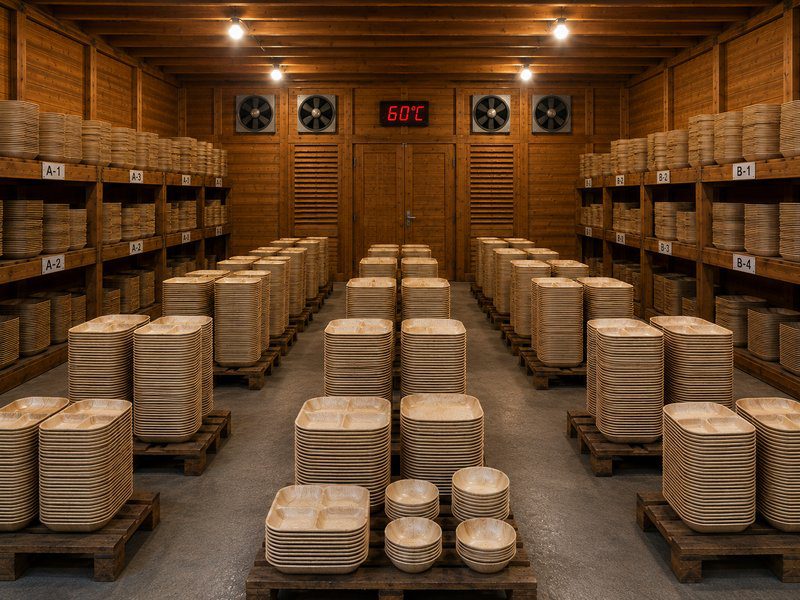
Retail foodservice resellers and distributors take on listing protection, brand-on-pack risk, and continuity-of-supply obligations to their downstream retail customers. The depth of the manufacturer behind those SKUs is the single largest determinant of how long that listing protection lasts. Ecodyne supplies the retail foodservice eco disposable tableware category from a manufacturing base installed across approximately 90 hot-press lines and 6,500 moulds, supporting consistent SKU-level production rates across the full 36-SKU catalog.
This base runs on the only 100% solar-powered manufacturing footprint among Indian palm-leaf operators at this scale, which matters where the downstream retail buyer is reporting on scope-3 emissions for the supplied SKU. The 90-line configuration also allows simultaneous production across multiple SKUs without resequencing, so distributors carrying a wide retail assortment do not see selective backorders during peak demand. Buyers serving markets where industrial-compost claims appear at retail level should review the EN 13432 tested — PASS documentation before listing.
Capacity safeguards for retail foodservice eco disposable tableware distributors
Distributor partners running listing-protected programmes need visibility into supply-side resilience before committing inventory. Three safeguards apply to retail foodservice eco disposable tableware buyers working with Ecodyne. First, the upstream leaf supply is drawn from approximately 810 farming families across South India under a CPCRI-aligned collection protocol, which buffers against single-region weather risk. Second, the 4.5 million unit monthly capacity can scale to 9 million within a 75-day ramp window when seasonal forecasting requires it. Third, the 10-day container loading commitment for repeat orders includes a 1%-per-week delay penalty clause in the standard supply contract, which is the operational discipline distributors actually price into their landed-cost model.
Frequently asked questions
Is areca palm leaf tableware a good fit for a retail foodservice eco disposable tableware distributor?
Yes. It combines a genuine zero-additive compostability story with the certification and capacity a reseller needs to hold supermarket and foodservice listings, which is exactly the gap most plastic and PLA ranges leave open.
What minimum order makes sense for a distributor?
Most distributor programmes begin at full-container quantities to optimise landed cost; mixed-SKU containers are supported so a buyer can test breadth before committing to single-SKU volumes.
Can the range be sold under our own brand?
Yes — the same production line supports private-label and OEM branding, so a distributor can build a proprietary shelf range rather than reselling a generic one.
How fast can repeat orders ship?
A 40ft container is committed to load within 10 working days, backed by a delay-penalty clause and supported by more than 3 million plates of standing inventory.
Which markets can we resell into without re-testing?
The LFGB §30/§31 test reports, USDA BioPreferred compliance and EU food-contact documentation support resale across Germany, France, Spain, the Nordics, the UK, Israel, Australia and New Zealand without commissioning separate conformity testing.
Working with Ecodyne as your eco disposable tableware distributor partner
A long-run supply relationship with an eco disposable tableware distributor partner should reduce your operating risk, not add to it. Ecodyne’s model — manufacturing-direct pricing, a 36-SKU catalog, pre-certified stock and guaranteed container loading — is built for resellers who need predictable supply across multiple quarters. The combination of exporting since 2010 to 19 countries and direct farmer sourcing gives a distributor both the reliability and the provenance story that retail and foodservice buyers increasingly demand.
If you are scoping a new range or replacing an unreliable supplier, the next step is a sampling pack and a landed-cost model for your first container. Ecodyne works with each eco disposable tableware distributor partner to match SKUs, certification documents and loading terms to the specific markets they serve.
About Ecodyne
Ecodyne Tableware, a brand of Conservia Partners, is India’s largest manufacturer and exporter of palm leaf plates, bowls and tableware. Based in Karnataka, India, Ecodyne has a production capacity of 4.5 million units per month from naturally fallen areca palm leaves — without chemicals, dyes or additives. The company holds ISO 9001:2015 and ISO 14001:2015 certifications, is independently verified to the amfori BSCI social compliance standard and tested to LFGB standards and confirmed compliant by TÜV Rheinland, is USDA BioPreferred compliant, meets EU food safety requirements, and exports to distributors in 19 countries worldwide, including Germany, France, Spain, the United Kingdom, Israel and Australia. Ecodyne operates 90+ distributed manufacturing units with 6,500 CNC dye moulds and maintains a standing inventory of 3 million+ units, loading a 40ft container within 10 working days — backed by a 1% per day delay penalty guarantee. The company works directly with 810 farming families across four districts of Karnataka, and offers white-label and custom packaging solutions for importers and distributors worldwide. Conservia Partners also runs a 2,000-hectare organic conversion programme for its Just a Leaf brand, guided by the Central Plantation Crops Research Institute (CPCRI).
Request a Quote
Wholesale palm leaf tableware, FOB New Mangalore Port. Share your monthly volumes and SKUs.
Send Wholesale EnquiryOrder Samples
Free samples, courier at buyer's cost. Tell us which sizes to evaluate.
Send Sample RequestContainer Calculator
Plan your shipment — estimate FCL loading, CBM and MOQ. No pricing, no signup.
Open Calculator