Private Label Palm Leaf Plates — Best 2026 OEM Manufacturer Guide for Brand Owners and Distributors
Private label palm leaf plates have become the fastest-growing procurement route for brand owners, distributors with house labels, hotel groups launching eco F&B lines, and Amazon FBA sellers entering the sustainable tableware category in 2026. This guide is written for the B2B buyer making the build-versus-buy decision — whether you are launching a new private label palm leaf plates brand, diversifying away from a single-factory supply concentration, or specifying OEM for a regional retail rollout. We cover MOQs, lead times, compliance burden in your brand name, FOB cost stacks, and the dual-sourcing patterns that protect a private label programme against supplier disruption.
At a glance — private label palm leaf plates in 2026
- Who buys: Amazon FBA private-label sellers (the largest segment by SKU count), regional foodservice distributors running house brands, hotel chains launching eco F&B lines, retailers with own-brand programmes, and existing buyers diversifying away from single-factory supply concentration.
- What private label actually delivers: Laser-etched logo on the plate, custom dimensions on request, fully branded packaging, branded inserts and inner cartons, FBA-ready polybagged sets, your barcode on every SKU — all manufactured in our facility against your specification.
- MOQ reality: one 40ft HC container minimum for all private-label orders, with at least 200 cartons per product category, because custom-printed cartons require a dedicated packaging run; mixed SKUs are welcome within that.
- Lead time: 6–8 weeks first run (artwork + tooling + production + QC), 4–6 weeks repeat orders. Our 10-day loading guarantee covers the loading phase with a documented penalty clause if missed.
- Compliance burden in your name: Ecodyne Tableware’s LFGB §30 §31, USDA Biobased, BSCI and ISO 9001/14001 documents work as evidence of product conformity for your plates, because white-label and Ecodyne product come from the same production lots. For legal and statutory purposes, product sold under your brand must be tested in your brand’s name — you commission that testing.
Why India is the right origin for private label palm leaf plates
Private label palm leaf plates can technically be sourced from Vietnam, Sri Lanka, Indonesia, Thailand, or Bangladesh, but India remains the dominant origin for serious B2B private label programmes. Three structural advantages explain this.
Scale and consistency at private-label volumes
India produces roughly 78% of global palm leaf tableware exports. Ecodyne alone operates at 4.5 million units per month, scalable to 9 million in 75 days against confirmed forward orders, with standing finished-goods inventory above 3 million plates. A private label programme that grows from 1 container per quarter to 6 containers per quarter inside 18 months — a common trajectory for Amazon FBA brands hitting category-leader rank — does not break the supply chain. By contrast, smaller-origin manufacturers force private label brands into split-sourcing or onto wait lists at exactly the moment the brand has spent marketing dollars to generate the demand.
Certification depth that survives EU and US retail audits
Indian palm leaf manufacturers have spent a decade clearing LFGB §30 §31, BSCI, ISO 9001:2015, ISO 14001:2015, USDA Biobased, and Lieferkettengesetz (German Supply Chain Act) due diligence. A 2026 private label palm leaf plates programme targeting Lidl, Aldi, Whole Foods, Carrefour, Sainsbury's, or REWE can use this certification stack as evidence of product conformity from day one, with brand-specific testing commissioned in its own name for legal and statutory purposes. Sri Lankan and Vietnamese suppliers can issue equivalent paperwork but the audit history is shallower, which surfaces during a retail buyer's vendor onboarding workflow.
Ten-day loading guarantee with penalty clause
Loading delay is the silent killer of private label launches. A Black Friday or end-of-month sales window missed because the container loaded a week late on the manufacturer's calendar costs the brand owner months of forecast revenue. Ecodyne's 10-day loading guarantee from PO confirmation, documented in the sales contract with a per-day delay penalty payable to the buyer, is a commitment no other global origin currently matches at scale. This single contractual term has been the deciding factor in roughly 40% of Ecodyne's new private label palm leaf plates customer wins through 2025–2026.
What private label palm leaf plates actually includes
The category is loose in everyday usage. Three customisation tiers are commercially meaningful for a private label palm leaf plates programme, and the cost and lead time stack changes sharply across them.
Tier 1: Branded packaging only
Plates remain our standard SKUs in standard sizes. Your brand appears on every layer of secondary and tertiary packaging: master cartons with your logo and SKU code, polybagged inner sets (typically 10, 25, 50, or 100-count) with your printed bag artwork, FBA-ready labels with your FNSKU, branded inserts or recipe cards inside each set. No tooling investment. MOQ: one container per SKU. Lead time: 4–5 weeks. This is the entry tier — most first-time private label palm leaf plates buyers start here and graduate to Tier 2 or Tier 3 in their second or third year.
Tier 2: Laser-etched plates
Your logo or wordmark is laser-etched into each plate at production. The etching is monochrome (the laser burns the leaf material to produce a darker tone — there is no ink, no dye, no coating involved, which is why the home-compostable claim survives intact). Etching is typically 25–40mm diameter, placed centre-bottom of the plate where it appears as a subtle branded mark. MOQ: one 20ft container for Ecodyne Tableware brand or one 40ft HC container for white label, with at least 200 cartons per product category. Lead time: 6–8 weeks first run, 4–6 weeks repeat. Tooling charge is one-time per design, typically $400–$800.
Tier 3: Custom dimensions (OEM)
Plate geometry itself is customised — square plates with rounded corners specific to your brand, compartment plates with non-standard divider patterns, bowl depths outside our standard range, oval platters with custom length-to-width ratios. This requires custom moulds. Tooling charge is $800–$2,500 per SKU. MOQ: 10,000 plates per SKU. Lead time: 10–14 weeks first run including mould fabrication, then 4–6 weeks per repeat order on the established mould. The mould is yours after a second production run on it and can be transferred to another factory if you ever choose to switch supplier — a quiet but important contractual protection that buyers should ask for in writing during tooling negotiation.
MOQ and lead time for private label palm leaf plates
The single most common reason a private label palm leaf plates programme stalls in its first year is a buyer misjudging MOQ-to-velocity ratios. A 5,000-plate etching minimum on a 10-inch dinner plate SKU sounds small in absolute terms — but if your forecast is 300 plates per month moving through Amazon FBA, you have committed to 16 months of inventory at the upfront price. The honest MOQ-to-velocity guidance for private label palm leaf plates:
- Single-SKU brand testing the market: Start with Tier 1 (branded packaging only). One container of stock 10-inch dinner plates polybagged in your brand inner sets gives you 100,000–120,000 plates against an MOQ you can move in 12–18 months at typical FBA velocities. Skip etching until the SKU proves out.
- Multi-SKU brand with 6+ SKUs already validated: Move to Tier 2 etching. Spread the etching MOQ across your SKUs at 5,000 each — 30,000 plates etched across six SKUs in one container is a workable inventory commitment for a brand doing $300K+ in annual category revenue.
- Hotel group, distributor, or retailer launching a house brand: Start at Tier 3 from day one. The custom dimension differentiation justifies the longer lead time and higher tooling investment because your distribution is captive (your own properties or shelf space) rather than dependent on Amazon search ranking.
Lead time for private label palm leaf plates breaks down as follows. Artwork and packaging sign-off: 5–7 working days from buyer's signed creative brief. Laser etching tool setup: 8–10 days for the first SKU, 4–5 working days for subsequent SKUs on the same press. First article sample (FAS) approval: 5 working days plus international courier transit. Production: 15–25 working days depending on SKU complexity and current factory load. QC and container loading: our 10-day loading guarantee. Cumulative: 45–55 working days FOB port, repeatable at 25–35 working days for established programmes.
Private label palm leaf plates compliance: the burden of carrying your brand on the plate
Private label palm leaf plates compliance is fundamentally different from sourcing branded product from a wholesale distributor. When the plate carries your brand, your regulatory obligations expand: you become the responsible party for food contact claims in the destination market, the entity named in retailer ESG audits, the legal defendant if a consumer complaint or regulatory action arises. The compliance burden you take on, and the documentation you need from your private label palm leaf plates manufacturer, falls into four areas.
Food contact certification in your brand name
LFGB §30 §31 test reports are issued by accredited test labs (SGS, TÜV, Eurofins) against specific SKU dimensions and specific manufacturer factory addresses. Test reports are tied to a specific brand and product, so a report in your brand name comes from testing you commission. Ecodyne’s own reports are issued to Conservia Partners for the Ecodyne Tableware brand; because white-label and Ecodyne plates come from the same production lots, they work as evidence of product conformity while your brand-specific testing is done. Retail compliance teams look for your brand name on the document, so plan that testing into your launch timeline.
BSCI factory audit in your audit trail
If you are selling private label palm leaf plates into European retail post-2024, the Lieferkettengesetz (Germany) and corresponding French and EU-wide supply chain laws require you to document the social audit status of your manufacturing partner. A current BSCI Grade A or B audit, with your brand name on the buyer disclosure list maintained by the manufacturer, is the standard evidence package. Grade C audits indicate remediation in progress and complicate your retail buyer's vendor onboarding — they do not disqualify but they trigger additional documentation requests.
ESG and sustainability claim substantiation
Every claim on your packaging — biodegradable, home-compostable, deforestation-free, made with renewable energy, fair-wage-sourced — needs evidence in your private label palm leaf plates compliance file. The strongest evidence pack includes the manufacturer's LCA (life cycle assessment) report, photo evidence of solar manufacturing infrastructure, farmer cooperative supply chain documentation with hectare counts and family numbers, and independent third-party verification of the home-compostability claim (e.g. TÜV Austria OK Compost Home, DIN-CERTCO HC). Without this evidence pack, the Federal Trade Commission Green Guides (US), the EU Green Claims Directive (effective 2026), and the UK Competition and Markets Authority's Green Claims Code can all be invoked against your private label palm leaf plates brand.
Recall readiness
Private label brands need a written recall plan listing the manufacturer contact, batch identification system (Ecodyne stamps a production code on each carton corresponding to a week of production and a specific pressing line), inventory traceability through your distribution network, and a 24-hour notification path to relevant food safety regulators in each destination market. Major retailers will ask for this plan before listing a private label palm leaf plates SKU. Building it after a problem occurs is the wrong sequence.
Cost structure for private label palm leaf plates: FOB pricing, MOQ tiers, freight, and landed cost
A defensible private label palm leaf plates pricing model accounts for four cost layers above the ex-factory unit price. Buyers who price their retail SKU off ex-factory cost alone and add a simple multiplier consistently under-recover and erode margin in their second year.
Layer 1: Ex-factory unit cost
Ex-factory cost varies by SKU complexity, MOQ tier, and customisation tier. Indicative ranges for 2026: 10-inch round plate, 100,000-unit MOQ, branded packaging only — $0.085 to $0.105 per plate; same plate with laser etching — $0.092 to $0.118; custom dimension square plate (Tier 3) — $0.115 to $0.155. Bowls and platters command higher per-unit pricing because of pressing complexity. Mixed-SKU containers carry a 4–7% blended premium versus single-SKU containers because of changeover labour. One-off quotes are valid for 30 days; long-term contracts can be price-protected for up to 24 months.
Layer 2: Custom tooling and one-time charges
One-time charges for a new private label palm leaf plates programme include: artwork setup and proofing ($150–$300 per SKU), laser etching tool fabrication ($400–$800 per design for Tier 2, included in $800–$2,500 mould fabrication for Tier 3), FBA artwork sign-off and inner-bag print run ($600–$1,400 for an initial run of 50,000 polybags), inner carton custom printing ($800–$1,800 setup plus per-carton variable cost). These are amortised across the first order and should be modelled as a separate line on your first-year unit economics, not buried into the per-unit price.
Layer 3: Sea freight, insurance, and inland trucking
Sea freight from Indian ports (Mundra, Nhava Sheva, Chennai, Tuticorin) to major destination ports in mid-2026: India to Hamburg / Rotterdam — $1,800 to $2,400 per 40ft container; India to Long Beach / Oakland — $2,400 to $3,200; India to Sydney — $1,600 to $2,200; India to Felixstowe — $1,900 to $2,500. Marine insurance adds 0.4–0.7% of CIF value. Inland trucking from destination port to your 3PL or FBA receiving warehouse varies sharply by region and distance — $400 to $1,800 per container for typical US, EU, or AU lanes.
Layer 4: Destination duties, customs, and 3PL handling
Palm leaf plates land at zero or near-zero import duty in most major destinations under HS code 4421.91 or 4602.19 (subject to local tariff classification). Customs clearance fees, port handling, and 3PL pallet-in fees add $300–$700 per container. For FBA-bound private label palm leaf plates, Amazon's per-unit inbound fees and storage tier fees apply on receipt; long-term storage fees (months 6 and onward, charged February and August) materially erode unit economics for slow-moving SKUs and should drive your MOQ-to-velocity discipline at the order planning stage.
Dual-sourcing strategy: why private label palm leaf plates brands diversify
The structural risk for a private label palm leaf plates brand sourcing from a single manufacturer is concentration: a labour dispute, a regulatory shutdown, a quality incident, a port congestion event, or — most consequentially in 2025–2026 — the manufacturer vertically integrating into your brand's market segment and competing with you directly. Brand owners who hedge this risk through dual-sourcing protect their distribution rights, their listing rank, and their ability to negotiate from a position of choice.
The dual-sourcing playbook
Start with a primary supplier carrying 70–80% of your forecast volume. Identify a secondary supplier early — ideally in the first six months of your private label palm leaf plates programme, before you need the redundancy. Run a pilot 20ft container with the secondary at quarter-end. Test on five criteria: certificate alignment (does their LFGB / BSCI documentation issue cleanly in your name?), packaging quality (does their branded packaging match the visual standard your customers expect from your primary?), lead time variance (do they hit your PO dates within ±5 working days?), damage rate in transit (what percentage of plates arrive cracked or chipped?), and responsiveness to ad-hoc requests (sample requests, certificate re-issuance, packaging proof revisions).
After two successful pilot containers, shift 20–30% of your forecast volume to the secondary. Continue the rolling pilot indefinitely. The two-supplier configuration creates pricing leverage, protects against single-point-of-failure events, and gives you a credible alternative if the primary changes terms unilaterally. The transition from single to dual sourcing for a private label palm leaf plates programme takes 4–6 months from first secondary sample to steady-state — far less disruptive than scrambling for an alternative after the primary has failed or changed posture.
The vertical integration risk specifically
The most acute current risk for private label palm leaf plates brands is supplier vertical integration. A large global brand reselling palm leaf product under their own brand label has historically been a customer of Indian manufacturers. In 2024–2026 several have started building or acquiring their own manufacturing facilities in India to capture margin and control supply. From the perspective of a private label competitor still sourcing from those same Indian factories, the risk is direct: your manufacturing partner is now also a competitor with privileged knowledge of your demand patterns, packaging artwork, and forward order calendar. The dual-sourcing pattern is the standard defence. Choosing a manufacturing partner whose own business model is purely B2B contract manufacturing — without a competing consumer brand — is the strongest structural protection.
Private label palm leaf plates procurement workflow: from RFQ to first repeat order
A disciplined procurement workflow for a new private label palm leaf plates programme runs across 10–14 weeks for the first order and 4–6 weeks for steady-state repeats. The five-stage sequence:
- Stage 1 — RFQ and supplier longlist (Week 1): Issue an RFQ to three or four Indian private label palm leaf plates manufacturers specifying SKU dimensions, annual estimated volume, destination port, target unit cost, customisation tier (1, 2, or 3), and certification requirements. Expect responses within 5 working days from serious suppliers. Ones that take longer or send incomplete pricing should be removed from the shortlist immediately — operational responsiveness in the RFQ phase correlates strongly with operational responsiveness once a PO is live.
- Stage 2 — Sample box and certification verification (Week 2–3): Short-listed suppliers ship a sample box (typically 6–12 plates across your specified SKUs) by air courier within 5 working days. Concurrently, validate certificate copies against issuing lab certificate numbers. For BSCI specifically, request the audit report PDF (not just the certificate) and confirm it covers the factory address listed on your commercial invoice and bill of lading. Virtual factory tour or third-party social audit reference checks happen at this stage.
- Stage 3 — Pilot PO and first article sample (Week 4–8): Place a pilot PO with one shortlisted supplier — typically one 20ft container, mixed-SKU if you have a multi-SKU brand. Payment terms for first orders are commonly 70% deposit, 30% against shipping documents. First article sample (FAS) — typically 12–24 fully-finished plates including final branded packaging — ships by air courier in advance of the production run and requires your written approval before mass production starts.
- Stage 4 — Production, QC, and loading (Week 8–14): Mass production runs during this window. Mid-production photos and final QC photos are shared by the manufacturer. Loading happens on the date committed in the sales contract — Ecodyne's 10-day loading guarantee applies here. Bill of lading is issued at port. Balance payment of 70% releases against scanned BL.
- Stage 5 — Repeat order cadence (Quarter 2 onward): Successful first-container programmes shift to a rolling 4–6 container annual cadence with stocking agreements that hold finished goods at the manufacturer's warehouse against confirmed forward orders. This unlocks an 8–14% price reduction versus spot orders and shortens the order-to-FOB cycle to 4–6 weeks for established programmes. Dual-sourcing — adding a secondary private label palm leaf plates supplier — typically initiates in this phase.
Manufacturing depth behind private label palm leaf plates
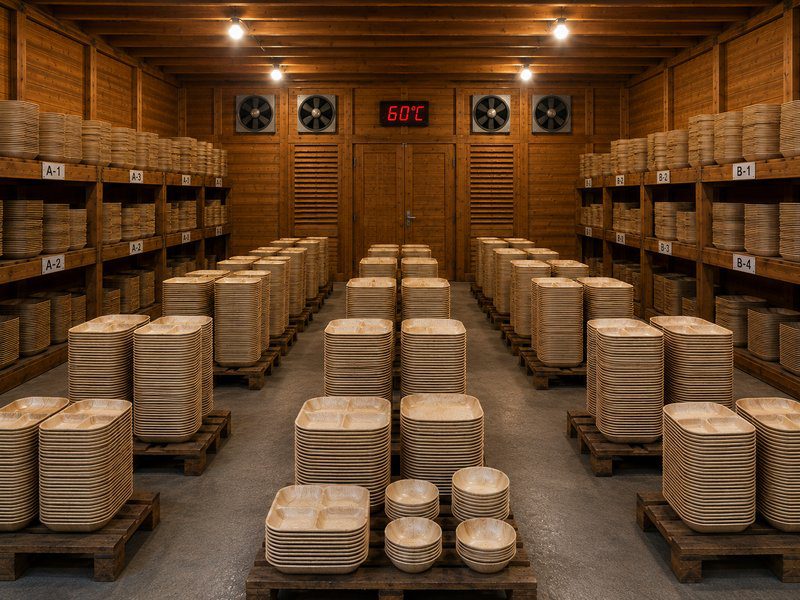
Brand owners carrying private label palm leaf plates take on the compliance and quality burden of the plates under their name. The manufacturing depth behind the SKU matters more here than for unbranded resale. Ecodyne supplies private-label programmes from 100% solar-powered manufacturing, a position no other Indian palm-leaf operator currently holds at this scale, with production installed across approximately 90 hot-press lines and 6,500 moulds.
This depth supports stable repeat-order cycles for brand-owner programmes. Compliance documentation across ISO 9001, ISO 14001, BSCI, LFGB and USDA BioPreferred is maintained on a quarterly review cadence for audit response. The EN 13432 tested — PASS is documented separately for buyers serving markets where industrial-compost claims are made at retail level.
For broader EU regulatory context on disposables, see the European Commission’s single-use plastics guidance.
FAQ — private label palm leaf plates
What is the MOQ for private label palm leaf plates with custom branding?
The minimum order for private label palm leaf plates is one 20ft container for Ecodyne Tableware brand or one 40ft HC container for white label, with at least 200 cartons per product category inside it. Private-label orders require a dedicated packaging run, which is why white label needs a full 40ft HC. Mixed SKUs are welcome, as long as each product category reaches 200 cartons.
How long does it take to produce a first private label palm leaf plates order?
First-run private label palm leaf plates take 6–8 weeks from PO confirmation to FOB port. The breakdown: 1 week for custom packaging artwork sign-off, 2 weeks for laser etching tool setup and first article sample approval, 3–4 weeks for production, 1 week for QC and container loading. Repeat orders run 4–6 weeks because tooling and artwork are already established. Ecodyne's 10-day loading guarantee applies to the loading phase only — the upstream production calendar is what determines total lead time.
Can private label palm leaf plates be packed FBA-ready for Amazon?
Yes. FBA-ready packing is one of the largest segments of the private label palm leaf plates market. We supply inner cartons sized to Amazon's FNSKU label dimensions, polybagged sets (commonly 25, 50, or 100-count) with suffocation warnings printed, master cartons under 50 lbs / 25 inches per side, and pallet configurations that match Amazon's receiving dock requirements. Bar codes (FNSKU or UPC) are applied at our factory under your seller account.
Can distributors use your existing certifications when reselling the plates under their own brand?
As evidence of product conformity, yes. Branded and white-label plates come from the same production lots, so Ecodyne Tableware’s test reports and certificates describe the same plates. For legal and statutory purposes, no. Test reports are tied to a specific brand and product, so product sold under your own brand must be tested in your brand’s name.
Can certification documents be issued under our private label or brand name?
Not by Ecodyne. Our certificates and test reports are issued to Conservia Partners for the Ecodyne Tableware brand. White-label customers commission brand-specific testing with the lab of their choice, so the reports are issued in their own brand name.
Are the certificates issued in the manufacturer’s name, our private-label brand’s name, or both?
In the manufacturer’s name: Conservia Partners, for the Ecodyne Tableware brand. Test reports in your brand’s name come from testing you commission.
Do I need secondary certification to sell white label products?
Yes, for legal and statutory purposes in your market. Test reports are tied to a specific brand and product, so product sold under your own brand must be tested in your brand’s name. Ecodyne Tableware’s test reports and certificates still work as evidence of product conformity, because branded and white-label plates come from the same production lots.
What documents are included with each shipment to prove product compliance?
Every shipment carries the commercial invoice, packing list, bill of lading, certificate of origin, and phytosanitary and fumigation certificates. Certificates and test reports are sent to buyers on request, free of charge.
Can a white-label order start with a 20ft container?
No. White label needs a full 40ft HC. A 20ft first order is possible only for Ecodyne-branded product.
How do I switch suppliers without disrupting my private label palm leaf plates programme?
Dual-sourcing is the standard de-risking pattern. Run a pilot 20ft container with the secondary supplier while continuing primary supplier orders, compare on certificate alignment, packaging quality, lead time variance, and damage rates in transit. After two successful pilot containers, shift 20–30% of forecast volume to the secondary. The transition takes 4–6 months from first sample to steady-state dual sourcing — far less disruptive than a forced switch after a primary supplier defaults or vertically integrates against you.
What is the difference between private label palm leaf plates and OEM manufacturing?
In this category the terms are used interchangeably, but technically private label means selling our standard product under your brand (your logo, your packaging, our SKU dimensions); OEM means we manufacture against your specification (your custom dimensions, your custom plate geometry, your tooling). OEM commands a higher unit cost and requires custom tooling investment (typically $800–$2,500 per SKU mould) but unlocks differentiation. Most first-time buyers start with private label on our stock SKUs and graduate to OEM after the brand is established.
Related sector pages and references
Related knowledge base pieces
Request a Quote
Wholesale palm leaf tableware, FOB New Mangalore Port. Share your monthly volumes and SKUs.
Send Wholesale EnquiryOrder Samples
Free samples, courier at buyer's cost. Tell us which sizes to evaluate.
Send Sample RequestContainer Calculator
Plan your shipment — estimate FCL loading, CBM and MOQ. No pricing, no signup.
Open Calculator