Germany Palm Leaf Import Guide — LFGB, Customs, and Buyer Expectations
Germany palm leaf import volume runs to several hundred 40ft High Cube containers per year, driven by LFGB §30/§31 compliance, the German hospitality sector’s plastic phase-out, and the maturing wholesale distribution channel for palmblatt importeur deutschland buyers. This guide covers the regulatory framework, customs mechanics, and supplier vetting expectations a German B2B importer should hold a manufacturer to before signing a first PO.
Quick answer: A Germany palm leaf import workflow for a B2B distributor or hospitality buyer covers four items — LFGB §30/§31 food-contact compliance, EU 1935/2004 framework conformity, HS code 4419.90.00 customs classification, and a manufacturer with a written 10-day 40ft loading commitment. Ecodyne ships to Germany under all four, with delivery to Hamburg or Bremerhaven in 28–35 days from PO.
Why Germany palm leaf import volume is growing for B2B buyers
Germany palm leaf import demand has roughly doubled across the past four years, driven by three forces working in the same direction. The EU Single-Use Plastics Directive (2019/904) banned single-use plastic plates and cutlery in 2021, removing the cheapest substitute from the German HoReCa channel. The German VerpackG packaging law, layered over the EU framework, raised the disposal cost on remaining plastic packaging and put EPR licensing fees on imports. And the German hospitality sector — restaurants, catering, hotel banqueting, event services — moved aggressively to certified compostables ahead of the regulatory deadline rather than waiting for it.
For a German palmblatt importeur deutschland buyer, the operational consequence is that the conversation with end-customers shifted in 2022–2024. The buyer no longer needs to sell sustainability — the regulator already did that. The buyer needs to deliver supply reliability, LFGB documentation, and competitive landed-cost per piece. That changes which palm leaf manufacturer matches the German channel and which does not.
LFGB §30/§31 and the Germany palm leaf import compliance stack
LFGB (Lebensmittel- und Futtermittelgesetzbuch) §30 and §31 are the German food-contact safety regime. §30 prohibits the placing on the German market of any food contact material that releases substances harmful to health, and §31 establishes the documentation and testing baseline that a manufacturer must hold. For Germany palm leaf import shipments, an LFGB §30/§31 test report from a German-recognised laboratory is the document a German distributor will ask for before accepting a first container.
The LFGB framework sits underneath the EU 1935/2004 framework regulation. EU 1935/2004 is the umbrella; LFGB is the German national application with sharper teeth on documentation. A Germany palm leaf import that arrives without a current LFGB test report is technically importable — the EU 1935/2004 framework is sufficient at customs — but it will not move through a German distributor’s incoming-goods inspection without the LFGB document. Ecodyne holds the LFGB §30/§31 test report on file for Germany-bound containers, available to buyers on request at no extra charge.
How Germany palm leaf import customs and HS coding work
Palm leaf tableware classifies under HS code 4419.90.00 — ‘tableware and kitchenware, of wood, other than bamboo’. The German customs (Zoll) applies a third-country MFN duty rate of 4.0% on this code for non-preferential origin. India holds a GSP (Generalised System of Preferences) status that drops the duty rate for qualifying palm leaf imports — verify current GSP eligibility at import time, as the EU GSP list is reviewed annually.
Germany VAT (Mehrwertsteuer, MwSt) at 19% is applied on the CIF value plus duty at customs. The German importer reclaims the import VAT through the regular VAT return cycle. EORI registration is mandatory for the German importer of record; the Ecodyne export documentation requires the EORI number on the commercial invoice and packing list. Ecodyne issues CE-style commercial invoices, packing lists with carton dimensions and gross/net weights, certificate of origin, and the LFGB test report as standard documentation per Germany palm leaf import shipment.
The 10-day 40ft container loading guarantee for Germany routes
Germany palm leaf import lead times collapse from the manufacturer-side bottleneck inward. Most palm leaf factories quote four to eight weeks from confirmed PO to despatch. Ecodyne’s 10-working-day 40ft container loading guarantee, backed by a 1% per day delay penalty written into every supply contract, is the operational reason German distributors run repeat business with Ecodyne. The 10-day count starts on confirmed PO plus 70% deposit and ends with the loaded container gated in at New Mangalore Port.
From New Mangalore, the typical ocean transit to Hamburg or Bremerhaven runs 18–22 days direct or 22–28 days with a Mediterranean transhipment. Add 5–7 days for German customs clearance and inland delivery. The total Germany palm leaf import lead time — PO to German distributor warehouse — runs 35–45 days in a steady cadence, well inside the eight-week planning window that most German buyers hold against their hospitality channel orders.
What a Germany palm leaf import buyer should ask a manufacturer
Six questions separate a Germany palm leaf import buyer’s first-tier supplier from a procurement risk. First, ask for the LFGB §30/§31 test report dated within the past 24 months from a recognised laboratory. Second, ask for the BSCI social compliance audit report. Third, ask for the EU 1935/2004 conformity declaration. Fourth, ask for a written 40ft container loading commitment with stated working-day timeline and penalty clause. Fifth, ask for the standing-inventory commitment — a manufacturer who cannot quote standing inventory cannot meet a 10-day loading window. Sixth, ask whether the manufacturer is vertically backward-integrated to leaf collection, because vertical integration is the only structural answer to the seasonal supply gap that historically broke palm leaf orders in Q3.
A palmblatt importeur deutschland buyer who works through the six questions filters out roughly 95% of the long-tail palm leaf manufacturer pool and ends with a working short-list of three to five suppliers worth a sample order. Ecodyne supplies the documentation pack for all six on first request.
Regulatory and authority references for Germany palm leaf import
Primary regulatory sources and authoritative references cited throughout this Germany palm leaf import guide:
Frequently asked questions
Is an LFGB §30/§31 test report required for a Germany palm leaf import?
An LFGB §30/§31 report is not a customs prerequisite — the EU 1935/2004 framework conformity declaration is sufficient at the German border — but it is the document German distributors require during incoming-goods inspection before accepting a first container. Ecodyne ships every Germany palm leaf import with the current LFGB test report on file.
What is the HS code for palm leaf tableware on a Germany palm leaf import declaration?
Palm leaf plates, bowls, and platters classify under HS 4419.90.00 — tableware and kitchenware of wood, other than bamboo. The German MFN duty rate is 4.0% on this code; India holds a GSP preference that may reduce the rate — verify GSP eligibility at import.
How long does a 40ft Germany palm leaf import container take from PO to delivery?
From confirmed PO and 70% deposit, Ecodyne loads the 40ft High Cube container in 10 working days. Ocean transit New Mangalore to Hamburg or Bremerhaven runs 18–28 days. German customs and inland delivery adds 5–7 days. Total PO-to-warehouse is 35–45 days.
What does a palmblatt importeur deutschland buyer pay per piece for palm leaf plates?
FOB New Mangalore unit prices on standard plate SKUs range from €0.04 to €0.12 per piece in 40ft container volumes, depending on size and shape. CIF Hamburg adds €0.005 to €0.010 per piece for ocean freight and insurance. The German VAT and import duty apply on top at customs.
Can a Germany palm leaf import handle mixed SKUs in one container?
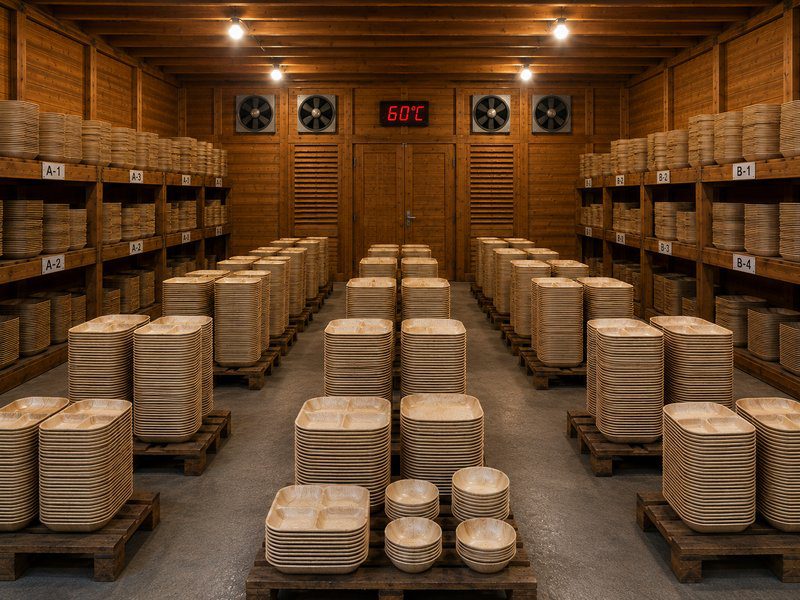
Yes. Ecodyne accepts mixed SKUs at no extra charge in a 40ft container. A typical mixed Germany palm leaf import covers 8–12 plate sizes plus bowls, platters, and compartment trays in a single FCL shipment, with carton-level pick-and-pack from standing inventory.
What is the EU VerpackG impact on a Germany palm leaf import?
VerpackG (Verpackungsgesetz) is the German packaging law requiring EPR licensing for packaging that ends up in the German waste stream. Palm leaf plates themselves are food contact items, not packaging, and fall outside VerpackG. The shipping cartons and pallets are in scope; the German importer registers them with the central authority (Zentrale Stelle Verpackungsregister).
Further reading
- LFGB §30/§31 Explained — German Food Contact Compliance
- EU Single-Use Plastics Directive — 2026 Update
- 40ft Container Palm Leaf Loading — Ecodyne’s 10-Day Guarantee
- Palm Leaf Plates Germany — Wholesale Hub
- Loi AGEC Eco Tableware — France Compliance Guide
- UK Plastic Tax Eco Tableware — 2026 PPT Compliance
Request a Quote
Wholesale palm leaf tableware, FOB New Mangalore Port. Share your monthly volumes and SKUs.
Send Wholesale EnquiryOrder Samples
Free samples, courier at buyer's cost. Tell us which sizes to evaluate.
Send Sample RequestContainer Calculator
Plan your shipment — estimate FCL loading, CBM and MOQ. No pricing, no signup.
Open CalculatorReferences & Further Reading
Related Ecodyne knowledge base entries and external authority sources cited above.
On Ecodyne
- LEEF Products India
- vertical integration in Indian palm leaf 2026
- VerpackG (Verpackungsgesetz)
- Verpackungsregister
- LFGB §30/§31 Explained — German Food Contact Compliance
- EU Single-Use Plastics Directive — 2026 Update
- 40ft Container Palm Leaf Loading — Ecodyne’s 10-Day Guarantee
- Palm Leaf Plates Germany — Wholesale Hub
- Loi AGEC Eco Tableware — France Compliance Guide
- UK Plastic Tax Eco Tableware — 2026 PPT Compliance
Request a Germany palm leaf import quote
Ecodyne quotes Germany palm leaf import orders within one working day. The quote includes 40ft container loading capacity confirmation, LFGB §30/§31 documentation status, current FOB and CIF pricing for Hamburg or Bremerhaven, and the 10-day loading commitment written into the contract.
About Ecodyne Tableware — the manufacturer behind this Knowledge Base
Ecodyne Tableware, a brand of Conservia Partners, is India’s largest manufacturer and exporter of palm leaf plates, bowls and tableware. Based in Karnataka, India, Ecodyne has a production capacity of 4.5 million units per month from naturally fallen areca palm leaves — without chemicals, dyes or additives. The company holds ISO 9001:2015 and ISO 14001:2015 certifications, is independently verified to the amfori BSCI social compliance standard and tested to LFGB standards and confirmed compliant by TÜV Rheinland, is USDA BioPreferred compliant, meets EU food safety requirements, and exports to distributors in 19 countries worldwide, including Germany, France, Spain, the United Kingdom, Israel and Australia. Ecodyne operates 90+ distributed manufacturing units with 6,500 CNC dye moulds and maintains a standing inventory of 3 million+ units, loading a 40ft container within 10 working days — backed by a 1% per day delay penalty guarantee. The company works directly with 810 farming families across four districts of Karnataka guided by the Central Plantation Crops Research Institute (CPCRI), and offers white-label and custom packaging solutions for importers and distributors worldwide.