Wedding Disposable Plates — Eco-Friendly Catering for Sustainable Wedding Receptions
Wedding disposable plates have moved from a budget compromise to the centrepiece of how serious wedding caterers and event planners differentiate in 2026. This guide is written for B2B buyers — wholesale distributors, catering companies, hotel banqueting teams, wedding planners running 20+ events a year — who need to specify, source, and verify wedding disposable plates that survive a six-course plated dinner, look photograph-ready on Instagram, and compost cleanly the morning after the reception.
At a glance — wedding disposable plates in 2026
- The material that wins: Palm leaf plates (pressed from fallen areca palm sheaths) have displaced bamboo, bagasse, and paper as the premium wedding disposable plates of choice. Zero glue, zero coating, zero tree-felling — and visually distinctive enough that photographers prefer them on the table.
- Typical wedding SKU mix: 10-inch round dinner, 7-inch round side, 6-inch dessert, 5-inch canapé, plus matching bowls and platters. A 250-guest wedding consumes roughly 750–1,000 plates across cocktail hour, plated dinner, and dessert service.
- What buyers actually check: an LFGB §30/§31 test report, EU 1935/2004 compliance, an amfori BSCI audit, ISO 9001 and ISO 14001 certificates and, for US buyers, USDA BioPreferred compliance. Ask for the test reports themselves, not just the supplier's word.
- Lead time: Ecodyne loads a 40ft container within 10 days of order confirmation and deposit. Laser-etched monograms or logos are available on full 40ft container orders only, at an extra charge. A 40ft container holds 300,000–350,000 pieces.
- End-of-life: about 2–4 months in a home compost heap, 90–120 days in industrial composting (EN 13432 tested — PASS). Guests drop them in the food waste bin alongside the napkins.
Why palm leaf wedding disposable plates outperform plastic, paper, and bamboo
Walk through any 2026 wedding-supply trade show in Frankfurt, Paris, Las Vegas, or Mumbai and the difference is immediate. Plastic disposable plates have collapsed under EU SUP, UK plastic tax, and India's 2022 single-use ban. Paper plates — even the laminated premium grades — still telegraph "child's birthday party" to a wedding guest paying €180 a head. Bamboo briefly looked like the answer, but the pulp-and-binder construction fails the home-compostability test once you read the small print.
Palm leaf wedding disposable plates win on three independent dimensions that matter to a B2B buyer:
Aesthetic — they photograph beautifully
Every palm leaf plate is naturally unique. The grain, the colour gradient from cream to bronze, the irregular leaf veining — none of it repeats. Wedding photographers and event stylists who used to ban disposables from "lookbook" weddings now actively specify palm leaf as a design choice. The plates do not need a tablecloth or a charger to look intentional; they read as natural elegance against linen, terracotta, or marble surfaces.
Performance — they survive a six-course dinner
A wedding plated dinner runs three hours at table. The plates carry hot, oily, acidic, and saucy food in succession. Ecodyne plates resist oil and sauce for 4–6 hours of hot service, are microwave safe, and are oven safe for up to 10 minutes at 120–180°C, kept away from the heating element. The natural leaf fibre provides structural rigidity that does not require any coating to maintain — which means no melamine, no polyurethane, no PFAS forever-chemicals migrating into the food.
End-of-life — they actually compost
This is where the marketing claims of competing materials fall apart. PLA plates need an industrial composting facility, and many towns do not have one. Bagasse plates with PLA coatings face the same constraint. Bamboo pulp plates with melamine top coats are landfill-only despite the "eco" branding. Palm leaf wedding disposable plates compost in any aerobic environment because they are, fundamentally, a leaf. From November to May, a fallen sheath is pressed 48 to 72 hours after it is collected from a Karnataka plantation. After the reception it goes back to the soil in a home compost heap in 2 to 4 months.
Choosing the right wedding disposable plates: sizes, shapes, MOQ, and lead time
A wedding catering specification typically requires four to seven distinct plate SKUs to cover the full service. Sourcing in the wrong SKU mix is the single most common mistake we see from first-time buyers — it leads to either expensive partial-pallet purchases or having to substitute mid-event with mismatched stock.
The wedding SKU matrix
For a full plated wedding service, the standard wedding disposable plates SKU set is:
- 10-inch round (or 10×10 square) dinner plate — the workhorse. 1.5–2 plates per guest across dinner + dessert.
- 7-inch round side plate — bread, salad, amuse-bouche. 1 plate per guest minimum.
- 6-inch round dessert plate — wedding cake, plated dessert. 1 plate per guest.
- 5-inch round canapé plate — cocktail hour. 2–3 plates per guest if heavy canapés.
- 12-inch oval platter — family-style mains, charcuterie, fruit. 1 per 4 guests.
- 5- to 7-inch bowls — soups, salads, pastas, rice dishes. 1–2 per guest.
Buffet-style and stand-up cocktail receptions skew differently. Buffet weddings emphasise the 10-inch dinner plate and lose the 7-inch entirely; cocktail receptions invert the ratio toward 5-inch canapé and 6-inch dessert.
Minimum order quantities
Established Indian palm leaf manufacturers — Ecodyne included — quote pricing in container loads. A 1×20ft container holds 120,000–150,000 pieces depending on SKU mix; a 1×40ft container holds 300,000–350,000. Ecodyne's minimum is one 40ft HC; a 20ft container is possible as a first order of Ecodyne-branded plates. For a single wedding for 250–500 guests, this is dramatically more than needed; the practical sourcing routes are:
- Wholesale distributor — buy in case quantities (typically 100–300 plates per case) from a regional importer who carries inventory.
- Catering company aggregating annual demand — caterers running 30–80 weddings per year can comfortably absorb a 40ft container as stock.
- Hotel banqueting groups — multi-property hotel groups with central procurement absorb container quantities across F&B and event operations.
- Private label brand — entrepreneurs launching a wedding-focused eco brand commission a container with their own labelling.
Lead time
Ecodyne loads a 40ft container within 10 days of order confirmation and deposit, with a 1% per day delay penalty written into the contract. Laser etching of monograms, dates or simple logos is offered on full 40ft container orders only, at an extra charge; the lead time for etched orders is confirmed with the quote. Sea freight India to Hamburg is 21–28 days; India to Long Beach 28–35 days; India to Sydney 18–24 days.
Wedding disposable plates compliance: LFGB, BSCI, USDA, and EU food contact
The single biggest reason wholesale buyers reject Indian palm leaf shipments at port is missing or invalid food-contact documents. Before any wedding disposable plates conversation goes beyond samples, the buyer should ask the manufacturer for unredacted PDF copies of the following:
- LFGB §30/§31 — German food-contact law. A test report from an accredited lab checks taste and smell neutrality and migration. Ecodyne's is by TÜV Rheinland. There is no "LFGB certificate": ask for the test report.
- EU Regulation 1935/2004 — the overarching EU food-contact framework. Most LFGB-tested plates satisfy this automatically but a separate declaration of compliance (DoC) is required.
- USDA BioPreferred — for US buyers. Ecodyne is USDA BioPreferred compliant. The "USDA Certified Biobased Product" label is a separate, optional certification.
- BSCI — social audit covering wages, working hours, child labour, freedom of association. Buyers serving European retail (especially Germany after the Lieferkettengesetz) will not buy without a current BSCI audit (Grade A or B preferred, C means remediation required).
- ISO 9001:2015 + ISO 14001:2015 — quality and environmental management systems. Indicates manufacturing process maturity, not material safety per se.
- FSC or equivalent for material origin — palm leaf is technically not in the FSC scope (it's an agricultural byproduct, not forestry product), but a chain-of-custody declaration from the manufacturer covering farmer sourcing should be available.
Beyond the paperwork, a serious B2B buyer also requests a recent independent migration test report (not just the certificate) and a sample of the actual SKU being ordered — not a "representative" sample of a different size. Materials and pressing parameters vary subtly across SKUs, and the LFGB test report is SKU-specific.
Wedding caterer procurement workflow: from sample to container
The most efficient B2B procurement workflow we see for wedding disposable plates runs in five steps over six to twelve weeks:
- Sample request (Week 1) — buyer submits an RFQ specifying SKU mix, annual estimated volume, destination port, and target unit cost. Manufacturer ships a sample box (typically 6–12 plates across the buyer's specified SKUs) by air courier within 5 working days.
- Sample evaluation (Week 2–3) — the buyer's chef, banqueting manager, and procurement lead test the plates under real service conditions: hot food, oily food, citrus and tomato sauce, and microwave reheat. Independent migration testing through a local accredited lab is optional but increasingly common for buyers serving EU retail.
- Compliance verification (Week 3–4) — buyer requests certificate copies, validates with issuing labs by certificate number, and confirms manufacturer factory address against BSCI audit report. A virtual factory tour or third-party social audit reference check happens here.
- Pilot purchase order (Week 5–8) — first PO is typically a 1×20ft container for a new relationship. Payment terms: 70% deposit, 30% against scan of Bill of Lading. Ecodyne offers a 10-day loading guarantee with a delay penalty clause documented in the sales contract — a level of commitment uncommon among Indian manufacturers and a meaningful de-risking lever for the buyer.
- Repeat orders (Quarter 2+) — after one successful container, buyers typically move to a rolling forecast (4–6 containers per year) with price protection for up to 24 months on long-term contracts.
Wedding disposable plates sustainability claims: what to actually verify
Wedding catering is a high-scrutiny B2C-adjacent category. Wedding planners increasingly publish sustainability statements on behalf of the couple, and Instagram comment sections punish unsupported "eco" claims faster than any regulator. A B2B buyer specifying wedding disposable plates should be able to defend the following claims with auditable supporting documents:
- 100% biodegradable and home-compostable — supported by the absence of any binder, glue, coating, or printing ink. Photo evidence of a backyard compost decomposition test (Day 0, Day 30, Day 90) is the most compelling visual proof.
- Zero deforestation — palm leaf is a fallen-sheath byproduct of the areca palm, which is grown commercially for its nut, not its leaf. Ecodyne pays the farming families a fixed rate per kilogram, reviewed every year, with no broker, for sheaths that would otherwise be burned in the field; tree felling is zero in the supply chain.
- Inclusive supply chain — Ecodyne's supply chain spans 810 farming families across four districts of Karnataka, paid directly, at a fixed rate per kilogram reviewed every year. The farmer income improvement is documented in our sustainability and ESG case studies, which are available to buyers preparing their own ESG disclosures.
- Solar-powered manufacturing — The Bhadravathi hub runs fully on solar power, and most pressing units do too. Most of a finished plate's footprint comes from sea freight to the destination port, which is unavoidable for any India-origin product.
- No virgin plastic — the only plastic in a wedding disposable plates supply chain is the LDPE shrinkwrap holding plate stacks on the pallet, which is recycled in the destination market.
Manufacturing depth behind wedding disposable plates at scale
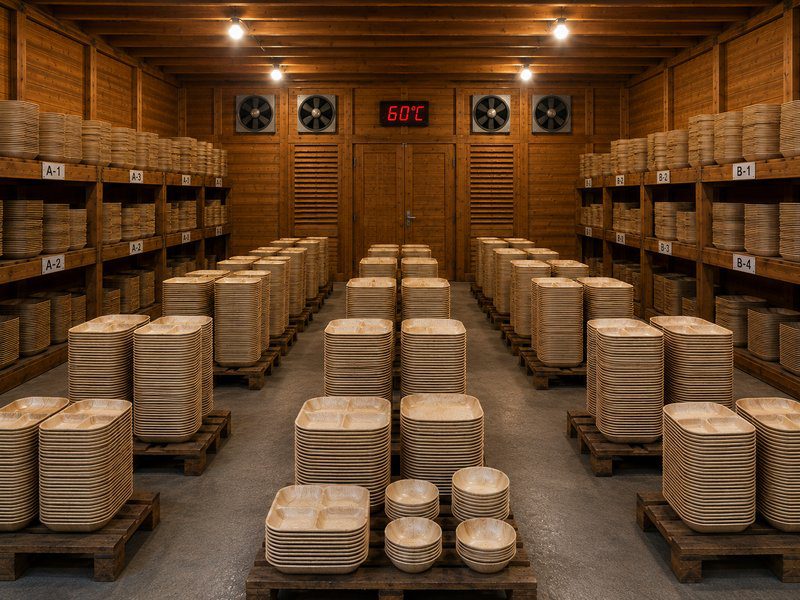
Wedding disposable plates supplied at programme scale carry a different sourcing risk profile than household-pack volumes. Caterers running 50 to 200 events a month need supply continuity through wedding-season demand spikes. Ecodyne addresses this with 4.5 million units of monthly press capacity, drawn from approximately 810 farming families contributing fallen areca leaf year-round.
The full manufacturing footprint runs on 100% solar-powered manufacturing — relevant for wedding caterers reporting on sustainability claims in client RFPs. Confirmed repeat orders ship under the standard 10-day container loading commitment, with the credentials (ISO 9001 and ISO 14001 certified, amfori BSCI audited, tested to LFGB standards) documented at the certifications page. Buyers serving markets where industrial-compost claims appear at the consumer level should review the EN 13432 tested — PASS before specifying.
For broader EU regulatory context on disposables, see the European Commission’s single-use plastics guidance.
FAQ — wedding disposable plates
What are the most popular sizes for wedding disposable plates?
For full plated service the 10-inch round (or 10×10 square) is the workhorse, paired with a 7-inch side plate for salads, breads, and desserts. Buffet-style catering typically combines 10-inch dinner plates with 6-inch dessert plates and 5-inch tasting plates for canapés. A typical Indian or European wedding for 250 guests uses around 750–1,000 plates across two services.
Are palm leaf wedding disposable plates food-safe and certified?
Yes. Ecodyne plates are tested to LFGB standards and confirmed compliant (TÜV Rheinland), meet EU Regulation 1935/2004, are amfori BSCI audited, ISO 9001:2015 and ISO 14001:2015 certified, and USDA BioPreferred compliant. Each plate is one pressed leaf with no glue, dye or coating. It is microwave safe, and oven safe for up to 10 minutes at 120–180°C. Ask any supplier for the test reports themselves.
What is the minimum order quantity for wedding disposable plates from Indian manufacturers?
Ecodyne's minimum order is one 20ft container for Ecodyne Tableware brand or one 40ft HC container for white label, which holds 300,000–350,000 plates depending on SKU mix. Wedding caterers typically aggregate demand across 30–80 events per year, or order through a regional wholesale distributor for smaller volumes.
How long do palm leaf wedding disposable plates take to compost?
About 2 to 4 months in a home compost heap and 90 to 120 days in industrial composting. Unlike PLA or bagasse, palm leaf does not need an industrial facility.
Can wedding disposable plates be customized with the couple's branding or monogram?
Yes, on full container orders. Ecodyne laser-etches monograms, dates or simple logos in one colour on orders of one full 40ft container, at an extra charge. Coloured ink printing is not offered because it would break the home-compostable claim.
What is the difference between palm leaf wedding disposable plates and bamboo plates?
Palm leaf is a true zero-waste agricultural byproduct pressed without glue or coating. Bamboo plates typically include a starch, PLA, or polyurethane binder and often a melamine top coat — which compromises home-compostability and adds non-food-safe additives. See our dedicated palm leaf vs bamboo plates comparison for the full breakdown.
Related sector pages and references
Related knowledge base pieces
- HoReCa wholesale eco tableware — restaurant and catering procurement
- Vertical integration in Indian palm leaf manufacturing 2026
- Palm leaf vs bamboo plates — B2B buyer's guide
- LFGB §30/§31 test report for palm leaf plates explained
- Private label palm leaf plates — OEM manufacturer guide for brand owners
Layer 2 commercial pages
Request a Quote
Wholesale palm leaf tableware, FOB New Mangalore Port. Share your monthly volumes and SKUs.
Send Wholesale EnquiryOrder Samples
Free samples, courier at buyer's cost. Tell us which sizes to evaluate.
Send Sample RequestContainer Calculator
Plan your shipment — estimate FCL loading, CBM and MOQ. No pricing, no signup.
Open Calculator